
 A Proud Canadian Company
What makes a booth noticeable is not necessarily the number of signs, but how clearly each one guides visitors from the aisle to a conversation. With so many display options, it’s easy to add pieces without creating a cohesive presence. The best trade show signage Ottawa exhibitors choose makes the booth’s purpose easy to grasp at a glance.
Visibility matters, but so do readability, booth size, and the action you want visitors to take. This guide shows how to bring those decisions together, from a prominent banner to supporting posters or foam board displays. You’ll learn how to set an information hierarchy, keep colours and messaging consistent, and plan a layout that welcomes visitors without crowding the space. Whether you’re preparing for a show at the EY Centre, the Shaw Centre, or another Ottawa-area venue, a coordinated approach gives every printed piece a clear job.
Key Takeaways
- Start with one booth goal: build awareness, explain an offer, or invite a conversation.
- Use a clear visual hierarchy so visitors notice your brand and main message before supporting details.
- Match your trade show signage Ottawa plan to your event goal, booth footprint, and core message.
- Measure the booth, walls, table area, and transport space before deciding where each sign belongs.
- Coordinate signs and banners with posters or foam board printing so every piece has a purpose.
Trade show signage in Ottawa: start with the booth goal
Visitors decide quickly whether a booth is relevant to them. Your signage has a brief opportunity to make its purpose clear, so adding more displays isn’t always the answer. Effective booth signage is focused, consistent, and tied to a goal.
Before choosing trade show signage Ottawa exhibitors can use to stand out, decide what you want visitors to do: notice your brand, understand an offer, or start a conversation. Each goal calls for a different message and supporting pieces. A banner might introduce the business, while a poster or foam board display explains a service or shows an example. For background on the format, What is a trade show? explains how booths and displays help businesses present their offerings to attendees.
Let the booth shape your plan. In a compact space, a few well-placed elements are often easier to read than a crowded collection. A larger footprint may allow separate areas for an introduction and a product discussion. Consider what visitors can see from the aisle, where they’ll enter, and how they’ll move through the space. Keep signs within the booth and leave the entrance clear.
Choose one primary message visitors can grasp quickly
Give the booth one main headline that speaks to your audience’s needs or names the offer. Visitors should be able to connect your brand with the central message before attempting to read smaller details. For example, a business introducing a service could lead with the problem it solves, then use a supporting poster to explain how it works.
Make the next step just as clear. Invite visitors to speak with a team member, view a sample, or learn about a specific offer. Keep extra details secondary. A sign should guide attention, not compete with the conversation.
Set the booth brief before selecting signs
A short brief turns a broad goal into practical choices. Record the event objective, booth dimensions, audience, and available display surfaces before selecting signs and banners, posters, or foam board printing. Note the table area, sightline restrictions, and how the printed pieces will be transported. This helps you assign each item a useful role instead of choosing displays simply because they’re available.
- Objective: State whether the priority is awareness, explaining an offer, or inviting conversation.
- Space: Measure the footprint and identify usable walls, tables, and freestanding areas.
- Audience: Choose wording and examples that speak to the people you want to reach.
- Event details: For Ottawa venues, review exhibitor rules, access details, and setup windows with the organizers.
Use the same brief to coordinate signage with other booth essentials and promotional items. Consistent messaging makes the booth feel considered, while giving each piece a distinct purpose helps visitors move from first glance to conversation.
Build a clear visual hierarchy with trade show booth signage
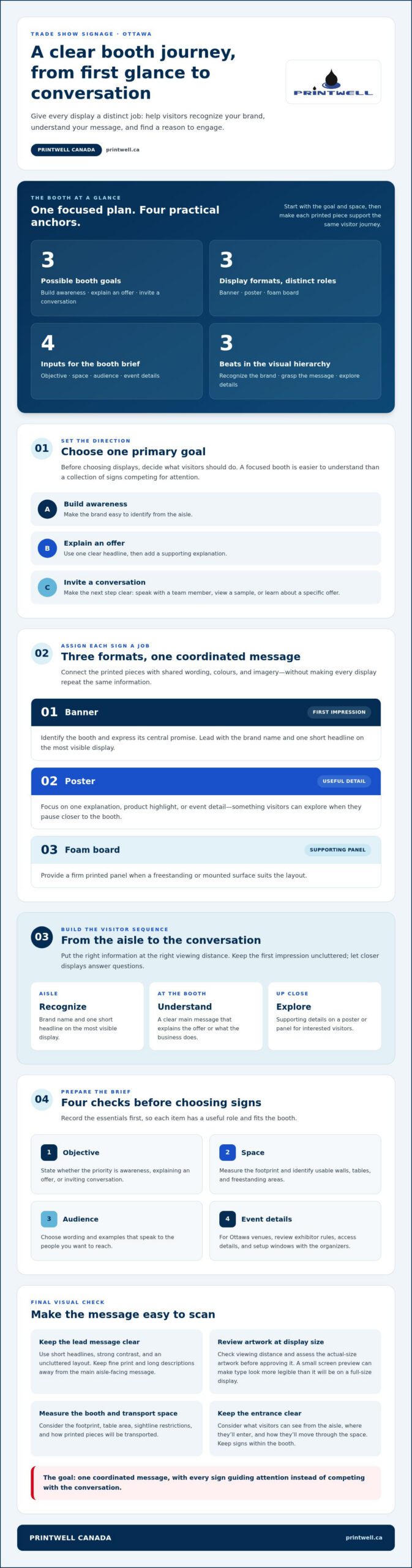
Visual hierarchy is the order in which visitors notice and understand information at your booth. It turns separate printed pieces into a simple sequence: recognize the brand, grasp the main message, then explore useful details. For trade show signage Ottawa exhibitors can use effectively, plan what people should see from the aisle and what they can read after stepping closer.
Lead with your brand name and one short headline on the most visible display. Put supporting information, such as product highlights or event-specific details, on a poster or panel closer to where visitors will pause. This distance-based approach keeps the first impression uncluttered and gives interested attendees more to discover. One dominant message makes the booth easier to scan because visitors don’t have to sort through competing headlines.
Consistency connects each point in that journey. Repeat key wording, colours, and imagery across printed surfaces, while giving each item a distinct job. A broader look at principles of exhibition design can help you think through how to make each visual choice intentional.
Use banners, posters, and foam board with distinct roles
Give every format a purpose instead of repeating the same block of information. A banner can identify the booth and express its central promise. A poster can focus on one explanation, product highlight, or event detail. Foam board can provide a firm printed panel when a freestanding or mounted surface suits the layout.
For example, a banner might introduce a company’s offer, while a nearby poster answers a common visitor question. Use shared colours and language to connect the pieces, but avoid making both displays do the same work.
Keep typography and artwork legible at a glance
Short headlines, strong contrast, and uncluttered layouts help people scan a display quickly. Keep fine print, long descriptions, and secondary details away from the main aisle-facing message. Before finalizing print files, review the artwork at its actual display size and consider the viewing distance in the booth.
Check that the headline stands out, the brand is easy to identify, and supporting text remains readable without dominating. A small computer-screen preview can make type look more legible than it will be on a full-size display, so assess the layout at scale before approving it.
Once each piece has a clear role, review the booth as a visitor would: from the aisle, at the entrance, and beside the display. This final pass can reveal repeated messages or visual gaps. For coordinated signs, banners, posters, and foam board printing, keep the same message and visual direction across the full set.
Three trade show booth design ideas for different Ottawa exhibitors
A booth concept should suit both your reason for exhibiting and the space available. These examples show how different goals can shape the message and printed pieces. Treat them as starting points, then confirm your booth dimensions and event requirements before settling on an arrangement.
Use the comparison to choose a direction, then adapt the details to your audience and offer. A guide to printing for Canadian businesses can also help you prepare artwork and printed materials carefully.
| Concept | Goal and footprint | Core message | Possible printed pieces |
|---|---|---|---|
| Compact awareness booth | Build recognition in a smaller space | Who you are and what you offer | One banner, with a supporting poster or foam board panel if useful |
| Product explainer or demonstration booth | Explain an offer while leaving room to engage | What the product does or problem it addresses | Banner plus focused poster or foam board details |
| Information-rich event booth | Help visitors browse several related themes | A concise introduction to the business | Recognition-focused banner with themed posters or foam board panels |
The compact awareness booth
For a smaller footprint, build around one prominent banner and a concise brand promise. The headline should make the business or offer easy to recognize from the aisle. Add a poster or foam board panel only if it answers a likely visitor question, such as what the service includes or who it’s for. Keep the front approachable, with materials positioned so they don’t block sightlines or make it difficult to enter.
The product-explainer or demonstration booth
Lead with a headline that names the product category or the problem it addresses. Then arrange supporting information in a simple sequence, such as the need, the solution, and a useful example. A poster can carry details visitors may want to scan while they stop, while the banner stays focused on the central offer. Leave room for conversation or a demonstration. Printed displays should support that interaction, not crowd it out.
The information-rich event booth
If visitors need to compare several services, group information into a few clearly labelled themes rather than squeezing every detail onto one panel. Posters or foam board can make those secondary topics easier to browse, with each piece covering a distinct subject. Keep the main banner focused on recognition rather than listing specifications. This separation helps visitors find relevant information without losing sight of the business behind it.
Across all three concepts, make each printed piece earn its place: identify the booth, explain a point, or help start an exchange. A thoughtful trade show signage Ottawa plan connects those roles while leaving space for visitors to move, pause, and talk.
Plan trade show signage dimensions, placement, and print readiness
A strong signage plan needs to work on paper and in the booth. Measure before choosing sizes, plan for how visitors approach, and review every file before printing. For trade show signage Ottawa exhibitors can prepare with confidence, use this workflow to connect the event space, display roles, and artwork in one practical checklist.
- Confirm the space. Record the booth’s width, depth, height restrictions, and open or shared sides. Measure available walls and table areas, then note transport limits, including how much display material you can carry and where it will be stored.
- Map sightlines. Sketch the booth and likely visitor approaches. Mark the primary view from the aisle, blocked angles, and places where people might pause. Check the organizer’s rules for hanging signs, structures, power, and floor placement so your layout fits the event requirements.
- Assign sign roles. Decide which piece identifies the booth, which explains an offer, and which provides supporting information. Match each role to a suitable surface and position rather than choosing dimensions in isolation.
- Prepare artwork. Follow the supplied requirements for dimensions, resolution, and file format. Keep content within the intended display area and follow any setup instructions for the selected print piece.
- Review before approval. Proof spelling, contact details, logos, contrast, and image placement. View the design at full size and check that the most important wording is easy to read from its intended viewing distance.
Map the space before choosing sign sizes
Start with the booth plan and build outward. Include wall locations, table footprint, open edges, and height limits in your sketch. Then draw arrows for likely visitor approaches and mark the clearest aisle-facing sightline. This map helps show whether a display will be visible, compete with another piece, or sit where people naturally gather.
For Ottawa events, review the organizer’s exhibitor rules and move-in instructions. Requirements can vary by event, including details about structures, hanging displays, power access, and where items may sit on the floor. Build those constraints into your sketch before committing to sign dimensions.
Prepare and review print artwork
Use the file requirements for the specific print piece instead of assuming one format or dimension works for everything. Check that logos and images remain clear at the intended size, and inspect small text at full scale. A careful proof can catch a misspelled URL, a low-contrast headline, or an image placed too close to an edge.
Plan backwards from the event date. Leave room for artwork preparation, review, any needed corrections, and the event’s move-in window. Avoid relying on an assumed print timeline. An approved file and an organized schedule give you more control over the remaining steps.
With measurements and artwork ready, coordinate signs, banners, posters, or foam board printing for the booth. Plan your printed trade show signage with the final dimensions and display roles in mind.
Bring your Ottawa trade show signage plan together with Printwell
A cohesive booth comes together one decision at a time: choose the event goal, simplify the message, assign a role to each sign, and confirm dimensions before preparing artwork. That sequence keeps printed pieces connected to what you want visitors to notice and do. With trade show signage Ottawa exhibitors can plan around their actual booth space, a banner, poster, sign, or foam board panel can contribute without competing for attention.
Turn the concept into a focused print brief
Before preparing files, bring the key details into one brief. Include the event date, booth measurements, audience, main message, and the action you hope visitors will take. Add a placement note for each surface, such as a banner for booth recognition, a poster for a focused explanation, or foam board for supporting information.
- Event and space: Record the event date, booth dimensions, usable surfaces, and organizer instructions.
- Audience and message: State who the booth is for and what they should understand first.
- Visitor action: Identify whether you want people to speak with your team, view an example, or learn about an offer.
- Artwork: Gather approved logos and images, then review each piece for consistent wording, colour, and readability.
A brief like this makes it easier to decide what belongs on each display. It also gives you a practical reference when checking artwork, dimensions, and print files, rather than relying on memory while coordinating several pieces.
Choose printed pieces that work together
Think of the booth as a small information system. A banner can help visitors recognize your business and its central offer; a poster can explain one related point; a sign or foam board piece can present supporting information where people can pause to read it. Keep the colour palette, wording, and visual style consistent so the displays feel like parts of one presentation.
Printwell Canada produces signs and banners, posters, and foam board prints for booth materials. Based in Ottawa, Printwell has a showroom at St. Laurent Shopping Centre, and customers can also order online. Local exhibitors can bring their coordinated printed pieces together through either option.
Once your goal, message, sign roles, and measurements are set, explore Printwell’s Ottawa printing options for the pieces in your brief. A clear plan helps you organize the artwork and select printed materials that fit your booth.
Next step: Write down your event date, booth dimensions, and main message, then use that brief to plan your signage.
Make your next booth plan easier to act on
Before finalizing your next trade show signage Ottawa plan, rehearse the message. Share it with someone unfamiliar with your business and ask what they understand at first glance. If they miss the point, simplify the wording before approving the artwork. Then picture the display in its actual space: can visitors approach comfortably, find the information they need, and see where to begin a conversation?
This review can catch confusion while there’s still time to refine the plan. Keep your event details, measurements, and approved artwork together so the next steps stay organized. Clear preparation leaves more room to welcome visitors and make useful connections at the show.
When you’re ready to print your booth materials, explore Printwell’s Ottawa sign and banner printing. Start with a clear plan, then bring your booth together with coordinated printed pieces from Printwell Canada.
Frequently Asked Questions
What signage do I need for a trade show booth?
Start with a banner or sign that identifies your business and gives visitors a reason to stop. For example, a software company could name its service category on the main display, then use a poster to show a sample interface or explain one feature. Before adding another piece, ask whether it answers a question the main display leaves open. This keeps the booth useful without making every surface carry the same message.
How do I make my trade show booth stand out without overcrowding it?
Choose one visual feature to lead, such as a bold headline, a striking product image, or a distinctive brand colour. Keep other elements quieter so they support rather than compete with it. If a large image demonstrates your product, for instance, use nearby text to explain what visitors are seeing instead of adding another headline. Leave open space at the front so people can approach comfortably and staff can welcome them.
What should a trade show banner say?
A banner should tell visitors who you are and what you help them do. A short benefit-led line is usually more useful from a distance than a list of services or technical details. For example, a business selling energy-efficient windows might lead with a benefit for homeowners, then use a nearby display to explain product options. Include a next step only if it’s easy to act on at the booth, such as inviting visitors to speak with your team.
How far away should trade show signage be readable?
Set the reading distance according to where each sign will sit and how visitors will encounter it. An aisle-facing headline needs to be recognizable before someone reaches your booth, while details on a counter display are meant for close reading. Test a proof from both positions if possible. If the headline disappears from the aisle or the smaller information feels cramped up close, adjust the layout or simplify the copy before preparing the final file.
What should I check before printing trade show signage in Ottawa?
Before printing, compare every piece with the Ottawa event’s exhibitor instructions and your booth plan. Confirm that the venue allows your intended display placement, then check that each file matches the print requirements for size and format. Review the final artwork for spelling, current contact details, logo use, contrast, and image quality. Leave time before the event to address corrections and organize transport instead of relying on an assumed production timeline.
Are banners, posters, or foam board better for a trade show booth?
The best format depends on the display’s job and where it will sit. A banner is useful for identifying the booth, a poster can give one topic room for a focused explanation, and foam board can present information on a firm panel. For trade show signage Ottawa exhibitors are planning, consider whether a piece needs to be visible from the aisle or read at close range, then select the format accordingly. Give each item a distinct purpose.
Can I reuse trade show signage at other events?
Yes, signage can be reusable if its message stays relevant beyond one event. Keep lasting information, such as your business name or a general service description, separate from details tied to a date, venue, or limited-time offer. Before taking a display to another show, inspect it for marks or damage and compare its dimensions with the new booth plan. A piece that worked in one layout may need a different position to remain visible in another.