 A Proud Canadian Company
What if the most sustainable giveaway is the one people already have a reason to use? A product labelled “eco-friendly” can still become waste if it doesn’t suit the people receiving it. Choosing sustainable promotional products means looking beyond a green-sounding claim to consider evidence, usefulness and how long an item is likely to stay in use.
It’s understandable to want merchandise that reflects your values without sacrificing audience fit, quality or a clear brand presence. But environmental claims can be hard to assess when they lack detail. In Canada, amendments to the Competition Act that took effect on June 20, 2024 include explicit requirements for substantiating environmental benefit claims.
This guide gives you a practical way to compare sustainability information, match products to your audience and plan an order with fewer avoidable waste points. It covers branded apparel, mugs, stickers and printed materials, with steps to help you decide what fits your campaign before you put your brand on it.
Key Takeaways
- Assess sustainable promotional products by material, manufacturing information, useful life and disposal, rather than relying on one “eco” label.
- Use a checklist to distinguish specific, substantiated details from broad environmental language.
- Compare apparel, everyday-use items and printed materials by audience, likely use and branding opportunity.
- Set your campaign goal and distribution plan before estimating quantities to help avoid surplus merchandise.
- Consider how custom apparel, embroidered items, mugs, stickers and printed materials can support a purposeful branded merchandise plan.
What Makes Sustainable Promotional Products a Better-Branded Choice?
Sustainable promotional products are merchandise choices assessed using relevant, supportable information about their materials, manufacture, useful life and disposal. This is more useful than simply calling an item “green.” It gives you several factors to compare and prevents one appealing feature from standing in for the product’s overall environmental impact.
A life-cycle perspective puts those factors in context. The sustainable product definition and characteristics describes sustainability in relation to a product’s life cycle, rather than a single attribute. For branded merchandise, look beyond the material named in a product description. Consider how the item is made, whether recipients are likely to use it and what may happen to it when it’s no longer needed.
What does sustainable promotional merchandise mean?
First, separate claims that can sound similar but describe different things. Recycled content is a statement about material. Reuse describes how an item may be used again. Local sourcing concerns where a product or its materials come from. Each can matter, but none establishes the full environmental impact on its own.
For example, a branded item described as containing recycled material may have a meaningful product attribute if the description specifies what the material is and how much of the product it represents. That detail doesn’t explain manufacturing conditions, expected durability or end-of-life options. Similarly, “reusable” describes potential, not proof of repeated use. The recipient’s habits and needs still count.
Manufacturing information is a separate consideration. Available details may describe how or where an item is produced. Useful life asks whether it’s suitable for regular use and likely to remain in good condition. Disposal considers what options exist when the item reaches the end of its use. Assess these questions separately so one positive detail doesn’t stand in for all the others.
Why does usefulness matter as much as the material?
A product can have an appealing material claim and still miss the mark if it doesn’t fit the recipient or campaign. Ask who will receive it, where they might use it and whether it fills a genuine need. A custom T-shirt may suit an event where attendees want something to wear afterwards. The same item may be a poor fit for an audience with no reason to wear it.
A reusable item serves its purpose through repeated use. A mug kept in regular rotation can be useful over time; one left unused in a cupboard won’t serve the same purpose. This isn’t a quantified environmental comparison. Actual impact depends on product-specific information and real use, so don’t assume that a reusable label guarantees a benefit.
Useful merchandise supports a brand through relevance, not just visibility. Pairing audience fit with credible details and a realistic view of an item’s life gives your team a more balanced basis for choosing. It also keeps broad green language from doing the work of evidence.
How to Evaluate Sustainability Claims on Promotional Products
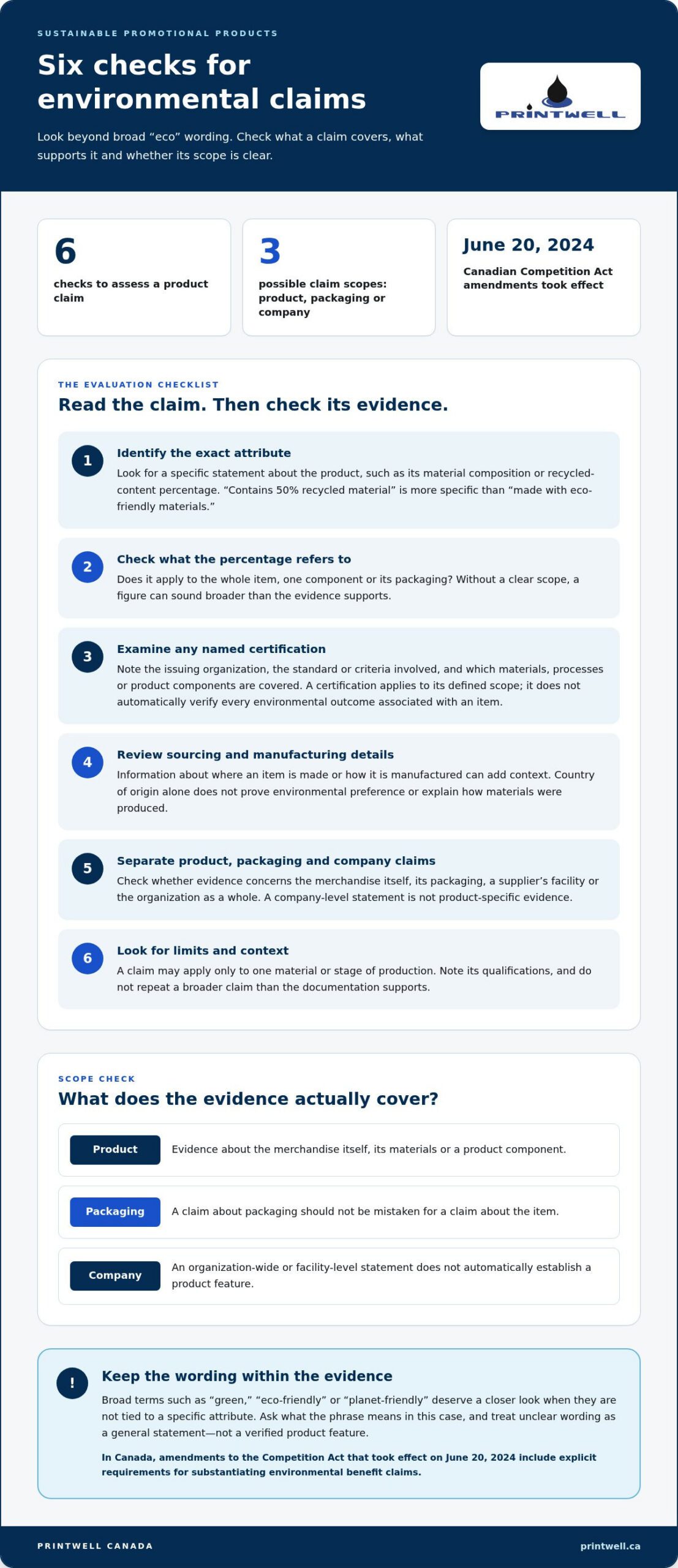
A product description may include useful environmental information, but a label or appealing phrase isn’t proof on its own. Use this checklist to identify what a claim covers and whether the supporting details are clear enough to compare.
A credible environmental claim identifies the specific attribute it covers and the evidence that supports it. Apply that test to a product description, certification details or supplier documentation before relying on a claim in campaign materials.
- Identify the exact attribute. Look for a precise statement about the product, such as its material composition or recycled-content percentage. “Contains 50% recycled material” describes a particular attribute more clearly than “made with eco-friendly materials.”
- Check what the percentage refers to. Does it apply to the whole item, one component or its packaging? A figure without a clear scope can sound broader than the evidence supports.
- Examine any named certification. Note the issuing organization, the standard or criteria involved, and which materials, processes or product components are covered. A certification applies to its defined scope; it doesn’t automatically verify every environmental outcome associated with an item.
- Review sourcing and manufacturing details. Information about where a product is made or how it is manufactured can build a fuller picture. Country of origin alone, however, doesn’t prove a product is environmentally preferable or establish how its materials were produced.
- Separate product, packaging and company claims. Check whether the evidence concerns the merchandise itself, its packaging, a supplier’s facility or the organization as a whole. A company-level statement shouldn’t be mistaken for product-specific evidence.
- Look for limits and context. A claim may apply only to one material or stage of production. Note any qualifications, and don’t repeat a broader claim than the documentation supports.
Broad terms such as “green,” “eco-friendly” or “planet-friendly” deserve a closer look if they aren’t tied to a specific attribute. Ask what the phrase means in this case. Is there a stated material detail, a defined certification or other relevant evidence? If the description doesn’t make that clear, treat the wording as a general statement, not a verified product feature.
This distinction matters in Canada. Competition Bureau Canada’s guidance on environmental claims is a useful reference for businesses assessing environmental marketing language. Amendments to the Competition Act that took effect on June 20, 2024 include explicit provisions related to environmental claims and substantiation. Consult the Bureau’s current guidance when preparing claims for a Canadian campaign, and make sure the wording reflects the evidence available.
Apply the same care to the details behind custom apparel, mugs, stickers and printed materials. Reviewing a claim and its scope helps you make a considered product choice without implying environmental attributes you can’t support. Explore custom printing options as you shape a merchandise plan around clear information and your campaign’s purpose.
Which Sustainable Promotional Product Categories Fit Your Campaign?
The right category depends on more than appearance or the material named in a product description. Start with the campaign’s purpose, who will receive the item and whether it fits into their routines. Then weigh its likely useful life against the product-specific information you can substantiate. No branded merchandise category is sustainable by default.
Use this comparison to narrow your options. The evidence column lists details to assess, not claims about any particular product.
| Category | Audience | Likely use | Branding opportunity | Sustainability evidence to examine |
|---|---|---|---|---|
| Apparel, such as custom T-shirts, hoodies or hats | Event attendees, staff or groups with a shared identity | Wearing at an event, at work or in everyday settings, if it suits the recipient | Printed graphics or embroidery can make a logo or message visible on clothing | Material details, manufacturing information, expected wear and care, and the specific claim or certification scope |
| Everyday-use items, such as mugs | Recipients whose routines make the item relevant | Regular use if it fits the person’s habits and needs | A logo or message can accompany an item through its everyday use | Product composition, manufacturing details, durability information and what happens at end of use |
| Stickers and printed materials | Event visitors, customers or people who need campaign information | Sharing a message, marking an item or providing information, depending on format | Colour, text and imagery can carry a campaign message in a compact format | Material and packaging details, quantity, intended use and practical disposal options |
When might branded apparel suit a campaign?
Apparel can help create a sense of team identity or give event staff a clear, consistent look. It’s a stronger fit when recipients are likely to wear it after the campaign, not just accept it on the day. Consider the group’s preferences, the setting and whether the style will still feel appropriate beyond one event.
Printing and embroidery offer different ways to apply branding, but neither method is automatically greener. Compare the specific product and decoration details instead of assuming the technique determines its environmental profile. For more on the branding approach, explore this custom embroidery guide.
When do drinkware, stickers or printed items make sense?
A mug may suit an audience that regularly uses one, but don’t assume every recipient wants or needs another. Stickers can work for a focused campaign when recipients have a reason to use them. Business cards, posters, signs and other printed materials can be practical when they serve a clear information or event purpose. Consider the format, quantity and likely disposal before ordering.
These categories support different goals, from team recognition to sharing event details. Match the item to real use, then assess its supporting information and expected life. For broader planning, consider how each merchandise category fits the campaign’s audience and purpose.
How to Plan a Promotional Product Order with Less Avoidable Waste
A well-planned order starts before you choose an item. Set the campaign goal, identify who should receive merchandise, decide how it will be distributed and estimate demand from real numbers. This connects the product and quantity to a distribution plan, rather than an audience you may never reach.
Order quantity should follow audience fit and expected use, not speculative reach. The more clearly you can account for who will receive each item and why they’ll use it, the easier it is to limit surplus.
How should you estimate quantities and avoid surplus?
Use confirmed attendee, employee or recipient numbers as your starting point. Then map out where the items will go: for example, reserved for registered event attendees, distributed to staff or included with a specific customer interaction. Separate the amount planned for distribution from any backup stock, and record the reason for that reserve instead of adding an unexplained buffer.
If your estimate depends on uncertain attendance or broad public exposure, make that assumption visible. Consider whether a smaller, targeted distribution would serve the goal better. An order for people most likely to value the item can be more purposeful than a larger quantity based on hoped-for reach.
How can Canadian businesses plan local merchandise thoughtfully?
For an Ottawa-area campaign, account for the venue, how merchandise will get there, when it needs to arrive and who will handle distribution. Pickup or delivery may suit different schedules and locations. Printwell Canada is based in Ottawa and has a showroom at St. Laurent Shopping Centre, alongside online ordering and nationwide shipping. Choose the route that fits your campaign logistics; local access or shipping alone doesn’t prove a smaller environmental footprint.
Include packaging and delivery in the plan. Consider how items will be packed, whether individual packaging is needed and how the order will reach its destination. Avoid calculating a footprint without reliable, order-specific information. Practical details still help: coordinating delivery with the event plan or preparing merchandise for a known distribution point can make handling clearer and reduce avoidable steps.
Use this short planning sequence before finalizing an order:
- Write down the campaign purpose and intended recipients.
- Confirm the planned distribution method and the quantity it supports.
- Set aside any backup stock separately, with the assumption documented.
- Include packaging, delivery or pickup, event timing and responsibility for distribution in the plan.
With the plan in place, explore Printwell’s custom printing options for branded apparel, mugs, stickers and printed materials.
Bring Your Sustainable Promotional Product Plan to Life with Printwell
You now have a practical way to compare claims, match merchandise to its intended audience and plan an order around real demand. Turn that thinking into a clear brief: what the campaign needs to achieve, who will receive the items, how they’ll be distributed and which product details matter to your decision.
Printwell Canada brings several custom printing categories together, so you can consider branded clothing and printed materials in relation to your campaign. The right choice depends on what each item needs to do. A staff shirt, event sign and customer handout serve different purposes, even if they share the same branding.
Which Printwell services can support branded merchandise?
Custom T-shirts and apparel printing can support campaigns that call for branded clothing, such as team wear or event apparel. Embroidered hoodies and custom hats offer other ways to apply a logo or message to clothing. Choose based on the audience, intended setting and likelihood that recipients will use the item. Printing and embroidery are different branding methods, not proof of an environmental advantage by themselves.
Custom mugs and DTF stickers can suit a campaign when there’s a clear reason for recipients to keep or use them. Business cards can carry key contact details, while signs and banners can support wayfinding or event messaging. Posters, foam board printing and event badges offer further formats for campaign communication. Choose each item to meet a specific need, rather than adding merchandise simply because it can be branded.
Keep the sustainability assessment tied to the specific item. Claims depend on its materials, manufacturing information, useful life and disposal options, along with evidence for any stated environmental attribute. Don’t assume a custom product is recycled, certified or otherwise environmentally preferable unless product-specific information supports that claim. This keeps campaign language accurate and the selection process consistent.
How can Ottawa and Canadian customers take the next step?
For an Ottawa-area project, Printwell’s showroom at St. Laurent Shopping Centre offers a local place to explore printing options. Online ordering is also available, and nationwide shipping can support campaigns across Canada. Consider the event location, distribution plan and timing as you decide which approach fits your order. Choose based on your logistics, not an unsupported assumption about environmental impact.
Before moving ahead, prepare a short brief with your campaign purpose, intended recipients, preferred product category, planned distribution and the evidence you need to assess any environmental claim. This gives your decision a practical foundation and connects the item to its intended use. For businesses planning sustainable promotional products, a clear brief brings audience fit, brand presentation and responsible claim-checking into one process.
If you’re ready to put that plan into action, explore Printwell’s promotional printing options and consider which format best supports your campaign.
Make Your Next Merchandise Decision More Intentional
Give your next merchandise decision a clear purpose before it becomes an order. Record what the campaign should achieve, who the item is for and what information supports any environmental claim. A short decision record keeps the choice grounded in evidence and helps colleagues understand why one option fits better than another.
That clarity also helps your brand communicate with confidence. Instead of relying on a broad green message, share only what you can accurately explain about the specific item. Thoughtful choices don’t need sweeping promises. They need a real audience, a reason to use the merchandise and claims that match the available information.
Ready to shape a campaign around your goals? Explore Printwell’s custom promotional printing options and take the next step towards choosing sustainable promotional products with care. A well-considered plan can make your branded merchandise more relevant, useful and true to your values.
Frequently Asked Questions
What makes a promotional product sustainable?
A promotional product is a more responsible choice when its environmental claims are specific, relevant and supported, and the item suits its recipients. For example, an event organizer can compare a proposed giveaway with another item that serves the same purpose, then record what product-level information supports the choice. That makes the decision easier to explain internally and helps prevent one appealing feature from standing in for a full assessment.
Are recycled promotional products always more sustainable?
No. Recycled content tells you something about a material, but not everything about the finished item. If you’re choosing between two products for the same event, compare the evidence available for each and consider which one attendees are more likely to keep or use. A recycled-content claim may be relevant, but it shouldn’t be the only reason to select an item or describe its overall environmental performance.
How can I tell whether an eco-friendly product claim is credible?
Look for a claim that names the specific feature and explains what it applies to. For example, distinguish a statement about the product itself from one about its packaging or the company that sells it. If a certification is named, review its scope and issuer rather than assuming it covers every environmental outcome. For Canadian marketing decisions, consult current Competition Bureau Canada guidance before using environmental claims publicly.
Which promotional products are best for sustainability-focused campaigns?
Can custom T-shirts be sustainable promotional products?
They can be considered for a sustainability-focused campaign, but the environmental description should reflect the specific garment and its supporting information. A business in Ottawa planning staff shirts, for example, can consider whether employees will wear them beyond a single event and what details are available about the garment. Printing or embroidery describes how branding is applied; neither method alone proves the shirt has a particular environmental benefit.
How can a business reduce waste when ordering promotional products?
Base the order on people you can reasonably expect to reach. For a workshop, use confirmed registrations as a starting point, then decide separately whether a limited reserve is needed for late changes. Plan how items will be handed out and what will happen to any leftovers. This avoids ordering for an uncertain audience and gives your team a clear reason for the quantity selected.
Are locally sourced promotional products always the greener option?
No. Local sourcing can be one useful consideration, but location by itself doesn’t describe a product’s full environmental profile. A Canadian organization may value domestic sourcing for its own procurement goals, yet should still review relevant product information and state the sourcing claim precisely. For an Ottawa campaign, practical access and distribution arrangements can also matter, but they shouldn’t be presented as proof of a product’s overall environmental advantage.