 A Proud Canadian Company
The shirt design you love most may not be the one buyers reach for. Learning how to design a shirt that sells starts with a practical question: who will want to wear it, and where? A clever graphic can still miss the mark if its message is unclear, the artwork is hard to read or the shirt doesn’t suit the audience.
That matters when you’re weighing colours, garment styles and printing methods before you know whether people are interested. A deliberate process helps you make those choices with purpose, then test the idea before committing to a larger run.
This guide covers how to define an audience, shape a clear concept and refine artwork for a wearable result. You’ll also learn how to choose a garment and decoration method, gather useful feedback and prepare files for production. Printwell Canada prints custom T-shirts and offers embroidery in Ottawa, with nationwide shipping. Start with the person who’ll wear the shirt, then build a design around their needs.
Key Takeaways
- Start with a clearly defined wearer, so your concept speaks to a real interest, identity, occasion or community.
- Test the idea with audience conversations and focused feedback before investing more time in the artwork.
- Make the main idea easy to recognize by balancing type, contrast, scale and placement.
- Choose a garment and decoration approach that suit the design’s detail, colours and intended use.
- Preview the finished design, gather feedback and use a sample or limited run to catch practical issues before producing more.
Start with the wearer: define who your shirt design is for
A shirt concept with commercial potential starts with a person, not a passing graphic trend. Before sketching slogans or choosing colours, picture the wearer: what matters to them, what they enjoy and what would make the shirt worth wearing? This audience-first approach is central to how to design a shirt that sells, because the design needs to connect with someone beyond its creator.
Your audience might share an interest, identity, occasion or community. A shirt for volunteers at an Ottawa neighbourhood event has a different purpose from merchandise for a local music community or a gift for a group celebrating a milestone. The more clearly you understand the wearer, the easier it is to choose a message and style that feels relevant.
What makes a shirt design marketable? It expresses an idea a specific audience values in a form they can comfortably picture wearing.
Choose a specific audience and wearing occasion
Ask three practical questions: Who would wear this shirt? Where might they wear it? What would it represent? A broad idea such as “people who like the outdoors” leaves plenty undecided. A more focused audience, such as Ottawa-area cycling club members looking for a shirt to wear on group rides, gives you a clearer setting, shared interest and reason for the design.
Keep the wearer’s preferences in view. A shirt for a casual community gathering may call for a different tone and placement than one intended for an activity or everyday wear. Consider whether the audience tends to favour understated graphics or expressive statements, and whether comfort and easy styling are likely to matter. Treat these as points to test, not assumptions about everyone in a group.
Turn the audience into a focused design brief
Write one sentence that connects the wearer with the idea you want the shirt to communicate. For example: “This shirt is for local cycling club members who want to show their shared enthusiasm with a bold, friendly graphic.” That line keeps the concept grounded and gives you a reference when feedback pulls the design in different directions.
Next, set a few boundaries. Decide on the tone, such as playful or understated; the visual style, such as clean typography or hand-drawn artwork; the garment’s intended use; and where the design should sit. You can explore functional and aesthetic considerations in Fashion Design Principles, then apply them to your audience and purpose.
Use the brief to make choices, not just describe the idea. If a visual trend doesn’t suit the wearer, leave it out. If a detail makes the message harder to understand or the shirt less comfortable to style, simplify it. Personal expression can be the starting point, but merchandise also needs to consider the buyer’s taste and context. A clear brief helps you keep what serves the wearer and set aside what doesn’t.
Validate the shirt idea before developing the artwork
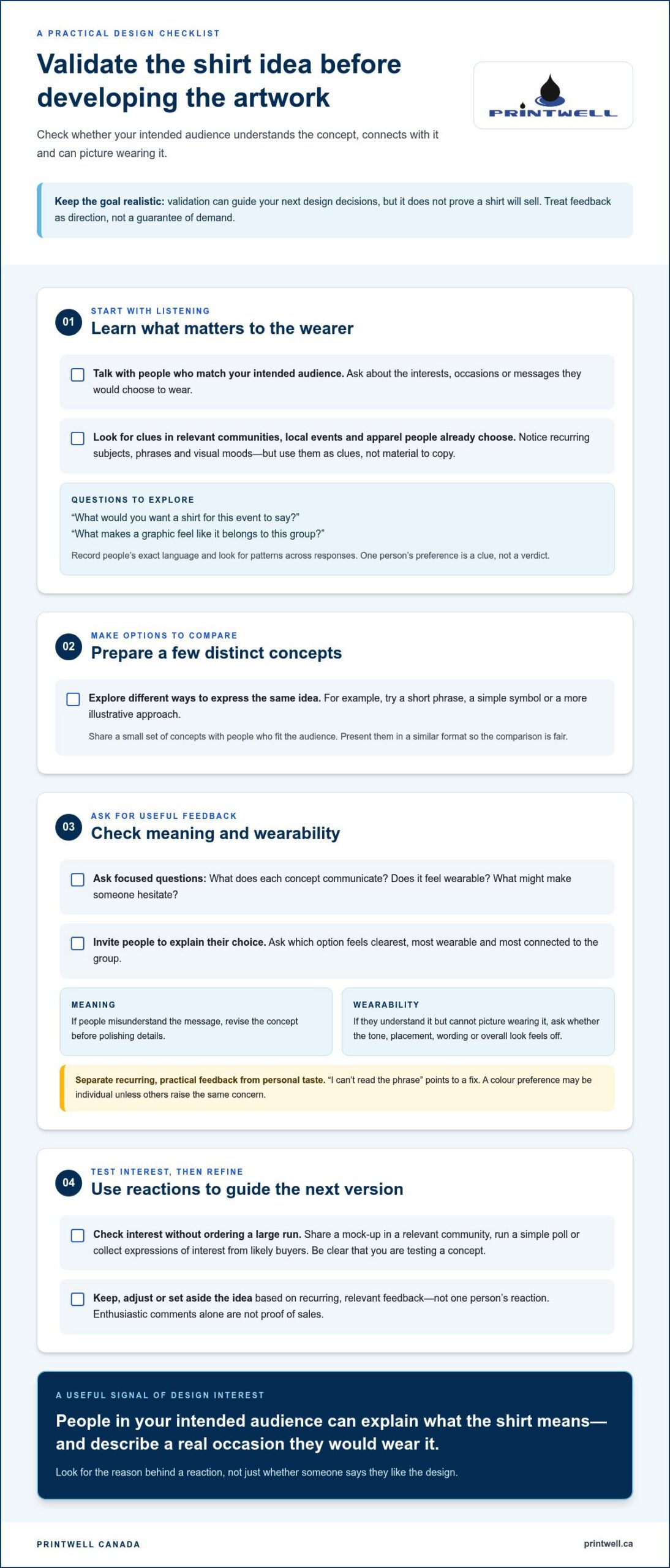
A promising concept deserves a reality check before you invest hours in detailed artwork or commit to a large quantity. Validation won’t prove that a shirt will sell. It can help you find out whether the intended audience understands the idea, connects with it and can picture wearing it. Treat feedback as direction, not a guarantee of demand.
Keep the process simple and in order:
- Listen first. Speak with people who match your intended audience about the interests, occasions or messages they’d choose to wear.
- Prepare a few different concepts. Explore distinct ways to express the same idea, such as a short phrase, a simple symbol or a more illustrative approach.
- Ask focused questions. Find out what each concept communicates, whether it feels wearable and what might make someone hesitate.
- Decide what to refine. Keep, adjust or set aside the idea based on recurring, relevant feedback rather than one person’s reaction.
A useful signal of design interest is when people in your intended audience can explain what the shirt means and describe a real occasion they’d wear it.
Research what your intended buyers respond to
Look at conversations in relevant communities, local events and apparel people already choose. Notice recurring subjects, phrases and visual moods, but use them as clues rather than material to copy. Then ask potential wearers open-ended questions: “What would you want a shirt for this event to say?” or “What makes a graphic feel like it belongs to this group?” Record their exact language and look for patterns across responses. One person’s preference is a clue, not a verdict.
Compare concepts and gather focused feedback
Share a small set of distinct concepts with people who fit the audience. Present them in a similar format so the comparison is fair. Ask which feels clearest, most wearable and most connected to the group, then invite people to explain their choice. Comments such as “I can’t read the phrase” point to a practical fix. “I just prefer green” may be personal taste unless others raise the same concern.
Separate feedback about meaning and wearability from reactions to colour or style alone. If people misunderstand the message, revise the concept before polishing its details. If they understand it but can’t picture wearing it, ask what feels off: the tone, placement, wording or overall look. Informal reactions are directional, so don’t treat enthusiastic comments as proof of sales.
You can check interest without ordering a large run. Share a mock-up in a relevant community, run a simple poll or collect expressions of interest from likely buyers. Be clear that you’re testing a concept, and note whether people explain why they’d wear it, not just whether they like it. When the idea is ready, Printwell Canada can produce custom T-shirts for Ottawa customers and across Canada. You can explore custom T-shirt printing as you move from audience feedback to production planning.
Build a shirt design that is clear, distinctive and wearable
Once the concept is set, give the artwork a clear order of importance. A person should notice the main image, phrase or symbol first, then take in any supporting details. If every element competes for attention, the message gets lost. A distinctive design doesn’t need to be complicated. One memorable idea, handled with care, can do more than a crowded layout of unrelated graphics.
A shirt graphic needs to remain understandable at the distance people are likely to see it. That could mean a quick glance across a room or a closer look in conversation. Check both. If the central idea only makes sense when someone studies tiny lettering or fine details, simplify or strengthen the artwork.
Make the main message easy to recognize
Start with the element that carries the idea: a bold symbol, a short phrase or a recognizable image. Give it the strongest emphasis through size, position or contrast. Add supporting text only if it clarifies the message, such as a group name beneath an event graphic. If the extra wording merely repeats the main idea, leave it out.
Try viewing the design small on your screen, then step back. Can you still tell what it’s about? Check whether the lettering holds together and whether the image has a clear outline. Fine lines or small details may become difficult to distinguish on a shirt, so use them selectively. Keep the artwork original and avoid borrowed graphics. A fresh interpretation of a shared interest will feel more considered than a familiar image copied from elsewhere.
Use colour, typography and placement with intention
Choose colours by looking at the artwork against the garment colour, not in isolation. A dark graphic on a dark shirt may disappear, while a high-contrast combination can make the main message easier to pick out. Consider how the colours work together and whether the design still reads at a glance. A restrained palette can focus attention, but the right choice depends on the concept and garment.
Type has a voice of its own. A playful message may suit rounded lettering, while a formal group name could call for a cleaner style. Limit the number of type styles so the words feel connected, and check that letter shapes are clear at the intended size. Avoid squeezing long wording into a small space. Shorten the phrase or give it more room.
Placement changes how a design feels. A large front graphic can make a statement, while a smaller front mark or a back design may suit a more understated look or provide room for additional context. Neither layout is automatically right. Preview the artwork on a shirt shape and consider how it sits on the body, whether it suits the intended use and how easily the wearer can style it.
As you refine the artwork, remove anything that doesn’t strengthen recognition, meaning or wearability. That’s a practical part of how to design a shirt that sells: make the idea easy to understand, visually distinct and suited to the person who’ll wear it.
Match the garment and decoration method to the design
A shirt’s fit, feel and decoration all shape how the finished piece comes across. A graphic designed for relaxed everyday wear may call for different garment choices from one created for a team event or branded apparel. Think about how the intended wearer will use the shirt, then choose a combination that supports both the artwork and the occasion.
Choose a shirt that suits its purpose
Consider the garment’s weight, fabric feel and cut together. A lighter-feeling shirt may suit warm-weather events or layering, while a heavier-feeling option may better match a structured look. A closer fit and a relaxed cut also create different impressions and may suit different audiences. There’s no single fabric or fit for every wearer, so let the purpose guide the choice.
For everyday wear, consider whether the audience would reach for the shirt beyond the event it represents. For a one-time gathering, the design might prioritize clear group identity and visibility. Branded apparel may need to feel consistent with how the organization wants to be represented. In each case, picture the shirt on the person who’ll wear it, not just as a flat mock-up.
Select decoration with the artwork in mind
Look at the artwork’s detail, colour, placement and garment material before settling on a decoration method. DTF printing can suit artwork that relies on printed colour and detail, such as a colourful event graphic or illustration. Prepare the design with its intended placement and garment in mind. For more context on this method, see the Complete Guide to DTF Gang Sheet Printing in Canada for 2026.
Embroidery creates a stitched look and can suit a design built around a simple symbol, lettering or a compact mark. It has a different visual character from a printed graphic, so consider whether the finish suits the message and garment. Neither method is automatically better; the right choice depends on the design’s style and the way you want it to appear. Explore the Power of Custom Embroidery guide for more on stitched decoration.
Placement matters, too. A larger front image may give an illustration room to read, while a smaller chest mark may better suit understated branded apparel. Consider whether the design needs one prominent location or whether a front-and-back arrangement supports its purpose. Share the artwork, garment choice and intended placement together when preparing the project. These details help align production with the result you have in mind.
Matching the garment and decoration is a practical step in how to design a shirt that sells, because a strong concept also needs to feel right as a real, wearable shirt. Printwell Canada offers custom T-shirt printing and embroidery in Ottawa. See how to bring your custom T-shirt design to print.
Prepare, test and refine your shirt design before a wider release
A finished-looking mock-up can make a design feel ready, but a careful final review may catch issues that aren’t obvious on screen. Check the artwork, see how it sits on the chosen garment, gather focused feedback and make any needed refinements before scaling up. This process can reduce avoidable surprises, but it can’t guarantee sales.
Check the artwork and garment preview
Work through a final review before sending artwork into production:
- Proof the details. Check spelling, alignment, contrast, edges and the relationship between the artwork and its placement. Zoom in to inspect fine elements, then step back to judge the overall impression.
- Preview it on the garment. Use a mock-up to assess scale and visual balance. Check whether the graphic appears too dominant, too small or awkwardly positioned for the shirt’s cut. A digital preview is helpful, but it can’t show exactly how the finished garment will look and feel.
- Prepare the production file. Use clean, high-resolution artwork in a format suited to the selected decoration method. Keep a final copy separate from working drafts, and make sure the version you submit reflects the approved design.
A preview helps you judge the composition, not every physical detail. If you’re planning a larger release, a printed sample can offer a more realistic check of placement, colour and how the artwork works on the actual garment.
Use feedback to guide the next production decision
Ask people from the intended audience for specific reactions after they’ve seen the design on a garment preview or sample. Do they understand what it communicates? Would they feel comfortable wearing it? What, if anything, feels confusing or out of place? These questions are more useful than a general “Do you like it?”, which may invite personal taste without explaining what to improve.
Compare responses with your original design brief. If people repeatedly point to a hard-to-read phrase or uncomfortable placement, consider revising that element. If opinions differ mainly on colour or style, weigh them against the audience and purpose you set out to serve. Informal feedback offers direction, not a prediction of how a release will perform.
A sample or limited initial run can help reveal practical issues before you produce a larger quantity. Assess the actual garment, notice whether the design reads as intended and learn from early wearers’ responses. Use what you learn to decide whether to adjust the artwork, garment or placement before proceeding. How to design a shirt that sells is a process of informed choices, not a guarantee that every concept will find buyers.
When your artwork is prepared and you’re ready to move from concept to printed apparel, explore Printwell custom T-shirt printing. Printwell Canada serves Ottawa and ships nationwide.
Take your shirt concept from idea to first print
Treat your first version as a learning opportunity. Let the finished shirt show you how the idea works beyond the screen, then use what you learn to guide future changes. No design process can promise sales, but careful decisions can help you create apparel with a clear purpose and a thoughtful finish.
When you’re ready to move from artwork to production, Printwell Canada offers custom T-shirt printing and embroidery. Ottawa customers can visit the showroom at St. Laurent Shopping Centre, and nationwide shipping makes it possible to order from across Canada.
Put your prepared design into production with Printwell custom T-shirt printing. Keep learning from each step and give your idea room to grow.
Frequently Asked Questions
Is a simple shirt design more likely to sell?
A simple design can be easier to recognize, but simplicity alone doesn’t create buyer interest. A small graphic for an Ottawa neighbourhood café, for example, may work well if customers understand its connection to the place. Ask intended wearers what they think the design represents before making a final call. If they notice something different from what you intended, adjust the concept rather than removing detail just for minimalism.
How do I know if people will buy my shirt design?
You can’t know with certainty before offering it, but you can look for useful signals. Share a mock-up with people who resemble your intended buyers and ask what they’d wear it for, what the design means to them and what might stop them from choosing it. Repeated comments can help you refine the idea. For how to design a shirt that sells, treat early reactions as guidance, not a sales forecast.
Can I sell a shirt design that uses a quote or image I found online?
Don’t assume online artwork, phrases, logos or illustrations are free to use commercially. Before including one, identify who owns it and whether you have permission for your intended use. Save relevant licence or permission records with your project files so you can refer to them later. If ownership or permitted use is unclear, seek qualified legal guidance. Starting with original artwork can help you avoid relying on material whose use you haven’t established.
What colours should I use for a shirt design?
Choose colours that fit the message and remain distinct against the shirt itself. Lettering that looks clear on a white screen, for example, may lose contrast on a dark garment. Preview the design against the actual garment colour and check small text, outlines and overlapping shapes. Screen settings can affect how colours appear, so use the preview to assess legibility and balance rather than assuming it will exactly match the finished print.
What file format should I use for a shirt design?
The appropriate format depends on the decoration method and artwork. Keep a high-resolution master file rather than relying on a screenshot or a small image downloaded from a messaging app. Vector artwork can be useful for clean-edged logos and lettering, while raster artwork may suit detailed illustrations. Before submitting a file, check that its dimensions and background treatment suit the design and that it’s prepared for the selected production method.
How many shirt designs should I launch at once?
There’s no fixed number that works for every project. For a first release, consider whether each design serves a different preference or purpose. Two genuinely distinct options, such as a text-led version and an illustration-led version, may give you a useful comparison. Several near-identical colour changes may make responses harder to interpret. Keep the presentation manageable, and make sure buyers can tell what sets each design apart before adding more choices.
Do seasonal shirt designs sell better?
Seasonal timing can make a shirt feel relevant, but it doesn’t guarantee demand. For an Ottawa event or seasonal gathering, consider when people will see the design and whether they might wear it after the occasion. A shirt tied to one date may have a shorter window of relevance than one connected to a broader local interest. Ask likely buyers what would make it worth wearing, and plan around the occasion without relying on timing alone.