
 A Proud Canadian Company
What if the sticker that looks toughest is still the wrong match for your equipment? Choosing non-peeling custom stickers for equipment takes more than picking a durable-looking finish. The surface, application method and working conditions all affect whether a sticker stays put.
If you’ve had stickers lift at the edges, peel away during use or fail after exposure to the elements, the frustration is familiar. Product descriptions don’t always explain how a sticker attaches or whether it’s suited to painted metal, plastic, textured surfaces or frequent handling.
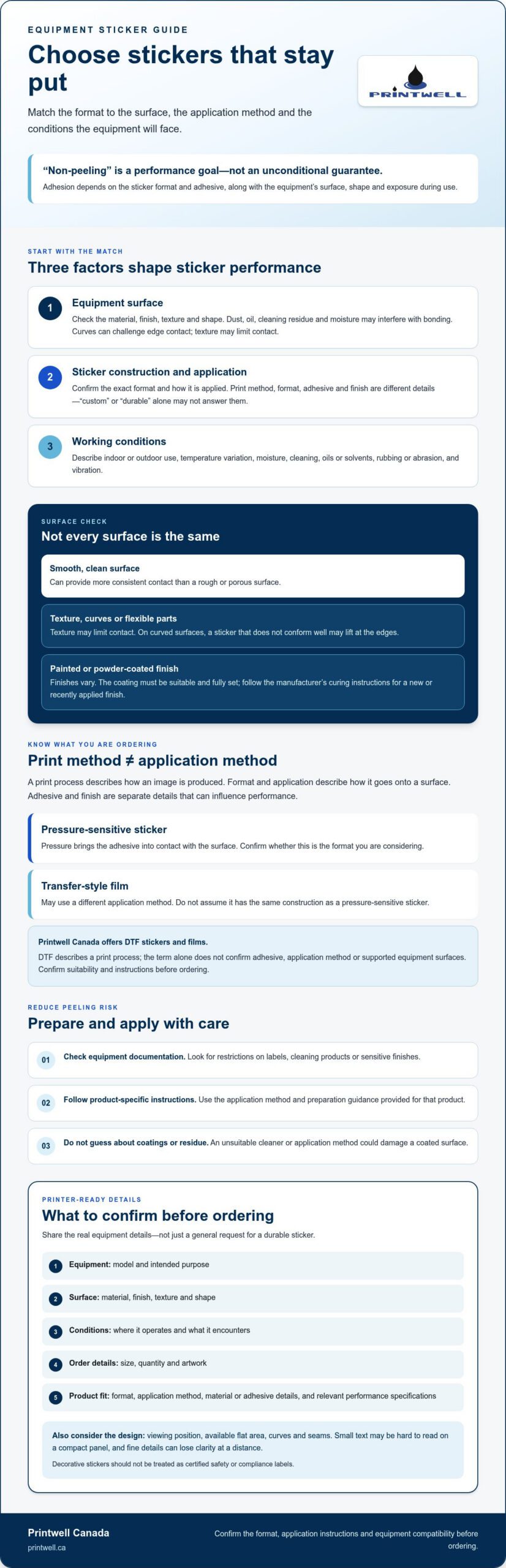
This guide covers how to assess the equipment’s surface and operating environment, what to confirm about a sticker’s construction and application, and how to prepare the surface to reduce peeling risk. It also outlines the details to give a printer before you order.
Printwell Canada offers DTF stickers and films. Since format and application details matter, describe your equipment and intended use, then confirm the product’s suitability and instructions before ordering.
Key Takeaways
- Choose non-peeling custom stickers for equipment by matching the sticker format to the equipment’s surface and operating conditions.
- Check whether the product is a pressure-sensitive sticker or a transfer-style film. The application method matters.
- Compare durability claims with details about the surface, environment, finish and intended use.
- Follow product-specific application instructions and equipment-manufacturer precautions when preparing and applying a sticker.
- Before ordering from Printwell Canada, gather the equipment model, surface details, conditions, size, quantity, artwork and intended purpose. Then confirm whether the available DTF sticker or film format is suitable.
What Makes Non-Peeling Custom Stickers for Equipment?
A sticker is less likely to peel when its construction is suited to the equipment’s surface and the conditions it will face. That’s the practical meaning of non-peeling custom stickers for equipment: a performance goal, not an unconditional guarantee. Adhesion depends on the sticker format and adhesive, along with the surface condition, shape and exposure during use.
A smooth, clean surface can provide more consistent contact than a rough or porous one. Dust, oil, cleaning residue and moisture may interfere with bonding. Edges can lift on curved surfaces if the sticker does not conform well, while texture may limit contact. Paint and powder coatings also vary, so don’t assume one sticker will adhere equally well to every finish.
Which equipment surfaces can make sticker adhesion challenging?
Flat, smooth metal or plastic may be easier to assess than a deeply textured panel, narrow curve or flexible component. Painted and powder-coated surfaces need extra care. A sticker may bond to the coating, but the coating itself must be suitable and fully set. For a new or recently applied finish, follow the manufacturer’s instructions about curing.
Before applying anything, check the equipment documentation for restrictions on labels, cleaning products or sensitive finishes. Don’t guess how to remove residue or prepare a coated surface. An unsuitable cleaner or application method could damage it.
What operating conditions should buyers disclose?
Describe where the equipment operates and what the sticker will encounter. Include whether it’s used indoors or outdoors, temperature variation, moisture and the routine cleaning method. Mention contact with oils or solvents, rubbing or abrasion, and vibration. These conditions can affect performance differently depending on the sticker construction and equipment surface. A broad “durable” claim does not prove suitability for every use.
If the sticker uses a pressure-sensitive adhesive, pressure brings the adhesive into contact with the surface. Other formats may use a different application method, so confirm which product you’re considering. Give the printer the actual surface and operating details, then ask whether that format is appropriate. When asking Printwell Canada about its DTF stickers and films, confirm the application method, equipment compatibility and any performance specifications before ordering.
How Sticker Construction and Application Affect Equipment Performance
A sticker’s print method, format, adhesive and finish describe different things. The print method explains how the image is produced; the format and application method explain how it goes onto a surface. Adhesive and finish are separate details that can influence how the sticker performs. A product described as “custom” or “durable” may not answer all four questions.
For example, you apply a pressure-sensitive sticker by pressing its adhesive side onto a surface. A transfer-style film may be applied differently, so don’t assume it has the same construction. The Pressure Sensitive Tape Council focuses on pressure-sensitive tapes, a reminder that adhesive products have distinct properties worth confirming rather than inferring from a broad product label.
What should you ask about adhesive, material and finish?
Ask the printer to identify the exact format and application method, then request guidance for your equipment’s specific surface and operating conditions. Confirm the finish and whether it suits the intended use. If you’re ordering a larger quantity, ask whether a sample or test application is available. Confirm this before planning around it.
Are DTF stickers and films suitable for equipment?
DTF describes a print process, but the term alone doesn’t confirm whether a product uses pressure-sensitive adhesive, how it’s applied or which equipment surfaces it supports. Printwell Canada offers DTF stickers and films. Before choosing a format, confirm the application instructions, intended surfaces and suitability for the equipment’s operating environment.
Artwork matters, too. Small text may be hard to read on a compact panel, while fine details can lose clarity at a distance. Consider the viewing position, available flat area and whether curves or seams could interrupt the design. Where practical, keep important information clear of edges and areas that move or are frequently handled. Decorative stickers shouldn’t be treated as certified safety or compliance labels.
Before ordering, confirm:
- Sticker or film format and application method
- Adhesive and material details, if applicable
- Suitability for the actual equipment surface and conditions
- Finish, artwork size, legibility and placement
- Application instructions and whether a test application is available
Use this checklist to assess non-peeling custom stickers for equipment without treating a general durability claim as proof. If you’re considering Printwell’s DTF stickers and films, ask about DTF sticker formats and describe your equipment surface and intended use before ordering.
How to Compare Custom Stickers for Equipment Before You Buy
Compare each option against the job it needs to do, not just its product description. “Waterproof” describes a claim about moisture, while “durable” can mean different things for different products. Neither term proves a sticker will resist peeling from every surface, tolerate a particular cleaning routine or suit an equipment’s curves and texture. Ask which conditions a claim covers and whether they match your use.
Adhesion and durability can be evaluated through specific tests, as shown by scientific testing of adhesive properties. Test findings help your decision only if they relate to the product and conditions in question. Use this comparison framework to identify what’s known and what still needs confirmation.
| Selection factor | What to compare | Verification status |
|---|---|---|
| Surface | Exact material, texture, curve, paint or coating | Confirm the format is intended for that surface |
| Environment | Indoor or outdoor use, moisture, temperature changes and cleaning routine | Ask which conditions are supported |
| Application method | Pressure-sensitive sticker, transfer-style film or another format | Request product-specific application instructions |
| Finish | Available finish and whether it suits the intended use | Confirm what the finish does and does not indicate |
| Handling | Expected rubbing, contact, oils, solvents or vibration | Disclose exposure and request suitability guidance |
Which selection criteria matter most for your equipment?
Start with the exact surface, then describe the equipment’s environment, cleaning routine and expected handling. Compare formats after the printer confirms their intended use. If a listing says “heavy duty” but doesn’t name supported surfaces or exposure conditions, treat that as a question, not proof. The same applies to claims such as “waterproof”: moisture resistance alone doesn’t establish peel resistance on your equipment.
Record each answer as confirmed, unclear or not applicable. If surface compatibility or a key exposure remains unclear, resolve it before buying rather than relying on a broad marketing phrase.
When should you use a certified industrial label supplier?
Prepare Equipment and Apply Stickers to Reduce Peeling
Careful application can reduce avoidable adhesion problems, but it can’t make an incompatible sticker suitable for every surface. Follow the sticker supplier’s instructions and the equipment manufacturer’s precautions. If either source advises against applying a sticker to a finish or component, don’t proceed without clarification.
Use this sequence before applying:
- Identify the surface. Check whether it’s painted, coated, textured, curved or made from another material, and note any sensitive finish.
- Consult the instructions. Review the sticker’s application guidance and the equipment documentation for cleaning restrictions or areas to avoid.
- Clean the spot carefully. Remove loose dust and visible residue using only a method approved for that equipment finish. Don’t assume a household cleaner, solvent or surface treatment is safe.
- Let the area dry. Make sure it’s dry and free of visible oil before continuing. If you’re unsure whether the surface is ready, check the product instructions or ask the manufacturer.
- Apply and inspect. Align the sticker before it touches the equipment, then apply it gradually as directed. Check that it’s positioned as intended and look for trapped air or lifting edges.
How should you prepare the equipment surface?
Preparation starts with protecting the finish, not using the strongest cleaner available. Follow equipment-specific guidance, especially for painted or powder-coated areas. A small, inconspicuous test may help show whether the proposed cleaning method or sticker affects the surface, but it can’t guarantee how the sticker will perform elsewhere or over time. If the finish is sensitive, get approval before testing.
What application and aftercare steps help?
Don’t reposition the sticker repeatedly or press harder than the supplier recommends. Follow the product’s instructions for application pressure, handling and any setting period. These details vary by format. Avoid exposing the sticker to cleaning or heavy use until the instructions allow it.
Inspect the edges periodically, particularly after routine cleaning or heavy handling. Replace a sticker that’s lifting, damaged or no longer readable. For asset identification, keep essential details legible. Decorative stickers shouldn’t replace safety or compliance labels.
Before applying non-peeling custom stickers for equipment, confirm that the format and instructions suit the equipment and its finish. Ask Printwell about DTF sticker application instructions and share the surface and intended use.
Choosing Custom Equipment Stickers from Printwell Canada
A useful sticker enquiry starts with the equipment, not just the artwork. Printwell Canada, based in Ottawa, offers DTF stickers and films. Share the intended use and confirm the format, application method and suitability for your equipment before placing an order.
What details should you send when requesting sticker guidance?
Give the printer enough context to discuss your request. A clear photo of the application area can show the surface and its shape. Include the equipment model, where and how it’s used, and any exposure to moisture, temperature variation, cleaning products, abrasion, oils or solvents.
Before ordering, confirm:
- Which DTF sticker or film format is available and how it’s applied
- Whether that format is suitable for the specific surface and operating conditions
- Which application instructions and equipment precautions to follow
- Current artwork, ordering and production requirements
These checks help you assess non-peeling custom stickers for equipment without assuming a product is suitable based on its name or appearance.
How can Ottawa and Canadian buyers take the next step?
Customers can order online or visit Printwell Canada’s showroom at St. Laurent Shopping Centre in Ottawa. Nationwide shipping is also available. Before ordering, contact Printwell with your equipment details and ask whether the available DTF sticker or film format matches your surface and intended use. Clarify any questions before proceeding rather than relying on an unverified performance claim.
For a practical first step, contact Printwell about DTF stickers and films with your equipment model, a surface photo and the conditions the sticker will face. This gives the printer useful information to discuss the format and application.
Make Your Equipment Sticker Choice With Confidence
Sticker performance depends on a good match between the product format, the equipment surface and the conditions it will face. Broad claims such as “durable” don’t confirm compatibility, so verify the application method and intended use before ordering. Careful surface preparation and product-specific instructions can also help reduce preventable lifting.
Start with the equipment model, a clear photo of the application area, its operating conditions, and your artwork, size and quantity needs. These details help you ask informed questions about non-peeling custom stickers for equipment without assuming a particular format will suit every surface.
Ottawa customers can visit the showroom at St. Laurent Shopping Centre, and nationwide shipping is available. Share your intended use and confirm the product details before ordering.
Frequently Asked Questions
Why do custom stickers peel off equipment?
Custom stickers may peel when their construction doesn’t suit the surface or operating conditions. Dust, oil or moisture can interfere with adhesion, while texture or curvature may limit contact. Abrasion and regular cleaning can also affect a sticker over time. These factors don’t identify a specific cause without inspecting the equipment and product. Check the supplier’s application instructions, describe the actual use and ask the printer to confirm suitability before ordering.
Can custom stickers stick to metal equipment?
They may, but “metal” alone isn’t enough to establish compatibility. A painted or coated panel can behave differently from bare metal, and texture, residue, curves and environmental exposure can all affect performance. Identify the exact surface finish and describe where and how the equipment is used. Then ask the printer whether the specific sticker format is intended for that surface. Don’t assume a product will adhere to every metal surface or piece of equipment.
How do I keep custom stickers from peeling?
Match the sticker format to the equipment surface, then follow the supplier’s application instructions. Prepare the area using a method approved for the equipment finish, and make sure it’s clean and dry before applying the sticker. Align it carefully and apply it as directed. There’s no universal cleaner or application method for all products and surfaces. Inspect the edges periodically. These steps can reduce avoidable peeling, but can’t guarantee performance in every use.
Are DTF stickers suitable for equipment?
DTF alone doesn’t confirm how a sticker attaches or which surfaces it suits. Printwell Canada, based in Ottawa, offers DTF stickers and films, but you should confirm the adhesive type, application method and equipment compatibility for the specific format. Before ordering, ask whether it’s designed for your equipment’s surface and operating conditions, and request its application instructions. Don’t assume DTF means an equipment-ready sticker.
Are waterproof stickers guaranteed not to peel?
No. A waterproof description doesn’t establish that a sticker will remain attached to every equipment surface. Water exposure and edge adhesion are different considerations, and performance can also depend on surface preparation, texture, cleaning and wear. Ask the printer what the product’s claims specifically cover and whether they apply to your equipment and use conditions. Treat broad wording such as “waterproof” or “durable” as a prompt for questions, not a performance guarantee.
Can custom equipment stickers be used as safety labels?
Don’t assume a decorative custom sticker meets safety, warning or regulatory requirements. Check the equipment manufacturer’s guidance and confirm applicable requirements with a qualified source. If a label has a safety-critical function, work with a supplier that can verify the required specifications and suitability for that purpose. General custom-printing claims aren’t proof of certification or compliance, so keep branding and asset identification separate from labels intended to communicate hazards or instructions.
What information should I provide when ordering equipment stickers?
Share the equipment model, surface material and finish, operating environment, cleaning routine, sticker size, quantity, artwork and intended purpose. A clear photo of the application area can help show its shape and condition. Also mention exposure to moisture, abrasion, oils or temperature changes. Ask the printer to confirm the available format, application instructions and suitability for that use. For Printwell’s DTF stickers and films, verify these details before finalizing an order.
Contact Printwell Canada about DTF stickers and films with your equipment details and intended use.