 A Proud Canadian Company
What if the lowest print quote ends up costing more in reprints, delays, or a finished product that doesn’t match your expectations? When you’re deciding how to choose a printing company, price matters, but it’s only one part of getting a result that meets your needs.
It’s reasonable to want clear answers before placing an order. Print methods and materials affect how a design looks and how well a product suits its purpose. A relevant sample, a clear proofing process, a confirmed schedule, and a responsive contact can all help you make a more informed choice.
This guide explains how to compare providers by project fit, print quality, communication, and fulfilment, not just by the quote. You’ll learn what to ask about production methods and materials, what to review before approving an order, and how to clarify timelines and delivery arrangements. Whether you’re ordering business cards, signs, banners, or branded apparel in Ottawa or elsewhere in Canada, choose a provider whose capabilities match your needs and whose process is clear from the start.
Key Takeaways
- Start with the product, quantity, intended use, audience, and deadline so you can focus on printers suited to the job.
- To decide how to choose a printing company, compare its relevant capabilities, materials, and quality checks against your project requirements.
- Use samples, proofs, portfolio examples, and reviews as evidence, and check whether they relate to the kind of work you need.
- Compare written proposals on equal terms by confirming product details, quantities, artwork assumptions, finishing, timelines, and delivery arrangements.
- Consider whether one provider can handle the items your project combines, such as apparel and selected business print products, with communication and fulfilment options that work for you.
Project First: What Do You Need a Printer to Produce?
Before comparing providers, decide what the finished product needs to do. Team uniforms, event banners, branded mugs, and business cards call for different products, materials, and production capabilities. A company that suits one job may not suit another. A long catalogue is less useful than relevant experience with your specific item and customization method.
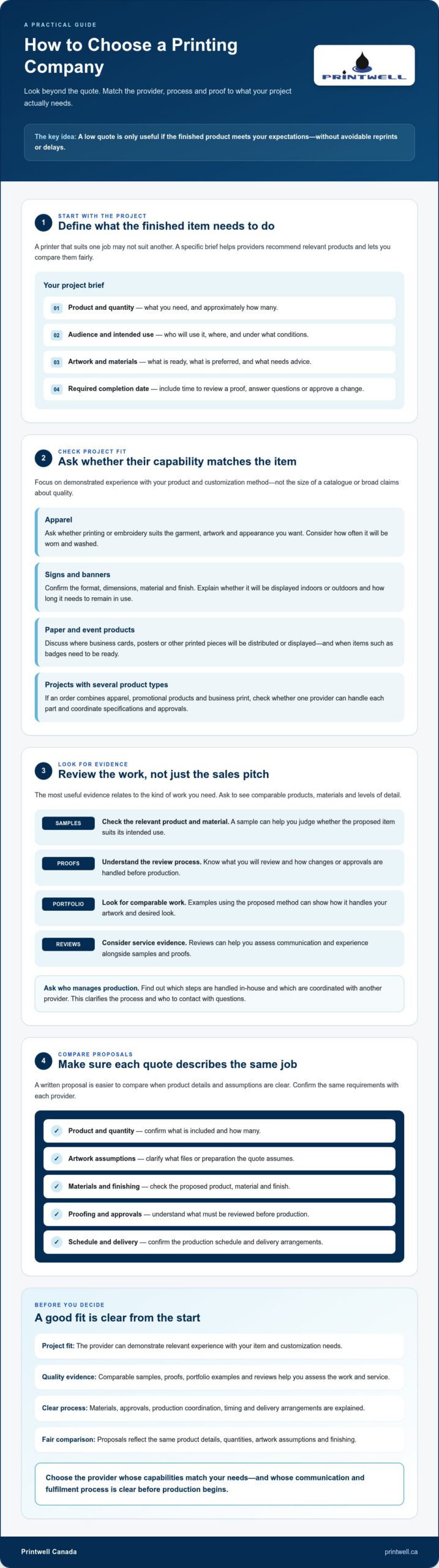
Start with a short project brief. Clarifying the details makes it easier to compare providers fairly and helps them recommend options that fit the intended result. That’s the practical first step in learning how to choose a printing company.
Turn the brief into a clear print specification
Note the product, approximate quantity, audience, intended use, artwork status, preferred materials, and required completion date. You don’t need to know every production detail yet, but explain the conditions the finished item must handle.
- Apparel: Will it be worn regularly, washed often, or used for a one-time event?
- Signs and banners: Will the display be indoors or outdoors, and how long must it remain in use?
- Paper items: Where will business cards, posters, or other printed pieces be distributed or displayed?
- Event products: When must items such as badges or promotional products be ready, and are there approval steps before production?
Leave time to review a proof, answer questions, or approve a change. If the deadline is firm, tell each provider when you need the completed order and ask them to confirm the production and delivery schedule. A specific date is more useful than a general request for “fast” service.
Match the provider to the type of print job
Ask whether the company regularly produces the specific item and uses the customization method your brief calls for. For branded apparel, printing and embroidery are different approaches. The right option can depend on the garment, artwork, and appearance you want. You don’t need to choose prematurely. Ask the provider to explain which options fit your requirements and why.
For signs and paper items, confirm that the provider can produce the required format, dimensions, material, and finish. The history of printing offers a broad look at how printing methods have developed, but your selection should come down to the needs of the project.
A provider may be a strong match for one category and not another. Focus on demonstrated capability, not catalogue size. If a project combines apparel with selected promotional or business print items, check whether one company can handle each part and explain how the orders will be coordinated.
Compare a Printing Company’s Capabilities, Materials, and Quality Controls
A printer’s capabilities should match the job you’ve defined, not just sound impressive. The right method and material depend on the artwork, the surface being printed or decorated, the quantity, how the item will be used, and the finish you want. A detailed poster image raises different questions from a logo on a hoodie or a banner intended for outdoor display.
Ask for examples of work similar to yours. General claims about quality tell you less than seeing a comparable product, material, and level of detail. For background on professional practices, consult resources from the printing industry standards organization PRINTING United Alliance, then use your own brief to guide the conversation with the provider.
What production capabilities should you verify?
Ask which printing or decoration methods the company can use for your item, and whether production is handled in-house or coordinated with another provider. Neither arrangement automatically makes a company a better fit, but knowing who manages each step helps you understand the process and who to contact with questions. For orders combining apparel, promotional products, and paper items, confirm how specifications and approvals will be kept clear across product types.
Capability | Evidence to request | Project relevance
Print or decoration method | Examples using the method proposed for your item | Helps assess whether it suits your artwork and desired look
Material and product options | Details or samples of the proposed substrate or item | Shows whether the material fits the product’s use and conditions
Production coordination | Explanation of in-house and external steps | Clarifies responsibility, communication, and consistency on multi-item orders
Quality checks | Description of file review, proofing, and approval steps | Helps you understand what will be checked before production
How to assess samples, artwork, and proofs
Examine a relevant sample for colour, fine detail, placement, material feel, and finish, where these matter to the product. A sample from another category may show general workmanship, but it won’t necessarily show how your artwork will look on your chosen item. Ask how the company checks supplied files and what the proof shows, such as layout, sizing, or placement.
Confirm who must approve the final proof before production and how requested changes are handled. Don’t assume a proof confirms details it doesn’t display. Ask questions until the approval process is clear. This practical comparison is central to how to choose a printing company with confidence. If you’re comparing apparel printing or embroidery with other items, you can review custom printing and embroidery options as part of your research.
Judge Print Quality and Service by the Evidence, Not the Sales Pitch
A polished portfolio and confident promises can make a provider look capable, but they don’t prove that your order will turn out as expected. Look for evidence related to your product and ask practical questions before you commit. This gives you a clearer view of both the finished work and the service you can expect along the way.
Different evidence answers different questions. Portfolio examples show the range of work a company presents. A physical sample lets you inspect a product or material. A proof helps you review your artwork and layout before production. Customer reviews can offer clues about communication and order handling. None is conclusive on its own. Financial information, such as the printing industry financial benchmarks, provides business context, not proof of how a particular item will look.
Which quality signals matter before production?
Clarify what the proof includes and what you’re expected to inspect, such as wording, colour, image placement, or sizing. Ask how the provider will contact you if artwork or specifications need clarification. A clear answer helps prevent assumptions from carrying through to production.
How to interpret reviews and portfolio examples
Look for specific comments, not just star ratings or general praise. A review describing the finished product, how questions were handled, or how an order was coordinated gives you more to consider than an unsupported claim of excellent quality. Read several reviews where possible, and remember that customer experiences may involve different products and project requirements.
- Portfolio: Does it include more than one example relevant to your product type?
- Sample: Can you assess the material, detail, and finish for yourself?
- Proof: Is it clear what you must review and approve?
- Communication: Are responses specific, easy to understand, and accountable?
Notice how the company responds to your questions. A dependable provider should explain limitations plainly, clarify next steps, and tell you when your approval is needed. Vague answers or absolute promises without supporting examples are reasons to ask follow-up questions, not automatic proof of poor work. When deciding how to choose a printing company, treat reviews and claims as leads, then check the details against your own brief.
Compare Printing Proposals, Timelines, and Delivery Before You Commit
A quote is useful only when you know what it covers. Before comparing totals, make sure each provider is pricing the same job: matching products, quantities, artwork assumptions, materials, decoration methods, and finishing. Otherwise, a lower figure may reflect a different specification rather than better value.
Use this process to compare written proposals fairly:
- Send each provider the same brief. Include the product, quantity, intended use, artwork status, preferred material, finish, and required completion date.
- Check what’s included. Look for the proposed method, material, proofing steps, and finishing or handling details. Ask which points depend on artwork approval and what remains unconfirmed.
- Clarify the schedule. Ask when you need to approve artwork, how long production is expected to take, and whether the stated timing includes shipping or only production.
- Confirm delivery and updates. Establish whether the order will be shipped or picked up, who will provide progress updates, and whom to contact if a question or issue comes up.
- Compare the whole proposal. Consider how well the documented plan fits your project, not just an unexplained difference in the quote.
Questions to ask before approving a print order
Before authorizing production, ask what happens if the artwork needs clarification or you request a change. Confirm whether production starts only after proof approval, who is responsible for reviewing the final proof, and how schedule changes will be communicated. If a problem arises, ask who will take ownership of the next steps. Clear answers make the process easier to follow later.
How to compare providers on a like-for-like basis
Use the same specification for every provider, then compare proposals line by line. Check that the product and quantity match, the artwork assumptions are equivalent, and the proposed material, customization method, proofing, and delivery terms address the same needs. Note differences in each provider’s responsibilities, including production updates and delivery coordination.
For Ottawa customers, an in-person visit can help clarify questions about a project or available options. Printwell Canada has a showroom at St. Laurent Shopping Centre, as well as online ordering and shipping across Canada. Its turnaround is described as fast, but confirm the schedule for your specific order rather than assuming a particular delivery date. This is a practical step in learning how to choose a printing company with confidence.
Ready to discuss a project involving custom apparel, business cards, signs, or banners? Explore Printwell’s printing options and confirm the details that matter for your order.
Choose a Printing Company That Fits Your Project, and Take the Next Step
The right provider is one whose capabilities match your product and intended use, whose quality you can assess, and whose communication, schedule, and fulfilment arrangements are clear. A low quote alone can’t tell you whether the proposed materials suit the job or whether the finished items will meet your expectations. Use your brief to make the final comparison, then confirm any open questions before approving production.
A final checklist for choosing your print provider
Before placing an order, make sure you can answer these questions:
- Does the provider handle the specific product and customization method you need?
- Have you reviewed relevant examples, material details, and the proofing process?
- Does the written specification reflect the agreed product, quantity, artwork assumptions, and finish?
- Are the approval steps and expected schedule clear?
- Do you understand whether the order will be shipped or picked up, and who will provide updates?
If any answer is unclear, ask for clarification. A straightforward conversation can reveal whether the provider understands your requirements and explains the next steps clearly. That’s a practical way to apply what you’ve learned about how to choose a printing company, without relying on a quote or broad promise alone.
When an Ottawa printing company may be the right fit
A local showroom can be useful if you’d like to discuss a project in person or see examples before deciding. Ottawa-based Printwell Canada lets customers order online or visit its showroom at St. Laurent Shopping Centre. Its product range includes custom T-shirts, embroidered hoodies, custom hats, DTF stickers and films, mugs, business cards, signs, banners, posters, foam board printing, digital photo printing, and event badges. Not every option suits every brief, so confirm the product and customization method that match your needs.
For branded apparel, compare printing and embroidery based on the intended look and use rather than assuming one method is right for every garment. Printwell also offers fast turnaround and shipping across Canada. Ask about the expected schedule and delivery arrangements for your order instead of assuming a specific completion date.
To make an enquiry, share the product you need, approximate quantity, artwork status, and required deadline. Those details give a provider a useful starting point for discussing fit, production, and fulfilment.
Make Your Next Print Project a Confident Choice
The best way to decide how to choose a printing company is to look beyond the quote. Start with a clear brief, check relevant examples and proofing steps, then compare written specifications, timelines, communication, and delivery arrangements. These details help you judge whether a provider’s capabilities suit the product and how you plan to use it.
Printwell Canada is an Ottawa-based option for custom apparel printing and embroidery, along with selected promotional and business print products. You can order online or visit the showroom at St. Laurent Shopping Centre. Printwell offers shipping across Canada and fast turnaround. Confirm the expected schedule and fulfilment details for your specific order.
Ready to explore options for your project? Explore Printwell’s custom printing services. Share your product, quantity, artwork status, and deadline to get the conversation started. With a thoughtful brief and clear questions, you’re well placed to choose a print provider with confidence.
Frequently Asked Questions
How do I choose a good printing company?
Choose a company whose capabilities fit your product, intended use, and deadline, then verify its work and process. Ask for relevant examples, learn what the proof confirms, and check that the written proposal clearly describes materials, quantity, finishing, production timing, and delivery. Clear, specific answers matter. For Ottawa customers, a local showroom may also make it easier to discuss options or view examples before ordering.
What should I ask a printing company before placing an order?
Ask whether the company produces your specific item and customization method, what materials and finishing are included, and what artwork requirements apply. Find out what the proof shows and who approves it before production. Confirm the expected production schedule separately from shipping or pickup timing. Also ask who will provide updates, how changes are handled, and what steps to take if the finished order appears different from the approved proof.
How can I tell if a printing company produces high-quality work?
Look for examples similar to your product, artwork, material, and intended use. A sample can help you assess colour, detail, placement, material feel, and finish, while a proof lets you check your order before production. Reviews may offer useful context about communication and order handling, but one testimonial or a broad quality promise isn’t enough. Ask direct questions and see whether the answers are clear and specific.
Is it better to choose a local printing company or an online printer?
Choose based on how you want to review the project and receive the order. A local printer can be useful if you value in-person discussion or want to see examples; an online provider may suit you if remote ordering and shipping are more convenient. In Ottawa, Printwell Canada offers online ordering and a showroom at St. Laurent Shopping Centre, with shipping across Canada. Confirm the schedule and fulfilment details for your order.
Can one printing company handle apparel and business printing?
Some companies handle multiple categories, but confirm they have relevant capabilities for each item in your order. Apparel printing and embroidery involve different customization methods, while products such as business cards, mugs, signs, and banners have their own requirements. Printwell Canada offers apparel printing and embroidery alongside selected promotional and business print products. Ask how each item will be specified, approved, and coordinated before ordering.
How do I compare printing quotes fairly?
Give each provider the same project brief, including product, quantity, artwork status, material preferences, finishing, and deadline. Then compare what each written proposal includes, along with proofing, production timing, shipping or pickup, and communication responsibilities. A lower quote may reflect a different specification or an item left unconfirmed. Ask providers to explain differences so you can judge the fit and value of each proposal on equal terms.
What happens if my printed order does not match the approved proof?
Contact the printing company promptly and describe the difference clearly. Keep the approved proof, order details, and relevant photos so you can explain what you’re seeing. Ask the provider to review the discrepancy and outline the available next steps. Don’t assume a reprint, refund, or other resolution is automatic; the outcome may depend on the order terms and the nature of the difference. Clear approval records can help keep the conversation focused.