 A Proud Canadian Company

A campaign’s value goes beyond the number of items distributed. Measuring ROI on branded merchandise means comparing the financial return with the full campaign cost: subtract the cost from the return, divide by the cost, then multiply by 100. Use revenue you can reasonably attribute to the campaign, rather than treating influenced pipeline as sales.
Revenue is only part of the picture. To understand whether merchandise helps strengthen customer relationships, compare retention rates and average order value over 12 months for accounts in a structured gifting program and accounts that didn’t receive one.
This guide explains how to calculate financial ROI, choose measures that match your campaign goal, and connect branded merchandise with digital activity using unique URLs, QR codes, or promotional codes. It also shows how to report revenue, pipeline, and retention separately, so your team can see what the campaign achieved.
Key Takeaways
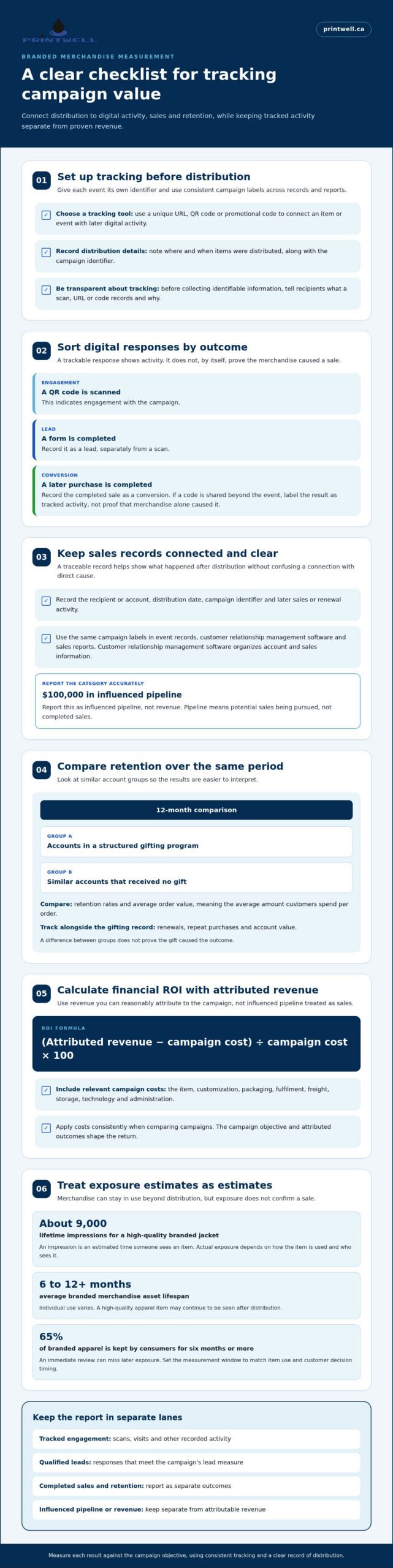
- Calculate financial return by subtracting total campaign cost from attributed revenue, dividing by campaign cost, and multiplying by 100.
- Compare retention rates and average order value over 12 months for accounts in a gifting program and similar accounts that didn’t receive merchandise.
- Choose measures that match the campaign goal, such as sales, meetings booked, customer retention, or brand exposure.
- Use a unique URL, QR code, or promotional code to connect merchandise distributed at an event with resulting traffic, leads, or conversions.
- Separate influenced pipeline from attributed revenue in reports, and use custom apparel or promotional items to give campaigns a tangible presence.
Attributing merchandise spend to revenue and retention
For a Canadian campaign, make tracking transparent and consent-based before collecting identifiable information. Tell recipients what a QR scan, unique URL, or promotional code records and why.
Physical Merchandise Attribution Tools
Merchandise attribution tools connect an item or distribution point with later digital activity. A unique URL, QR code, or promotional code can track traffic, leads, or conversions from a specific event. Give each event its own identifier, then record where and when items were distributed. This lets your team compare activity without treating every scan as a sale.
For example, a QR code on event merchandise can lead to a campaign page. A scan indicates engagement; a completed form indicates a lead; and a later purchase is a conversion. Report these outcomes separately. If the code is shared beyond the event, label the result as tracked activity, not proof that the merchandise alone caused it.
Sales Tracking for Merchandise
Sales tracking links campaign records with customer activity in your sales system. Record the recipient or account, distribution date, campaign identifier, and later sales or renewal activity. Your sales team can then see whether an account engaged after receiving merchandise. This creates a traceable path from distribution to a sales outcome while distinguishing a connection from direct causation.
Use consistent campaign labels across event records, customer relationship management software, and sales reports. Customer relationship management software is a system for organizing account and sales information. If a recipient books a meeting or makes a purchase, record the event and the associated campaign. Report $100,000 in influenced pipeline as influenced pipeline, not revenue. Pipeline means potential sales being pursued, not completed sales.
Comparing Retention Outcomes
Retention measurement compares whether customers continue their relationship with a business. Compare retention rates and average order value over 12 months for accounts in a structured gifting program and accounts that received no gift. Average order value is the average amount customers spend per order. Use similar account groups and the same measurement period, so differences are easier to interpret.
Track renewals, repeat purchases, and account value alongside the gifting record. For example, if a customer receives a gift and later renews, include that outcome in your retention analysis. This does not prove the gift caused the renewal. It shows whether the gifting group’s outcomes differ from those of a comparison group over the same period.
Separating Influence from Revenue
Attribution assigns a business result to a campaign based on recorded evidence. Influenced pipeline and influenced revenue are not necessarily attributable revenue, so report them separately. For each sales record, note whether the campaign came before the activity, whether a trackable response occurred, and whether a sale was completed. These distinctions make reports clearer for decision-makers.
A reliable record of distribution and follow-up is the starting point for measuring ROI on branded merchandise. Review tracked engagement, qualified leads, completed sales, and retention separately, then compare each result with the campaign objective. This gives your team a grounded view of merchandise’s contribution without presenting every later interaction as a direct financial return.
How Do You Calculate ROI for Branded Merchandise?
Calculate return on investment (ROI) by subtracting campaign cost from attributed revenue, dividing by campaign cost, then multiplying by 100. Merchandise can keep generating exposure after distribution, while digital and traditional ads depend on paid placements or campaign schedules.
Cost per Impression and Lifetime Exposure
Cost per impression is campaign cost divided by the estimated number of times people see an item. It helps compare ongoing exposure with a one-time campaign expense. A high-quality branded jacket can generate about 9,000 lifetime impressions. Branded merchandise has an average asset lifespan of 6 to 12+ months, though individual use varies.
To estimate impressions, consider how often recipients use or see an item and for how long. Divide the campaign’s total cost by the estimated impressions. Treat the result as an estimate, not a confirmed view count: actual exposure depends on how the item is used and who sees it. This measure helps compare formats, but it does not show whether exposure led to a sale.
Measurement Windows and Brand Familiarity
A measurement window is the period used to observe campaign outcomes. Set it to match how long the item may stay in use and how quickly customers make decisions. Branded apparel is kept by consumers for six months or more in 65% of cases, so an immediate review can miss later exposure.
The mere exposure effect describes how repeated encounters can make a brand feel more familiar. Track direct responses separately from broader familiarity, using measures such as visits to a campaign page or recognition in customer feedback. A jacket seen repeatedly may support recall, but exposure alone does not establish a purchase. Compare results over the same campaign period using consistent tracking methods.
Merchandise Costs, ROI, and Tax Treatment
Campaign cost includes more than the item itself. Add customization, packaging, fulfilment, freight, storage, technology, and administration where relevant. These costs affect the ROI calculation, while the campaign objective and attributed outcomes shape the return. Include relevant expenses consistently to compare campaigns fairly.
For example, a campaign costing C$10,000 and generating C$50,000 in new sales has a 400% ROI. The calculation is (C$50,000 minus C$10,000) divided by C$10,000, multiplied by 100. For tax purposes, whether an expense is deductible depends on its business purpose, recipients, and records. Keep invoices and distribution details, and assess tax treatment separately from marketing ROI.
For a campaign that includes printed materials, custom business cards can provide another branded touchpoint to track alongside merchandise.
What should you measure by campaign type?
Choose measures that match the campaign goal: conversions, booked meetings, sales, retention, or reach. These metrics show whether merchandise supported the intended outcome, rather than forcing every campaign into a single ROI measure.
Campaign Objectives and Success Metrics
A campaign objective states what the merchandise should help achieve; success metrics show whether it did. Define both before distributing items. For lead generation, track qualified leads and meetings; for sales, track completed purchases; for retention, compare renewals and repeat orders.
Set a baseline and define the measurement period before launch. A conversion-focused program can use review points at 30, 60, and 90 days, adjusted to the typical buying cycle. For an event campaign, record distribution, responses, and follow-up activity separately. The right measure depends on the intended action, not simply the number of items handed out.
ROI from Revenue and Costs
Financial ROI compares revenue attributed to a campaign with its total cost. Subtract campaign cost from attributed revenue, divide by campaign cost, and multiply by 100. Use completed sales tied to campaign records, not every opportunity that happened to progress afterward. This gives finance teams a clearer view of realized return.
Include relevant expenses such as products, customization, packaging, fulfilment, freight, storage, technology, and administration. Apply the same cost categories across campaigns to make comparisons meaningful. If sales take longer to close, align the review period with the buying cycle. A campaign can generate useful engagement before its financial return appears in completed transactions.
Campaign Data, Reach, and Reporting
Campaign reporting organizes activity and outcomes into a concise account of performance. For a leadership update, report the objective, total spend, distribution, tracked engagement, and the result that best fits the goal. An illustrative report could record 500 kits delivered and 18 meetings booked. Those figures describe reach and response, not revenue.
For a chief financial officer (CFO), separate completed sales from meetings, leads, and influenced pipeline. Reach describes how many people received or encountered campaign material; it does not establish that they purchased. Show the measurement period and tracking method beside each result. For example, label QR activity as visits, booked appointments as meetings, and completed purchases as sales. This keeps the report useful without overstating what the data proves.
Using unique URLs, QR codes and promotional codes
A unique URL, QR code, or promotional code can connect merchandise distributed at a specific event with resulting traffic, leads, or conversions. To test merchandise’s impact, compare a group that receives items with a similar group that does not, then track the same outcomes for both.
Assign each event or audience its own tracking method. For example, give attendees at one event a QR code that leads to a dedicated campaign page, and use a different code for another event. A unique URL is a web address created for a campaign. It can include tracking details that help analytics tools identify visits from that distribution point.
A QR code is a scannable square that opens a digital destination, such as a landing page. Place it where recipients can scan it easily, and make the next step clear. If the goal is lead generation, track completed forms, not scans alone. If the goal is sales, record completed purchases associated with the campaign.
Promotional codes can connect a later purchase with a specific event or item. For instance, use an event-specific code at checkout and record each completed order against it. Keep the code easy to enter and distinct from codes used in other campaigns. Because a code may be shared, treat it as evidence of a response, not proof that one item caused the sale.
For a stronger comparison, decide on the test before distributing items. Split similar audiences into a merchandise group and a comparison group that receives no item. Keep other campaign elements, such as the message and follow-up, consistent. Compare the groups’ tracked visits, leads, and conversions. This helps isolate merchandise’s contribution from other marketing activity.
Use a consistent campaign name across the QR destination, promotional code, event records, and analytics platform. For example, label each record with the event and distribution group. This makes it easier to connect a scan to a form submission or sale and avoid duplicate counts when someone uses several touchpoints.
Review event giveaway results over three to six months, matching the window to the buying cycle. Check scan activity, page visits, submitted forms, booked meetings, and completed sales as separate outcomes. If a recipient scans but doesn’t convert, record the visit without counting it as revenue. This gives the campaign report a clear trail from item distribution to measurable action.
For privacy-conscious tracking in Canada, explain what information a campaign page collects and why, and collect only what measurement requires. Keep personal details separate from general scan totals where possible. Report grouped totals for event traffic and leads, and limit access to identifiable records to people who need them.
Connecting merchandise to digital marketing
Physical merchandise can extend a digital campaign into everyday settings, while online content gives recipients a clear next step. Coordinate the message, visual identity, and call to action across both channels. For example, an event item can point recipients to a landing page that continues the conversation and records their response.
Brands using physical merchandise achieve 60% to 80% more brand recall than brands relying solely on digital ads. That comparison makes physical items a useful complement to online advertising, not a replacement for it. A digital ad can prompt an initial visit, while a useful branded item can keep the same message visible after the ad stops appearing.
Plan the recipient’s journey across each touchpoint. An online ad might introduce a product, an event item can reinforce the message, and a campaign page can explain the next step. Keep the wording and visual style consistent. If the ad offers a product demonstration, make it easy to book one on the linked page.
Connect each channel with campaign-specific tracking. For example, give an event audience a landing page that differs from the one used in social media ads. Compare visits, form submissions, and completed purchases by source. This helps show whether merchandise supported digital activity without assuming every later sale came from a single item.
Digital channels can also support follow-up after distribution. A recipient who visits a campaign page might see related content in a later email or advertisement. Identify these interactions in reporting so your team can distinguish a first visit from a later conversion. A sales record linked to the campaign provides stronger evidence than an impression alone.
Choose measures that fit the campaign goal. For awareness, review brand recall and tracked visits; for lead generation, count completed forms and qualified enquiries; for sales, record completed transactions. Use the same definitions across channels. A click, a form submission, and a purchase are different outcomes, even when they belong to the same campaign journey.
For a clear performance review, present digital and physical results side by side. Note campaign spend, tracked reach, engagement, leads, and attributed sales. Label influenced pipeline separately from revenue, and state which touchpoints were measured. This gives decision-makers a practical view of each channel’s contribution without overstating what the tracking proves.
Bring your campaign’s physical and digital touchpoints together by planning a printed campaign element that supports the message recipients see online.
Printwell Canada: Custom T-Shirts
Printwell Canada helps turn campaign plans into tangible branded merchandise, including custom T-shirts, Direct-to-Film (DTF) stickers and films, embroidered hoodies, and custom hats. These items can support event giveaways, employee programs, or customer gifts, giving your audience a physical reminder of your message.
Choose an item that fits the campaign and its recipients, then connect distribution to your selected tracking method. For example, pair event merchandise with a unique QR code or campaign page so you can review scans, visits, and resulting leads separately. This connects the printed piece to your measurement plan without treating every interaction as a sale.
Contact Printwell Canada to discuss campaign merchandise, or visit printwell.ca.
Make your next campaign more intentional
Let each campaign inform the next. A disciplined approach to measuring ROI on branded merchandise can help your team refine which audiences, messages, and items best support its goals. Use what you learn to sharpen the brief, choose a suitable product, and plan how recipients will encounter your message. This steady improvement supports more thoughtful campaign decisions.
Printwell Canada offers Custom T-Shirts, DTF Stickers and Films, and Embroidered Hoodies for branded campaigns. Choose an item that suits your audience and how they’ll receive it, whether at an event, through a team program, or as a customer gift. Contact Printwell Canada today to discuss your merchandise plans. A well-considered next step can turn your campaign goals into something people can see, use, and remember.
Frequently Asked Questions
How can creative strategy improve merchandise ROI?
Creative strategy can improve ROI by making an item relevant to its audience and campaign purpose. For example, a welcome gift for new employees should reinforce workplace identity, while an event giveaway should connect naturally with the event message. Choose a clear design and useful item, then give recipients a simple next step. A thoughtful match can encourage people to use the merchandise and make the campaign easier to measure.
How do you report merchandise ROI to leadership?
Give leadership a concise report that links the campaign goal to its business result. Include the audience, total spend, measurement period, attributed revenue, and supporting indicators such as meetings or repeat purchases. Separate confirmed sales from influenced pipeline, which represents potential deals rather than completed revenue. Close with a decision, such as whether to repeat the campaign, adjust its audience, or test a different item.
How do you calculate ROI on branded merchandise?
Subtract total campaign cost from attributed revenue, divide the result by total campaign cost, then multiply by 100 to express ROI as a percentage. For a complete calculation, include costs beyond the merchandise itself, such as customization, packing, delivery, and campaign administration. Use revenue tied to recorded campaign activity, not every sale during the campaign period. If the result is below zero, costs exceeded the attributed return.
How do you track branded merchandise impressions and conversions?
Estimate impressions by considering how often recipients see or use an item, and label the result as an estimate. Track conversions through a campaign landing page, QR code, or promotional code connected to an analytics tool or sales record. Distinguish a page visit from a completed form or purchase. Use consistent campaign labels and remove duplicate actions before reporting totals, so repeat scans do not inflate results.
What is the average cost per impression for branded merchandise?
Treat this as a comparison point, not a fixed rate for every campaign. The calculation divides total campaign cost by estimated impressions, so the result varies with the item’s cost, frequency of use, and exposure period. State the assumptions behind your estimate, especially how you counted views and estimated continued use.
How do you attribute sales or leads to branded merchandise?
Give each distribution group a distinct tracking marker, such as a campaign-specific QR code or promotional code. Then connect resulting form submissions, booked meetings, and purchases to that marker in your sales records. For example, a completed form counts as a lead, while a later order counts as a sale. Record the sequence and source, and note other marketing touchpoints when they also influenced the customer’s decision.