 A Proud Canadian Company

A uniform proposal wins support when it solves a visible workplace problem, not just refreshes the look. To understand how to get buy-in for new company uniforms, start with employee feedback and evidence about fit, comfort, wear and replacement needs. Then compare cost per wear and connect the change to clear business goals.
It’s reasonable for employees and decision-makers to question a uniform change: it affects what people wear every day, and the initial expense needs a practical justification. A strong case takes those concerns seriously. It shows how the proposed garments suit the roles, support a consistent appearance and make sense over time.
This guide explains how to gather useful staff input, document garment problems, compare durability and cost per wear, and set objectives tied to recruitment, brand recognition or workplace needs. You’ll also learn how to present the evidence clearly, so the discussion moves beyond personal preference to a thoughtful decision grounded in comfort, function and value.
Key Takeaways
- Compare comfort and durability alongside upfront cost to build a more complete picture of uniform value.
- Gather staff feedback and document garment issues so the proposal reflects the realities of daily work.
- Connect uniform choices to clear business priorities, such as brand recognition, recruitment or job requirements.
- Plan replacement schedules around wear and use cost-per-wear comparisons to explain the budget case.
- Use custom T-shirts or other branded apparel to put a considered uniform plan into practice.
Balancing uniform cost, comfort, and durability
Build the case around how garments perform over time, not just their purchase price. Compare wear, comfort, fabric and replacement needs with the demands of each role.
-
Compare long-term uniform costs
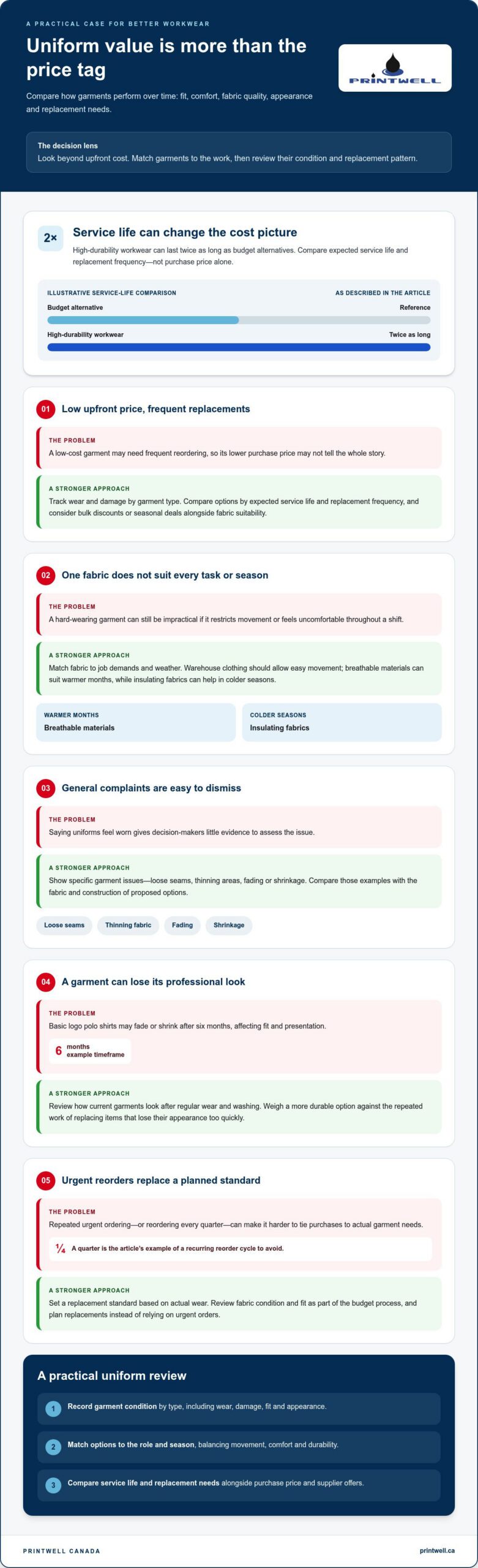
Compare garments by expected service life and replacement frequency, not purchase price alone. High-durability workwear can last twice as long as budget alternatives, reducing how often a business needs replacements. Track wear and damage by garment type, then compare options against those patterns. Avoid choosing a low-cost item without considering whether frequent reordering will outweigh its lower upfront cost.
-
Balance comfort with durability
Match fabrics to the work and the season, then assess comfort alongside resistance to wear. A warehouse uniform, for example, needs to allow easy movement while standing up to daily tasks. Breathable materials can suit warmer months, while insulating fabrics can help in colder seasons. Durability isn’t the only measure of quality: a hard-wearing garment still needs to feel practical throughout a shift.
- Examine fabric quality. Use garment evidence to show why quality matters. A low-quality fabric may fail after three washes, turning an apparently affordable choice into an early replacement. Check existing garments for loose seams, thinning areas, fading and shrinkage. Compare those examples with the fabric and construction of proposed options. A specific damaged shirt gives decision-makers a clearer basis for discussion than a general claim that current uniforms feel worn.
- Consider appearance over time. Assess whether uniforms retain a professional look through regular wear and washing. Basic polo shirts with company logos may fade or shrink after six months, affecting both fit and presentation. Use the condition of current garments to identify which problems matter most to staff and customers. Then weigh a more durable option against the repeated work of replacing items that lose their appearance too quickly.
- Set a replacement standard. Choose garments suited to daily use, and plan replacements around actual wear rather than relying on repeated urgent orders. High-quality uniforms can withstand daily wear and tear for longer, potentially reducing replacement frequency. Avoid a cycle of reordering every quarter by reviewing fabric condition and fit as part of the budget process. A clear standard helps explain why comfort, durability and appearance belong in the same decision.
Use that figure alongside evidence of garment condition to judge whether a cheaper option remains economical in practice. Choosing durable uniforms can help avoid reordering them every quarter, while a planned review of wear can keep purchasing decisions tied to actual needs.
Supplier comparisons should include more than garment prices. Employers should consider bulk discounts and promotional or seasonal deals when comparing uniform suppliers, then weigh any savings against fabric suitability and expected wear. Account for seasonal weather when selecting uniform fabrics, using breathable materials for warmer months and insulating materials for colder seasons. For warehouse roles, uniforms should allow workers to move easily and be durable enough for their work. This keeps comfort, function and value in view when assessing options.
Gathering employee feedback and evidence of garment problems
Collect specific examples from employees before choosing garments. Their daily tasks, fit concerns and experiences with current clothing can shape a practical proposal.
- Ask for clear, role-specific feedback. Invite employees to describe what works and what causes difficulty during a shift. Use focused prompts about movement, fit, fabric, laundering and garment condition. For example, ask a delivery worker whether a jacket restricts reaching, or a counter employee whether a shirt stays comfortable through customer-facing duties. Record recurring concerns separately from individual preferences.
-
Identify requirements by employee role
Group feedback by job duties, then identify the garment needs tied to each role. Ground crews may need lightweight fabrics, while electricians may need flame-resistant clothing. Avoid assuming one uniform suits every employee. Compare each role’s movement, work setting and practical clothing requirements, then document where a shared garment works and where different options are necessary.
-
Address comfort, safety, and inclusion
Invite employees to identify concerns about comfort, safety, dress codes, body types, gender and religious needs. Offer inclusive choices in fit and style, and consider whether a uniform can accommodate religious garments or individual coverage preferences. For safety-sensitive work, match clothing to the hazards and tasks involved. Avoid presenting a single cut or fit as suitable for everyone.
- Explain the benefits in practical terms. Show employees how the proposal responds to their feedback, supports their work and creates a consistent appearance. For example, explain that a role-specific option addresses restricted movement, while coordinated garments help customers identify staff. Professional, modern uniforms can help employees feel more confident, and shared clothing can support team spirit and collaboration. Keep the explanation tied to observed needs, not abstract claims.
- Handle resistance through dialogue. Ask employees to describe the concern behind an objection, such as an uncomfortable neckline, a limited fit or an unclear dress-code expectation. Explain the reason for the proposed change and note which suggestions informed it. For Canadian workplaces, identify the applicable federal, provincial or territorial employment standards before setting a uniform requirement, and consider employment terms and accommodation needs. Avoid treating every concern as opposition to the whole plan.
- Make ordering straightforward. If employees order individually, use an online profile for each person and set spending limits or approval steps. Clear profiles can capture the employee’s chosen size and garment options. For example, an approval step can help ensure an order stays within the assigned allowance. This approach can also make individual packages easier to distribute than sorting a bulk delivery by size.
Linking uniform objectives to recruitment, brand awareness, and safety
Choose a business outcome before selecting a uniform, then connect each design choice to that goal. A clear link helps decision-makers assess what the change is meant to achieve.
-
Link uniforms to business objectives
Choose the priority the uniform should support, such as recruitment, brand awareness or workplace safety. For recruitment, consider whether a professional, modern appearance reflects the employee experience you want to present. For safety, identify the hazards and tasks associated with each role. Avoid presenting one garment as a solution to every objective; show how each choice answers a specific workplace need.
-
Build the case for branded uniforms
Connect garment quality and presentation to the impression customers receive. Employees in clean, coordinated clothing can be easier for customers to identify, helping customers feel more confident about whom they’re speaking with. A professional image also depends on garments that suit the work and maintain a consistent appearance. Use examples from customer-facing roles to show why a worn or mismatched uniform may undermine the intended brand impression.
- Make brand recognition deliberate. Select company colours, logo placement and fabrics to create a consistent look across work locations and roles. For example, a recognizable colour can help customers distinguish employees from visitors, while a visible logo connects the garment with the business. Keep the design practical and legible at the distance customers usually see staff. Avoid adding details that make the uniform harder to wear or maintain.
- Estimate exposure without overstating it. Map where employees wear branded clothing during regular work, such as customer visits, deliveries or public-facing shifts. Note the settings and interactions that could make the business visible. Treat this as an estimate of opportunities for recognition, not a guaranteed count of impressions or new customers. A simple explanation of who sees the uniform and where keeps the marketing case grounded.
- Connect safety features to actual tasks. Identify workplace hazards before choosing garments for a role. Reflective strips and flame-retardant fabrics can help protect employees from workplace hazards, so explain which work conditions make those features relevant. Don’t present a branded garment alone as a safety measure. Show how the clothing choice fits the task and supports the company’s broader safety approach.
- Present a focused business case. Summarize the objective, the garment choice and the reason it supports that objective. For example, a customer-facing team may need consistent branding, while employees working around hazards need suitable protective features. Add practical measures for reviewing the decision, such as employee feedback, customer identification and garment condition. This gives decision-makers a clear basis for assessing the proposal after launch.
Uniform budgets and replacement schedules
Build a budget that accounts for initial orders and replacements caused by wear. A clear rollout plan also helps employees understand what changes and when.
-
Set uniform budgets and replacement schedules
Track uniform spending by role and garment type, including replacement needs caused by wear and tear. Review garment condition and replacement frequency as part of the budget, rather than treating the first order as the full cost. Set a review point for each uniform group, then adjust the schedule when actual wear shows a different pattern. Durable choices can help avoid reordering every quarter.
-
Clarify employer uniform costs
Don’t assume employees must pay for required clothing simply because it carries an employer’s logo. In Canada, budget and policy decisions should account for the employment standards, employment terms and deduction rules that apply to the workplace. Identify those requirements before assigning uniform costs to employees. Then explain what the organization will provide, what employees are expected to do, and how replacements will be handled.
- Plan the rollout in stages. Set out the decision, ordering, distribution and start dates in a written plan. Begin with one department or site as a pilot, then gather feedback about fit, comfort, ordering and distribution before expanding. A staged rollout gives managers time to resolve practical problems, such as missing sizes or unclear order approvals, before the new policy reaches everyone.
- Make the policy easy to follow. Tell employees which garments are required for their roles, how to order them, and who approves orders. Explain how the policy handles damaged items, worn-out clothing and changes in role. For example, a staff member moving from an office role to warehouse duties may need a different garment plan. Clear instructions reduce confusion and help managers apply the policy consistently.
- Review actual spending after distribution. Record orders, replacements and reasons for replacement by garment type. Separate ordinary wear from issues such as poor fit or clothing unsuitable for a task. That record shows whether the budget and replacement schedule match workplace conditions. Use the findings to refine future orders, rather than repeating the same allocation when employees’ needs or garment wear tell a different story.
- Explain the budget before the change takes effect. Share the replacement approach and ordering steps alongside the uniform policy. Employees should understand how the organization plans for ongoing wear, not only the initial rollout. For example, describe how employees report a damaged item and how a replacement fits the established budget. A transparent process makes the policy easier to apply across teams.
Presenting cost-per-wear comparisons
Compare garments using purchase cost and expected wears. This shifts the discussion from the first invoice to how clothing performs during regular work. A clear comparison also helps decision-makers see why a higher initial cost can make sense over time.
- Use one consistent formula. Divide a garment’s purchase cost by the number of times it’s worn before replacement. Compare options using the same wear period and the same role’s use pattern. Keep purchase cost, estimated wears and replacement assumptions visible. That way, decision-makers can see what drives the result instead of relying on a headline claim.
- Build the comparison from workplace evidence. Review how often employees wear each garment and the condition it reaches before replacement. A shirt worn during every shift has a different use pattern from an outer layer used only in colder weather. Use records, employee feedback and existing garments to ground your estimate. Avoid assuming everyone wears each uniform item equally often.
- Compare like with like. Match garments by purpose, role and working conditions. A warehouse shirt and an occasional-use branded layer aren’t equivalent choices. Note differences in fabric, fit and task suitability alongside the cost-per-wear calculation. This gives your comparison a fair basis and avoids favouring a lower-cost garment that doesn’t meet the same practical need.
- Show replacement assumptions plainly. High-durability workwear can last twice as long as budget alternatives, while low-quality fabric may fail after three washes. Present these as general comparisons, not guaranteed garment lifespans. Include the evidence behind your own estimate, such as observed wear or employee reports. If a basic polo fades or shrinks after six months, examine current garments to see how that example relates to your workplace.
- Include repeat orders in the comparison. A low initial cost can look different once replacement frequency is considered. Compare the initial purchase with the cost of replacement over the same time frame. Keep ordering and distribution workload separate from garment costs, but mention them as operational considerations. This practical approach to how to get buy-in for new company uniforms makes the full decision easier to assess.
- Present assumptions and the decision together. Use a table showing garment type, purchase cost, estimated wears, replacement timing and cost per wear. Label estimates clearly, and explain how different wear patterns affect the result. A transparent comparison can help employees and managers understand the reasoning behind buying. For another step in how to get buy-in for new company uniforms, connect your approved apparel plan with custom apparel options.
Printwell Canada: Custom T-Shirts
Printwell Canada can help turn an approved uniform plan into branded apparel, including Custom T-Shirts, Embroidered Hoodies and Custom Hats. These options suit teams seeking a consistent visual identity for customer-facing work, events or everyday staff wear.
Bring your chosen design and uniform goals into the ordering process so the apparel supports the look you’ve agreed on. Branded clothing can help customers recognize staff, but it isn’t a substitute for protective workwear where job hazards require specific safety features. Choose garments that fit the purpose, role and workplace requirements.
If your plan calls for branded apparel, contact Printwell Canada to discuss your project.
Turn the approved plan into a clear next step
Once your team agrees on the purpose and direction, move from discussion to a first order that reflects those decisions. A practical part of how to get buy-in for new company uniforms is making the approved design tangible, so employees can see how it represents their work and workplace. Keep the first order aligned with the garment choices and branding your team has already considered.
Printwell Canada offers Custom T-Shirts, DTF Stickers and Films, and Embroidered Hoodies for branded apparel projects. These options can help bring a consistent look to staff clothing while giving your organization a way to put its chosen identity into practice. The next step is a conversation about the apparel that suits your plan.
Discuss uniform options with Printwell Canada, and move your team’s decision forward with confidence.
Frequently Asked Questions
How to get employee buy-in for new company uniforms?
To understand how to get buy-in for new company uniforms, explain the problem the change is meant to solve, then give staff meaningful choices. For example, show two approved shirt colours and ask employees to rank them, while keeping safety and brand requirements clear. Share the decision criteria, invite concerns privately as well as in a team meeting, and report back on which suggestions influenced the final choice.
How to involve employees in choosing work uniforms?
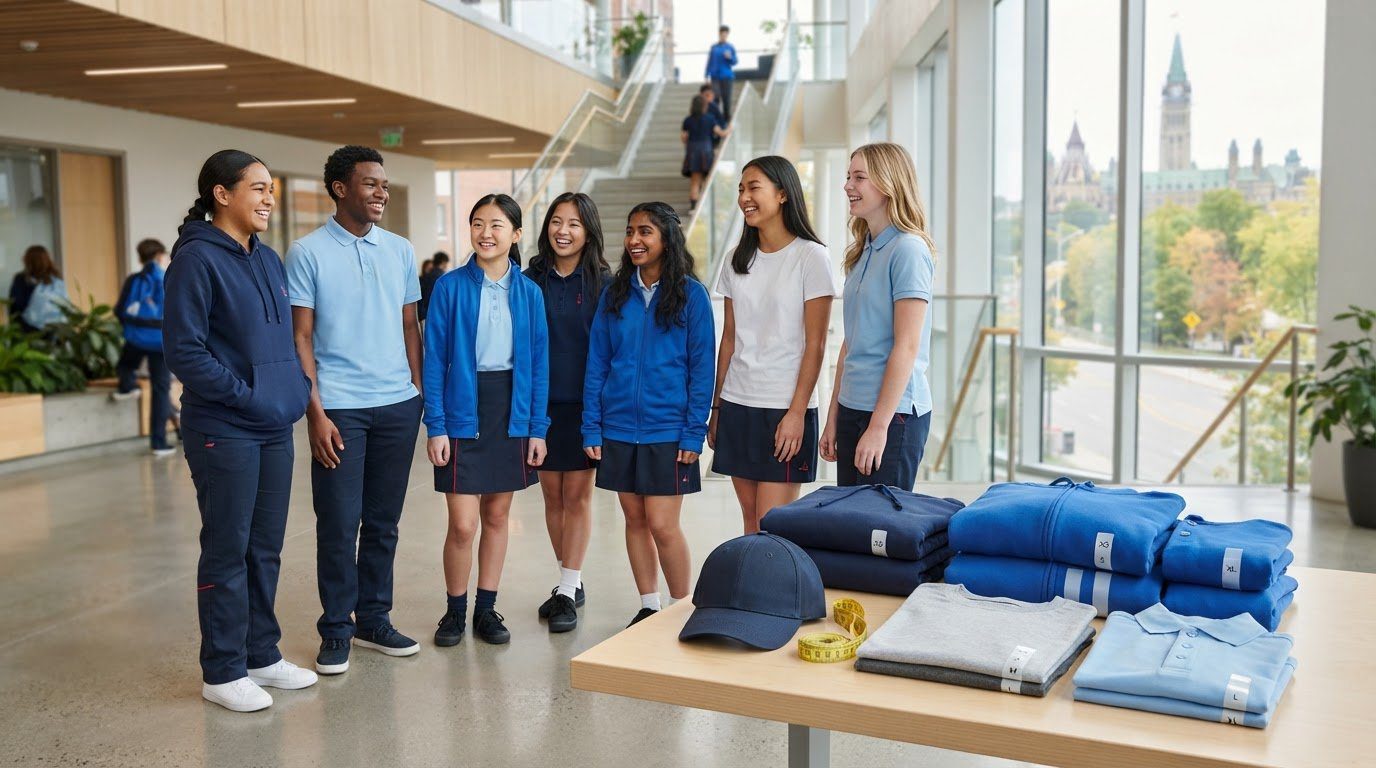
Give employees a structured role by asking representatives from different jobs or shifts to review garment options and report back. Ask them to assess practical details such as sleeve length, pocket placement, fabric feel, and whether the uniform works with required protective equipment. If possible, let staff handle sample garments and try on a range of sizes before giving feedback. This helps surface fit and task-related concerns early.
What questions to ask staff before introducing a uniform policy?
Ask what employees need their clothing to do during a typical shift. Useful questions include: “Which tasks make your current clothing uncomfortable or impractical?”, “Do you need extra pockets or room for layers?”, and “What sizing or fit concerns should we consider?” Also ask how uniforms will work across different roles and seasons, and what would make the policy easier to follow. Invite honest answers without asking staff to justify personal preferences.
How to pilot new uniforms and gather employee feedback?
Run a small trial with employees who represent different roles, then collect feedback after they’ve worn the garments during real work. Ask about fit, comfort, movement, laundering, and whether the uniform suits the tasks performed. An Ottawa employer could use Printwell Canada custom T-shirts for a pilot, then gather comments through a short form or check-in. Record recurring issues and decide what to adjust before ordering for the wider team.