 A Proud Canadian Company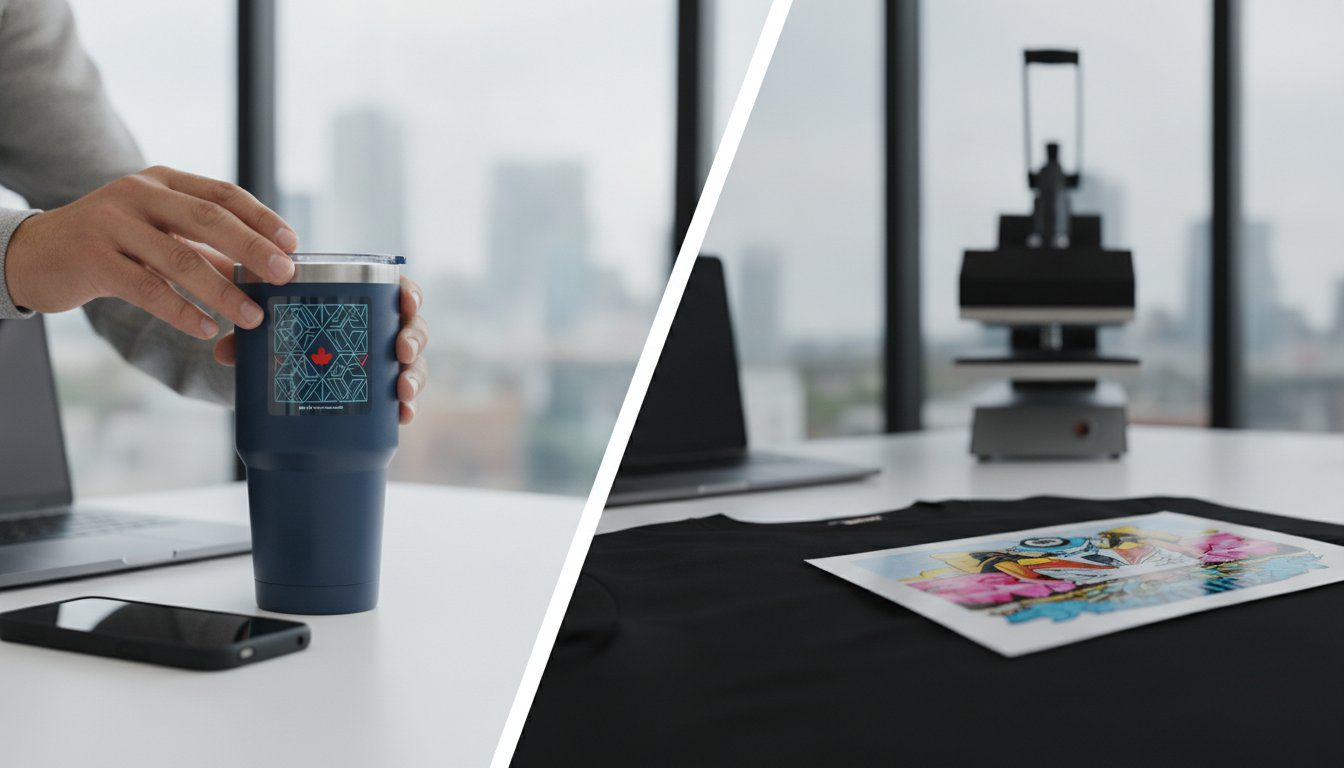
What if the most durable branding tool in your kit didn’t require a heat press or a complex industrial setup? Many Canadian entrepreneurs realize that while standard DTF is a powerhouse for apparel, applying that same logic to hard goods often leads to peeling decals and faded logos. If you’ve ever watched a carefully applied sticker lift off a stainless steel tumbler or a piece of tech gear, you know the frustration. This is where uv dtf changes the game. It offers a permanent-feeling solution that combines the vibrant colours of digital printing with the rugged resilience of industrial finishes.
We understand that you want your promotional items to look as professional as the services you provide. You need branding that stays put, looks sharp, and stands up to daily wear. This guide promises to clarify the confusion between these two popular technologies so you can make the best choice for your 2026 projects. We will explore the technical specifications, compare long-term durability standards, and highlight the best applications to help your brand leave a lasting impression on any surface.
Key Takeaways
- Learn how uv dtf technology uses ultraviolet-curable ink and a protective varnish layer to create professional-grade transfers for hard goods.
- Distinguish between standard DTF for textiles and UV DTF for hard substrates, ensuring you choose the right method for your specific branding project.
- Identify the best applications for hard-surface transfers, from personalizing stainless steel tumblers to branding tech accessories like laptops and phone cases.
- Understand the essential durability standards and care tips required to keep your vibrant colours looking sharp and scratch-resistant for the long term.
- Discover how to organize gang sheets to maximize your budget while maintaining high-quality, professional results.
What is UV DTF Printing? A Modern Branding Solution
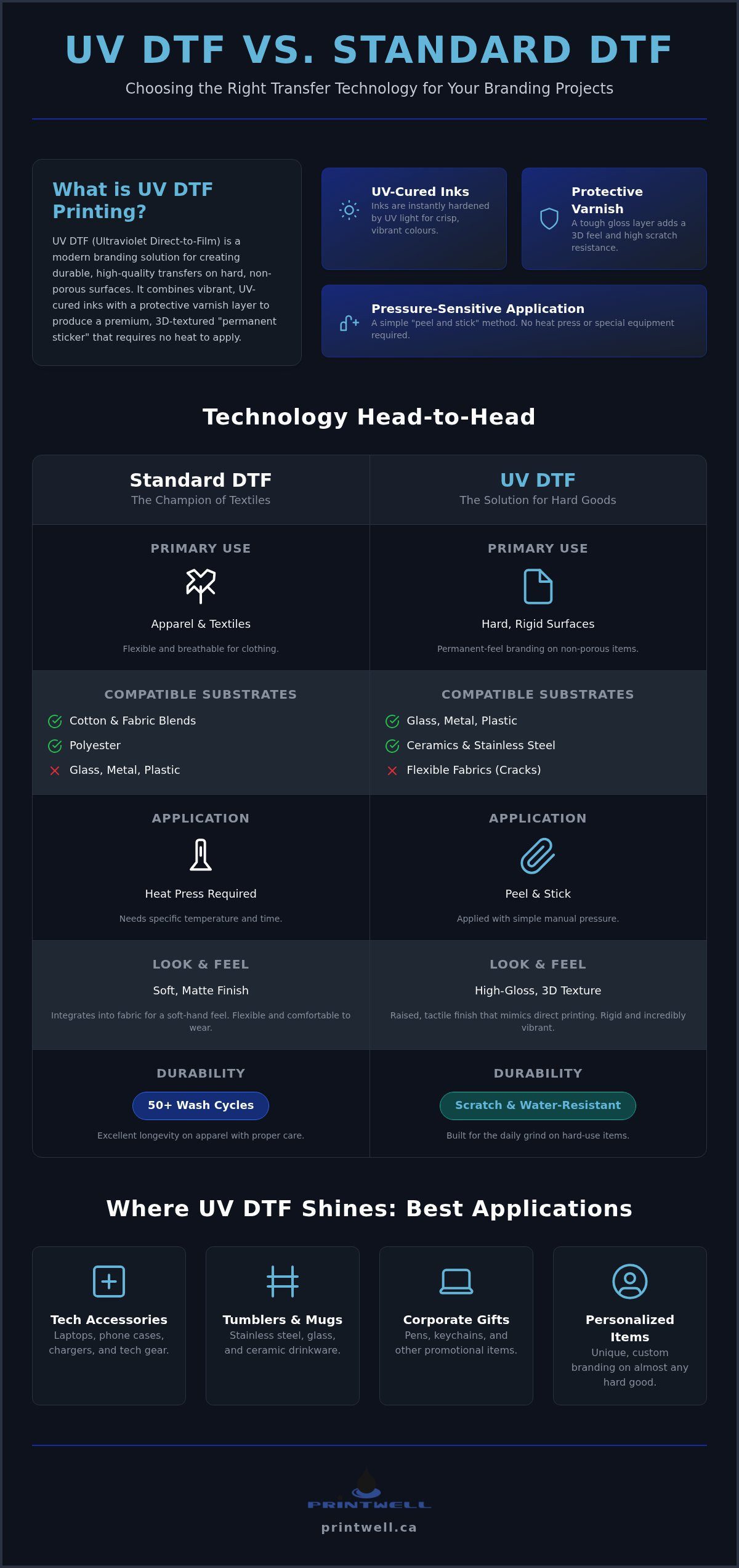
UV DTF stands for Ultraviolet Direct-to-Film. It’s a modern branding solution that uses UV-curable inks to create durable, high-quality transfers for a wide range of promotional items. Unlike the traditional Direct-to-film (DTF) printing process that focuses primarily on apparel and textiles, this method is a pressure-sensitive transfer solution designed specifically for non-porous surfaces. It combines vibrant ink, a protective gloss varnish, and a high-strength adhesive into a single, efficient step. The result is a high-gloss, 3D-textured sticker that mimics the look and feel of direct-to-object industrial printing.
This technology is a game-changer for Canadian brands looking to customize hard goods without investing in massive machinery. It delivers a premium finish that is tactile, vibrant, and incredibly tough. When you run your fingers over a finished uv dtf transfer, you can feel the raised edges of the ink and varnish. It provides a level of professional sophistication that standard vinyl decals simply cannot match. By utilizing this process, you can achieve a permanent-feeling brand presence on items that were previously difficult or expensive to decorate.
How the UV Curing Process Works
The magic happens the moment the ink hits the film. Industrial print heads deposit the UV-curable ink alongside a specialized varnish layer. As the film passes through the printer, powerful ultraviolet lights instantly harden the liquids into a solid, durable film. This rapid transition ensures that the colours remain crisp, the fine details stay sharp, and the adhesive remains potent. The addition of the varnish layer is critical; it acts as a transparent suit of armour that provides superior scratch resistance and a brilliant shine. This instant curing means the transfers are ready for application almost immediately, helping you organize your production workflow with confidence.
Pressure-Sensitive vs. Heat-Applied Transfers
One of the most significant advantages of uv dtf is the ease of application. Standard DTF transfers require a heat press, specific temperature settings, and precise timing to bond with fabric fibres. In contrast, these transfers are pressure-sensitive. They utilize a simple “peel and stick” mechanism that requires nothing more than manual pressure or a firm rub with a squeegee. This makes the technology accessible to businesses of all sizes, from small boutiques to large-scale manufacturers. These transfers create an incredibly strong bond on a variety of materials, including glass, metal, and plastic. Whether you are branding a stainless steel tumbler or a plastic laptop lid, the adhesive ensures your logo stays exactly where you put it.
UV DTF vs. Standard DTF: Comparing the Two Technologies
While both technologies share the “Direct-to-Film” name, they serve entirely different masters. Standard DTF is the undisputed champion of the textile world. It provides a soft, matte finish that integrates seamlessly with fabric fibres. In contrast, uv dtf is the definitive solution for hard substrates, delivering a high-gloss, raised texture that makes logos pop on everything from corporate gift mugs to tech gear. The application process also sets them apart. Standard transfers require a heat press, specific temperature settings, and precise timing. UV transfers are pressure-sensitive, meaning you can apply them by hand or with a squeegee for an instant, professional bond.
Substrate Compatibility: Where Each Method Wins
Standard DTF is the king of cotton, polyester, and various fabric blends. It’s designed to be flexible, breathable, and comfortable against the skin. However, it simply cannot bond to non-porous surfaces because it relies on the heat-activated adhesive melting into fabric weaves. This is where uv dtf shines. It is the only viable choice for glass, ceramics, and stainless steel. It creates a “permanent sticker” effect that feels like it was printed directly onto the object. It’s important to remember that these methods are not interchangeable. Because the UV-cured ink is rigid, it cannot be used on flexible fabrics as the design would eventually crack and peel under tension.
Durability and Longevity Factors
Longevity is a hallmark of both methods, as highlighted in the State of the DTF Market Report. A high-quality standard DTF transfer can withstand 50 or more wash cycles on clothing without significant fading or cracking. UV DTF transfers are built for the daily grind of hard-use items. They are scratch-resistant, water-resistant, and stand up well to the unique challenges of the Canadian climate. Whether your branded gear is exposed to the summer sun or the winter cold, the protective varnish layer keeps the vibrant colours from fading. For brands looking to elevate their custom mugs and hard goods, this durability ensures the logo remains visible and professional for the long haul.
When analyzing cost, both methods offer significant advantages for small to medium runs. Traditional printing methods often require high setup fees or minimum order quantities that don’t make sense for limited editions. Both DTF variants allow you to print small batches or even single units without breaking the bank. For bulk promotional orders, the speed of application with UV transfers makes them highly efficient. You can easily organize your production schedule to brand a hundred water bottles in an afternoon without once turning on a heat press. This efficiency lowers your overall labour costs while maintaining a premium look that rivals expensive industrial pad printing.
Where UV DTF Shines: Best Applications for Hard Surfaces
UV DTF technology isn’t just a technical upgrade; it’s a strategic shift for how Canadian businesses handle hard-surface branding. You no longer need a massive pad printer or a laser engraver to get professional results on stainless steel tumblers or water bottles. This process allows you to apply vibrant, durable logos to a variety of items right at your desk. It eliminates the high setup costs typically associated with direct-to-object printing, making it accessible for projects of any size. By removing the need for specialized machinery, you can focus on the creativity and quality of your brand presentation.
Personalizing tech gear is another area where this technology excels. Laptops, phone cases, and power banks become premium brand touchpoints with ease. For local makers and small-batch creators, it’s a genuine game-changer. Artisanal candles and apothecary jars look elevated with high quality DTF stickers that provide a sophisticated “no-label” look. The 3D texture adds a tactile quality that makes retail packaging feel expensive and intentional. It turns a simple container into a piece of craftsmanship that customers want to keep.
Promotional Products and Corporate Gifting
Elevating custom promotional products in Canada has historically required large bulk orders to justify industrial setup fees. uv dtf changes that math entirely. It’s perfect for employee recognition gifts because it supports low-minimum orders without sacrificing visual impact. You can maintain perfect branding consistency across metal tumblers, wooden desk organizers, and plastic tech gadgets. The 3D logos catch the light and invite touch, making your corporate gifts stand out from standard flat-printed items. It transforms a simple giveaway into a memorable token of appreciation that reflects your brand’s commitment to quality.
Industrial and Signage Uses
Beyond the world of gifts and retail, uv dtf serves a vital role in practical industrial settings. Labelling equipment and tools with permanent, high-visibility serial numbers becomes a straightforward task. These transfers stand up to the rigours of busy office environments and high-traffic retail spaces where standard vinyl stickers would quickly fail. You can also create small-scale architectural signage or custom office door nameplates with professional ease. The adhesive bond is strong enough to handle daily cleaning and minor abrasions, ensuring your safety labels and directional signs remain legible and professional for years to come.
Durability Standards: Is UV DTF Really Permanent?
When Canadian brands ask if uv dtf is truly permanent, the answer lies in the chemistry of the cure. These are not standard paper decals that peel at the first sign of friction. They are robust, multi-layered films designed to endure the rigours of daily use. One critical factor for success is patience; the specialized adhesive reaches its maximum bond strength 24 hours after application. Giving the transfer this window to set ensures it grips the substrate with industrial-level tenacity, making it nearly impossible to remove without intentional effort.
Daily wear is the ultimate test for any branding solution. Whether it is the constant friction of a laptop sliding into a bag or the natural oils from a person’s hands on a water bottle, these transfers hold their ground. The UV-cured ink is chemically stable. This means your logo won’t run or smear when exposed to common cleaning agents or alcohol-based wipes. We often get asked about dishwasher safety. While the bond is incredibly strong, the intense heat and aggressive detergents of a dishwasher can eventually compromise the edges. To keep your branding looking pristine for years, we always recommend hand-washing as the gold standard for care.
The Varnish Advantage
The clear varnish layer is the secret weapon of this technology. It acts as a transparent shield, protecting the underlying CMYK ink from environmental wear and tear. This layer creates a subtle domed effect that adds depth and dimension to your logo. This tactile quality significantly boosts brand perception, making the item feel like a premium, custom-manufactured product. While different film manufacturers offer varying gloss levels, the result is always a high-impact finish that catches the light and invites touch. If you want to see this quality firsthand, you can order custom UV DTF transfers and test the finish on your own products.
Weather Resistance in Canada
In Canada, we deal with some of the most extreme temperature fluctuations on the planet. From the biting cold of a Prairie winter to the humid heat of an Ontario summer, materials expand and contract constantly. High-quality uv dtf transfers are engineered to be UV stable, which prevents the varnish from yellowing or the colours from fading under direct sunlight. This stability makes them a reliable choice for items that spend time outdoors or near bright windows. The cured film remains slightly flexible enough to handle the expansion and contraction of metal and glass surfaces without cracking or losing its grip.
Getting Started: Ordering UV DTF Transfers in Canada
Ready to bring your designs to life? The first step involves preparing high-resolution vector files. Because uv dtf captures incredible detail, low-quality raster images often lead to blurry edges or pixelated gradients. Using vector formats ensures your logo remains sharp at any scale. It allows our printers to interpret the exact boundaries of your design, resulting in a crisp, professional finish that reflects the quality of your brand. When your artwork is clean and precise, the final transfer carries that same level of craftsmanship to your products.
Efficiency is key to a profitable branding strategy. We recommend utilizing the power of the gang sheet to maximize your budget. By grouping multiple designs, sizes, or logos onto a single transfer sheet, you reduce waste and lower your cost per unit. This approach is particularly effective for businesses that need a variety of branding sizes for different products, from small tech decals to larger signage elements. It’s an industrious way to organize your ordering process while ensuring you have every logo you need for a complete product line.
Applying your transfers is a straightforward process that anyone can master. First, clean the surface of your object with isopropyl alcohol to remove any oils or dust. Second, carefully align your transfer to ensure it is straight. Third, apply firm pressure across the entire design using your thumb or a squeegee. Finally, slowly peel back the carrier film to reveal your vibrant, 3D-textured branding. This simple method provides a permanent-feeling result without the need for complex equipment or high-heat tools.
Artwork and File Preparation Tips
To ensure your design pops on dark or transparent surfaces, you must manage the “White Ink” layer correctly. Our systems use a base layer of white ink to provide opacity and colour accuracy. We suggest maintaining a minimum line thickness of 1pt for fine-detail logos to ensure the adhesive and varnish layers have enough surface area to bond securely. Always use CMYK colour profiles to match Canadian brand standards; this ensures the colours you see on your screen translate perfectly to the final physical product without unexpected shifts in tone.
Why Order from a Canadian Provider?
Choosing a local partner for your branding needs offers more than just patriotic pride. Ordering from within Canada allows you to avoid the headache of unexpected cross-border duties and the long shipping delays often associated with international suppliers. You receive personalized customer service from experts who understand the local market and take personal responsibility for your project’s success. By combining these hard-surface solutions with custom DTF transfers for your apparel, you create a cohesive and professional brand identity across all your assets. Ready to upgrade your branding? Explore our UV DTF options at Printwell Canada and see how easy it is to elevate your promotional products with professional, durable transfers.
Take Your Branding Beyond the Fabric
The choice between these two technologies depends entirely on your specific substrate. While standard DTF remains the undisputed king of soft textiles, uv dtf offers a transformative solution for your hard-surface branding needs. It bridges the gap between simple stickers and expensive industrial printing by providing a durable, 3D-textured finish that stands up to the daily grind. You don’t need a heat press or specialized machinery to achieve professional results. You only need a clean surface and a clear vision for your brand’s visibility.
We take immense pride in helping Canadian businesses navigate these modern tools with confidence. Our team provides expert support for file preparation and gang sheet optimization to ensure your designs look sharp while maximizing your budget. With high-resolution prints and fast nationwide shipping, we make it easy to maintain a consistent, premium look across all your promotional gear. We are ready to help you make a lasting impression from coast to coast.
Get Started with Premium UV DTF Transfers at Printwell Canada
Your craftsmanship deserves a finish that reflects the quality of your work. We look forward to seeing how these permanent-feeling transfers elevate your next project.
Frequently Asked Questions
Can UV DTF transfers be used on t-shirts or other clothing?
No, uv dtf transfers are designed specifically for hard, non-porous substrates and are not suitable for fabrics. Because the UV-cured ink is rigid, it cannot stretch or flex with the natural movement of a t-shirt or hoodie. For apparel branding, you should use standard DTF transfers which are engineered to bond with fabric fibres and withstand regular laundry cycles.
Are UV DTF stickers dishwasher safe for coffee mugs and tumblers?
While these transfers have incredible bond strength, we always recommend hand-washing to ensure the longest possible life for your branded mugs and tumblers. The high heat and aggressive chemicals found in many dishwashers can eventually weaken the adhesive edges over time. Hand-washing keeps the varnish layer glossy and ensures the 3D texture remains intact for years of daily use.
Do I need a heat press to apply UV DTF transfers?
You do not need a heat press or any specialized heating equipment to apply these transfers. They are entirely pressure-sensitive; you simply peel the backing, place the design on your clean surface, and rub it firmly with your thumb or a squeegee. This “peel and stick” nature makes it an ideal solution for small businesses that want professional results without investing in industrial machinery.
How long do UV DTF transfers last on outdoor surfaces?
You can expect these transfers to last approximately 2 to 3 years when used on outdoor surfaces in the Canadian climate. For indoor applications where the design is protected from direct environmental stress, the lifespan typically extends to 3 to 5 years. The protective varnish layer provides excellent UV stability, which helps prevent the colours from fading or the film from yellowing under direct sunlight.
What is the difference between a UV DTF transfer and a regular vinyl sticker?
Unlike a regular vinyl sticker that has a visible background film, uv dtf transfers leave only the ink and varnish on the surface. This creates a “direct-to-object” look that feels like it was printed as part of the item. Additionally, the UV curing process creates a raised, 3D texture and a much harder finish than standard vinyl, providing a more premium and tactile brand experience for your customers.
Can I apply UV DTF to curved or irregular surfaces?
Yes, you can apply these transfers to curved surfaces like water bottles or rounded jars with excellent results. However, because the cured film is relatively rigid, it is best suited for single-curve surfaces rather than complex, multi-dimensional spheres. For the best bond, ensure the surface is thoroughly cleaned with isopropyl alcohol before you begin the application process to remove any oils or dust.
What file format is best for ordering UV DTF gang sheets?
High-resolution vector files are the gold standard for ordering gang sheets. Formats like PDF, AI, or EPS allow for the crispest possible edges and ensure your white ink and varnish layers are placed with perfect precision. If you are using raster images, ensure they are at least 300 DPI at the final print size to avoid any pixelation or loss of detail in your finished transfers.
Is there a minimum order quantity for UV DTF transfers in Canada?
One of the greatest benefits of this technology is its accessibility for small-batch projects and limited editions. While many traditional printing methods require large minimums to cover setup costs, this process allows for much more flexible ordering. You can often order a single gang sheet to test multiple designs at once, making it a cost-effective way to brand a small run of artisanal products or corporate gifts.