 A Proud Canadian Company
With the Canadian streetwear market reaching a record $3.2 billion CAD in 2026, the demand for professional, retail-ready apparel is higher than ever. It’s exhausting to manage high setup fees for small orders or spend hours weeding vinyl only to watch a print crack after a few washes. You can avoid these common pitfalls by using custom DTF transfers to produce high-quality garments that represent quality, durability, and local pride. We understand that every shirt you press is a reflection of your commitment to excellence.
This resource will show you how to create vibrant, full-colour designs with a soft-hand feel that your customers will love. You’ll discover how to maximize your production budget using cost-effective gang sheets while ensuring your products meet the updated 2026 OEKO-TEX safety standards. We’ll guide you through the technical essentials, bulk ordering strategies, and the “Made in Canada” advantages that will help your business stand out in a competitive market. It’s time to elevate your brand with a solution that is accessible, reliable, and straightforward.
Key Takeaways
- Discover why the direct-to-film process is the modern standard for creating vibrant, full-colour, and professional-grade apparel that represents your brand with pride.
- See how custom DTF transfers outshine traditional methods by offering superior detail, better durability, and a softer feel.
- Learn to maximize your budget and reduce waste by organizing multiple designs onto a single, high-efficiency gang sheet.
- Master the specific heat press settings needed to ensure your designs remain crisp, vibrant, and crack-free for over 50 wash cycles.
- Identify the key quality markers for sourcing reliable Canadian suppliers who deliver fast shipping, high-resolution results, and dedicated support.
What are Custom DTF Transfers? The Modern Standard for Apparel Decoration
Direct-to-film (DTF) printing is a revolutionary method that has transformed how we think about apparel branding in Canada. It relies on three essential components: vibrant water-based inks, premium PET film, and a specialized TPU adhesive powder. Together, these elements create a durable, flexible, and high-resolution graphic that can be applied to almost any fabric. For Canadian business owners, using custom DTF transfers means moving away from the limitations of traditional methods and embracing a process that delivers professional results every time. It’s a system designed for quality, reliability, and visual impact.
The “transfer” element is the true innovation here. Unlike direct-to-garment (DTG) printing, where the ink is applied directly to the shirt, DTF allows you to store your designs on film until they’re needed. This shift is a game-changer for inventory management. You don’t have to pre-print dozens of shirts in every size and colour. Instead, you can keep a stock of transfers ready to go; you press them only when an order comes in; you reduce waste while increasing your product variety. This flexibility allows small brands to remain agile and responsive to customer trends without carrying the burden of unsold stock.
As of 2026, the technology has evolved significantly to offer a much softer, more breathable “hand-feel” than early iterations. Modern transfers are thin, lightweight, and incredibly flexible. They move with the fabric rather than sitting on top of it like a heavy plastic shield. This makes them ideal for everything from high-performance athletic wear to premium streetwear hoodies. When you use high-quality custom DTF transfers, you’re providing a garment that feels as good as it looks.
The DTF Process: From Digital Art to Finished Garment
The journey begins with your digital art being printed in reverse onto a translucent PET film. A layer of white ink is printed over the colours to provide a solid base, followed by the application of a TPU adhesive melt powder. This powder is what creates the permanent bond between the ink and the textile. Finally, the film is cured through a specialized oven or heat press, making the design stable, smudge-proof, and ready for transport across Canada. It is an organized, methodical process that ensures every detail of your original design is preserved.
Why Canadian Brands are Switching to DTF Transfers
Many local brands are making the switch to DTF because the traditional barriers to entry have vanished. This method provides several practical advantages:
- You eliminate the need for expensive screen setups, messy emulsions, or darkroom equipment.
- You gain access to unlimited colour palettes and complex gradients without the “per-colour” pricing that makes screen printing so costly for small runs.
- You benefit from superior stretchability; these prints don’t crack or peel when the fabric is pulled, which is a common failure point for traditional heat-transfer vinyl.
DTF vs. Screen Printing and Vinyl: Choosing the Right Method
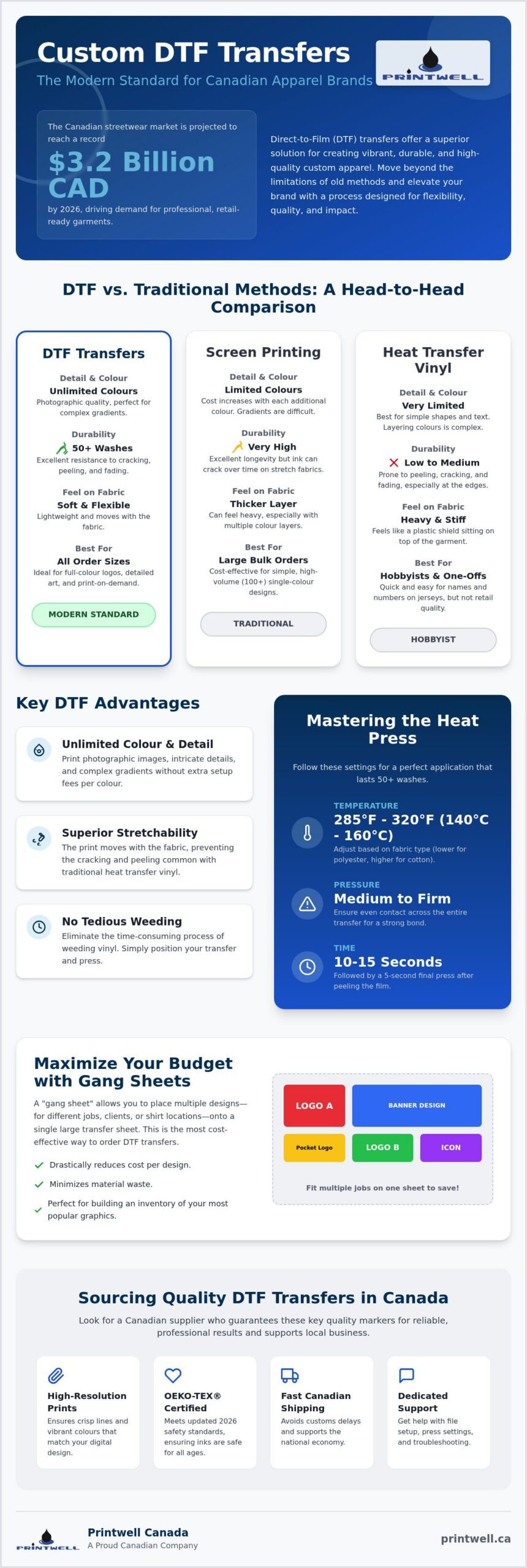
Selecting the ideal decoration method is a balance between visual quality, production speed, and long-term value. While screen printing has been a traditional staple in Canada, custom DTF transfers provide a level of detail that manual screens simply cannot replicate. Screen printing requires a separate setup for every colour; this drives up costs for complex, multi-coloured designs. In contrast, DTF handles high-resolution gradients and photographic details with precision. When you consider the impact of new manufacturing technologies on the local apparel industry, it is clear that digital agility is becoming the new standard for growing brands.
Durability is often the deciding factor for professional branding. High-quality transfers are engineered to be vibrant, flexible, and resilient. Industry wash-testing confirms that these prints hold up against 50+ wash cycles without significant cracking or fading. This performance rivals traditional screen printing and far exceeds standard heat-transfer vinyl, which often peels at the edges after a few months of wear. You get a product that is built to last; your customers receive a garment they can trust; your brand reputation remains intact.
The “weeding” factor is another area where DTF shines. If you have ever worked with vinyl, you know that picking away tiny bits of excess material is a notorious bottleneck. Custom DTF transfers eliminate this labour-intensive step entirely. The adhesive only bonds where the ink is present. You save hours of labour; you increase your daily output; you reduce the risk of human error during production. This efficiency makes it the most cost-effective choice for small to medium production runs where screen printing setup fees are too restrictive.
Performance on Different Fabrics: Cotton, Poly, and Blends
DTF is a truly universal solution for Canadian decorators. It excels on 100% polyester performance wear, a fabric that often presents challenges for other printing methods. On cotton blends, you can achieve a soft, vintage look, or maintain high-opacity on dark fabrics without a thick, plastic feel. These transfers also provide a reliable barrier against dye migration on sublimated garments. This ensures your white logos stay crisp and bright rather than absorbing the underlying fabric dye. If you are looking to branch out into different textures, custom embroidery remains an excellent premium alternative for structured corporate uniforms and hats.
The Environmental and Practical Benefits
Sustainability is a growing priority for Canadian consumers and business owners alike. DTF printing significantly reduces water waste compared to the intensive chemical reclamation processes required in traditional screen printing. Practically, it is also a major space-saver. You can store hundreds of designs in a single drawer rather than filling shelves with pre-printed inventory. This organized approach allows you to scale your business without expanding your physical footprint. To see how these benefits can work for your specific project, you might want to browse our transfer options to find the right fit for your next run.
Maximizing Your Investment: The Art of the DTF Gang Sheet
A gang sheet is essentially a master template that allows you to organize multiple designs onto a single roll of film. By grouping different logos, sizes, and graphics together, you maximize every square inch of the material. This strategic layout is the most effective way to realize significant cost savings on custom DTF transfers. Instead of ordering individual prints, you pay for the space on the sheet; you fill that space with as much art as possible; you drive down your unit cost. You save time, you reduce waste, and you increase your profit.
To truly master the gang sheet, you must think like an artisan. Nest small logos between larger back graphics. Add neck labels, sleeve prints, or hem tags into the empty gaps that would otherwise go to waste. This approach ensures you are getting the highest possible yield from your order. It turns a standard production run into a highly efficient branding kit. When you calculate your final price-per-print, you will see a healthier profit margin that allows your Canadian brand to remain competitive and profitable.
Technical Requirements for High-Resolution Prints
Professional results require professional files. When sourcing custom DTF transfers, precision in your file setup is what separates a hobbyist from a professional. A resolution of 300 DPI is a non-negotiable standard to ensure your designs remain crisp and clear. Lower resolutions often result in fuzzy or pixelated edges that can ruin the look of a premium garment. Additionally, you must manage transparency carefully in your PNG files. Any stray pixels or semi-transparent glows can lead to unwanted white outlines during the printing process. For accurate Canadian branding, always use CMYK colour profiles to ensure the final product matches your digital vision.
Preparing Your Files for Printwell Canada
At Printwell Canada, we want your project to be a success from the first press. Follow this checklist to ensure your files are ready for production:
- Ensure all backgrounds are fully transparent.
- Keep lines at a minimum thickness of 0.02 inches to ensure proper adhesive bonding.
- Do NOT mirror your designs; our software handles the reversal for you.
- Double-check your dimensions to ensure they fit within the sheet boundaries.
Avoiding these common mistakes will save you time and prevent production delays. If you are looking to expand your branding beyond apparel, consider our high quality DTF stickers for your promotional packaging and hard-surface needs. Taking the time to prepare your files correctly ensures that the final product is a faithful representation of your brand’s quality and craftsmanship.
Application Guide: Mastering the Heat Press
The application phase is where your digital vision becomes a physical reality. While the quality of your custom DTF transfers is paramount, the final result depends entirely on the precision of your heat press technique. Think of the heat press as your primary tool of the trade; it provides the consistent temperature and even pressure that a home iron simply cannot replicate. A home iron has hot spots and lacks the heavy, vertical force needed to drive the adhesive into the fabric fibres. To achieve a retail-ready finish that lasts, investing in a reliable heat press is a non-negotiable step for any serious Canadian brand.
Success lies in finding the “Goldilocks” zone: the perfect balance of temperature, pressure, and time. For most standard garments, you should aim for a temperature between 150°C and 160°C with medium-to-firm pressure for approximately 12 to 15 seconds. If the pressure is too light, the bond will be weak; if the heat is too high, you risk scorching the fabric. You must also identify whether you are using a hot peel or cold peel film. Most premium transfers in the Canadian market are cold peel, meaning you must allow the garment to cool completely before removing the film. This patience ensures the adhesive has fully solidified, resulting in a crisp, clean transfer every time.
One of the best-kept secrets among master printers is the “Second Press.” After you have peeled the film, place a sheet of parchment paper or a Teflon sheet over the design and press it again for 5 to 8 seconds. This simple step serves two purposes. It further embeds the ink into the textile for maximum durability; it also removes the plastic-like sheen of the film to create a sophisticated matte finish with a soft-hand feel. This small extra effort is what separates a basic t-shirt from a premium brand garment. If you are ready to start your next project, you can order your custom transfers here to experience this quality firsthand.
Fabric-Specific Heat Press Settings
If your design isn’t sticking, the culprit is almost always insufficient pressure or a cold platen. Ensure your press is fully up to temperature before starting your run. If you notice “halos” or adhesive residue, you may be using too much pressure or excessive heat. When working with difficult areas like seams, pockets, or zippers, use a heat press pillow to lift the printing surface. This ensures the heating element makes full, flat contact with the transfer, realizing a perfect bond even on the most challenging garment structures.
Sourcing the Best Custom DTF Transfers in Canada
Choosing a local partner for your branding needs is about more than just convenience; it’s about business continuity and reliability. When you source custom DTF transfers within Canada, you bypass the complexities of international customs, avoid unpredictable border delays, and support the domestic economy. A Canadian-owned business understands our specific market conditions and the unique needs of brands from coast to coast. You get faster delivery; you avoid hidden import fees; you receive products designed for our local standards. It is a practical, patriotic choice that ensures your production line never stops moving.
Quality isn’t a suggestion in the apparel industry; it’s a requirement for survival. When evaluating a supplier, you should look for high-resolution 300 DPI print standards, consistent colour accuracy, and accessible customer support. A true partner provides more than just a product; they provide technical expertise and a genuine commitment to your success. We recommend ordering a sample pack to test durability and colour vibrance on your specific fabric blends before committing to a large run. It’s the most reliable way to ensure the final result matches your professional standards and represents your brand with pride. For a deeper dive into the full production workflow, our complete 2026 guide to DTF prints in Canada walks you through every step from file preparation to finished garment.
At Printwell Canada, we blend professional confidence with a master artisan’s touch. We take personal responsibility for every project, ensuring your designs are printed with precision and care. Our team is industrious, modern, and highly organized, yet we retain the human touch that makes collaboration easy. We act as your friendly guide through the technical world of apparel decoration, helping you navigate choices with straightforward, helpful advice. We believe that high-quality branding should be accessible to every Canadian business, regardless of their size or industry.
Nationwide Shipping: From Coast to Coast
We offer fast nationwide shipping across all provinces, ensuring your business stays on schedule from the Atlantic to the Pacific. Our packaging standards are rigorous to protect your investment during transit. We ship transfers flat and moisture-free to prevent any environmental damage or curling before they reach your heat press. This reliability allows you to scale your business with confidence, knowing your production partner is as committed to your deadlines as you are. Whether you are in a major city centre or a smaller community, we ensure your tools arrive ready for application.
Beyond Apparel: Expanding Your Brand with DTF
Your brand identity shouldn’t be limited to t-shirts and hoodies. By utilizing specialized transfers, you can apply your logos to hard surfaces like custom mugs, tech accessories, and business cards to create a cohesive brand experience. This thoughtful, intentional approach allows your apparel to match your promotional items perfectly. It’s a modern way to elevate your professional image and ensure your message is visible across multiple touchpoints. Realize your brand vision with custom DTF transfers from Printwell Canada today!
Ready to Elevate Your Canadian Brand?
Building a successful apparel brand in Canada requires the right tools, a bit of patience, and a reliable partner. You now have the knowledge to master custom DTF transfers; you understand how to optimize gang sheets for profit; you know the secrets to a perfect heat press finish. These technical skills allow you to move past the high costs of screen printing and the labour of vinyl weeding. By focusing on high-resolution quality and durable application, you can create garments that truly resonate with your audience and stand the test of time.
At Printwell Canada, we are here to support your growth with 300 DPI high-resolution prints and no setup fees on gang sheets. We take pride in our craftsmanship; we ensure your orders arrive flat and ready for use with fast nationwide shipping. It’s time to turn your digital designs into a professional reality that you can be proud of. Order Your Custom DTF Transfers from Printwell Canada and start building your legacy today. We are ready and eager to assist you with your next project.
Frequently Asked Questions
How long do custom DTF transfers last on a t-shirt?
High-quality transfers typically last for 50 or more wash cycles before any noticeable fading or cracking occurs. This durability makes them a reliable choice for professional streetwear and workwear that needs to withstand regular use. By following proper care instructions, you ensure your designs stay vibrant and intact for the entire lifespan of the garment. It’s a level of quality that builds long-term trust with your customers.
Do I need a special printer to use DTF transfers?
You do not need to invest in an expensive specialized printer to utilize this technology for your brand. We manage the complex printing, curing, and adhesive application using our industrial-grade equipment. This allows you to receive ready-to-press film that you can apply with a standard heat press. It’s a low-barrier way to achieve professional results without the high overhead costs of manufacturing the prints yourself.
Can I apply DTF transfers with a regular home iron?
A professional heat press is required to achieve a permanent and reliable bond between the transfer and the fabric. While a home iron can generate heat, it lacks the consistent temperature control and heavy, vertical pressure needed to properly activate the adhesive. Using a press ensures your custom DTF transfers don’t peel or crack after the first few washes, protecting your brand’s reputation for high-quality craftsmanship.
What is the minimum order for custom DTF transfers in Canada?
We offer flexible ordering options with low minimums to help Canadian small businesses grow without the burden of excessive inventory. Whether you need a single custom design for a prototype or a full gang sheet for a production run, our system is designed to be accessible. This approach allows you to scale your business at your own pace while maintaining healthy profit margins on every garment you produce.
How do I wash a garment with a DTF print to ensure it lasts?
The best way to care for a DTF-printed garment is to wash it inside out in cold water and hang it to dry or use a low-heat dryer setting. You should avoid using aggressive bleaches or liquid fabric softeners, as these can weaken the adhesive bond over time. Taking these simple steps will keep your designs looking crisp, vibrant, and professional for many years to come regardless of the fabric type.
What is the difference between a standard transfer and a gang sheet?
A standard transfer consists of one individual design, whereas a gang sheet allows you to organize multiple graphics onto a single roll of film. Ordering custom DTF transfers on a gang sheet is the most strategic way to maximize your budget. You can mix and match different logos, neck labels, and sleeve prints to fill every square inch of the film, significantly reducing your total cost per print.
Are DTF transfers better than screen printing for small businesses?
DTF is often the superior choice for small businesses because it removes the high setup costs and screen fees associated with traditional printing. It allows you to produce full-colour, photographic designs on demand without worrying about minimum order quantities. This flexibility is essential for brands that want to offer a wide variety of designs without the financial risk of holding large amounts of unsold stock.
Can DTF transfers be applied to hats and bags?
You can absolutely apply these transfers to hats, bags, and other non-apparel items made from heat-resistant fabrics. They are perfect for branding polyester tote bags, cotton caps, and even nylon backpacks. To get the best results on curved or structured surfaces, we recommend using a specialized hat press or a heat press pillow to ensure even contact and a perfect bond across the entire design area.