
 A Proud Canadian Company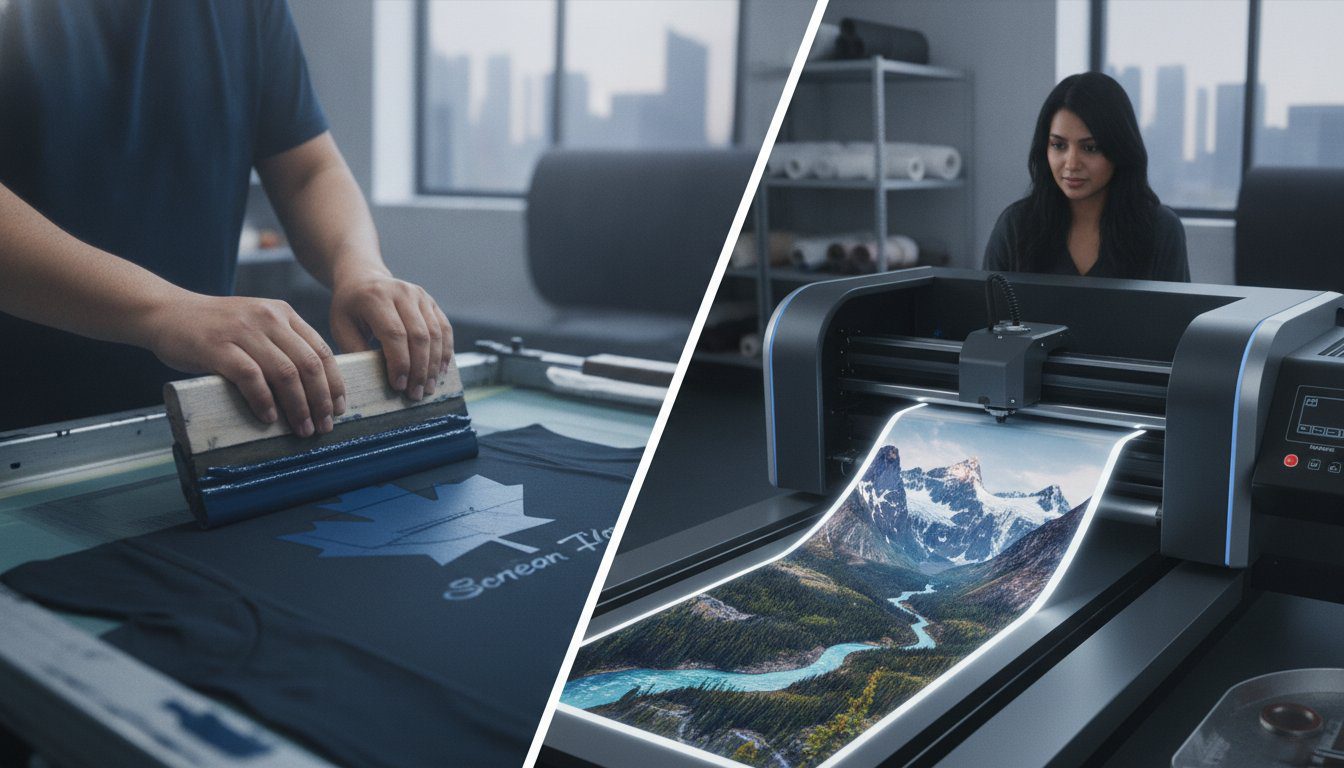
The traditional screen printing press is no longer the undisputed king of the Canadian custom apparel industry. For years, you probably felt that achieving professional, retail-quality designs required massive bulk orders and those dreaded setup fees for every single colour in your logo. It’s a common headache to see your budget eaten up by screen charges before the first garment is even loaded. When comparing DTF vs screen printing Canada for your 2026 projects, the right choice depends on your needs for vibrance, volume, and long-term value.
This guide promises to simplify your decision by highlighting which method offers the best durability and colour accuracy for your specific brand. We’ll explore how modern DTF technology now withstands over 50 washes while staying compliant with the latest 2026 textile safety regulations. You’ll discover the exact break-even points where screen printing becomes the better deal and why digital films are revolutionizing fast turnaround times across the country. We’re here to help you choose a path that delivers professional results, respects your budget, and ensures your vision arrives exactly as intended.
Key Takeaways
- Identify the break-even points where bulk screen printing savings begin to outweigh the no-minimum flexibility and zero setup fees of digital transfers.
- Compare the high-detail colour vibrance of modern films against the traditional Pantone-matched inks used for large-scale corporate branding.
- Master the fabric compatibility rules to prevent dye migration on dark polyesters and ensure your custom hoodies remain durable for dozens of washes.
- Make an informed decision on DTF vs screen printing Canada by using our 2026 decision matrix for order size, design complexity, and budget.
- Learn how a hybrid printing strategy can streamline your production timeline while maintaining professional standards for your Canadian brand.
Understanding the Mechanics: What is DTF vs Screen Printing?
To choose the right method for your custom apparel, you need to look under the hood of the machinery. While both techniques result in a stunning finished product, the path they take to get there is entirely different. One relies on physical barriers and pressure; the other uses digital precision and chemical bonding. Understanding the fundamental mechanics of DTF vs screen printing Canada helps you decide which process aligns with your project’s complexity and timeline.
A fundamental distinction exists between direct ink application and transfer technology. Screen printing is a direct process where ink passes through a mesh. DTF is a transfer method where the design is printed on a carrier film before being applied to the garment. By 2026, the Canadian market has seen a rapid evolution as printers embrace this digital flexibility to meet the demands of modern branding.
The Craft of Screen Printing
Screen printing remains the heavyweight champion for high-volume production and simple, bold designs. It operates on a “one screen per colour” rule. If your logo has four colours, we burn four separate screens. This physical setup provides unmatched saturation, incredible longevity, and a cost-effective result for bulk orders. We typically use plastisol inks for a vibrant, slightly raised finish or water-based inks for a softer, breathable feel that sinks into the fibres. Burn a screen; produce a masterpiece.
The Innovation of Direct-to-Film (DTF)
The Direct-to-film printing process has completely changed how we handle complex, multi-coloured logos. Instead of burning screens, a high-end digital printer recreates your artwork with photographic detail on specialized PET film. A critical component here is the TPU (Thermoplastic Polyurethane) adhesive powder. Apply the powder, cure the ink, and press the design. Apply heat; create a permanent bond. This creates a flexible, durable bond that stretches with the fabric without cracking.
DTF eliminates the need for “weeding” vinyl or the labour-intensive process of screen burning. It allows for:
- Unlimited colour gradients without extra setup costs.
- Fine lines and intricate details that screens struggle to capture.
- A consistent finish that maintains quality, durability, and professional standards.
This technology provides a reliable solution for Canadian brands that need fast turnarounds and high-detail accuracy. Choosing between DTF vs screen printing Canada no longer means sacrificing quality for speed.
Cost Analysis: Budgeting for Your Canadian Printing Project
Budgeting for custom apparel in Canada requires a clear understanding of where your money actually goes. When evaluating DTF vs screen printing Canada, the total on your invoice isn’t just determined by the number of shirts you buy. It’s a balance of setup labour, material costs, and design complexity. Traditional screen printing is front-heavy, meaning you pay for the preparation of the mesh screens before a single drop of ink hits the fabric. In contrast, digital transfers move straight from the computer to the printer, bypassing those initial hurdles entirely.
The most significant difference lies in how we bill for “Screen Charges” versus “Gang Sheets.” Screen printing requires a unique screen for every colour in your design. If you have a vibrant five-colour logo, that is five separate setup fees. DTF utilizes a gang sheet approach, where we group multiple designs onto a single roll of PET film. This method ignores colour counts, allowing for photographic detail without a price penalty. According to FESPA’s analysis of printing methods, the lack of physical setup in digital processes makes them the primary choice for modern, high-detail branding.
Small to Medium Batches (1-49 Pieces)
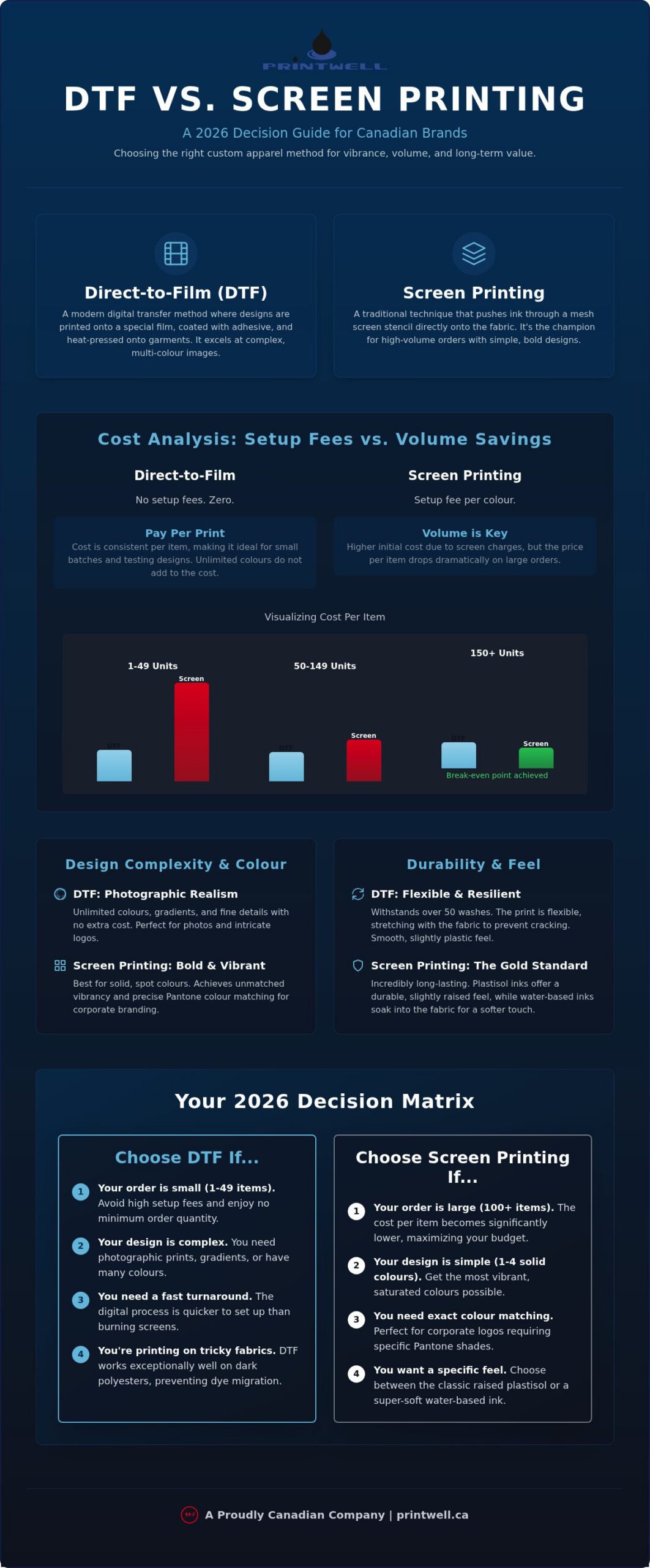
For startups and small businesses, DTF is the clear financial winner. Because there are no screens to burn or reclaim, you avoid the high entry costs that often make small screen-printed orders prohibitively expensive. You can realize savings of up to 80% on small runs with complex logos by choosing digital. Utilizing DTF gang sheet printing Canada allows you to maximize your budget by fitting multiple logos, neck labels, and sleeve prints onto one sheet. This flexibility lets you test new designs without committing to massive inventory.
Bulk and Corporate Orders (100+ Pieces)
Once your order volume scales past the 150-unit mark, the financial math shifts back toward the screen press. Screen printing is built for speed and repetition. While the setup takes time, the actual printing process is incredibly fast. This efficiency drives the per-unit cost down significantly as the volume increases. Large-scale events and national corporate uniforms typically rely on professional printing services to handle these high-volume runs. At this scale, the cost of the screens is spread across hundreds of items, making it the most economical choice for simple, high-visibility branding.
Geography also plays a role in your final budget. We provide fast nationwide shipping across all Canadian provinces, ensuring your project arrives on time whether you’re in the Maritimes or the Rockies. Calculate your volume, assess your colours, and evaluate your timeline to find the best value. You can browse our selection of custom t-shirts to see which options best fit your current project scale.
Quality, Durability, and the Tactile Experience
The tactile experience of a custom garment is often the first thing a customer notices. If you’ve ever worn a t-shirt where the print felt like a heavy plastic shield, you’ve experienced the downside of low-quality application. When choosing between DTF vs screen printing Canada, you have to weigh the soft, integrated feel of traditional ink against the crisp, photographic precision of modern film. While older transfer methods earned a reputation for a “sticker-like” texture, 2026 technology has refined the TPU adhesive to create a finish that’s remarkably thin and flexible. It stretches with the fabric, breathes with the wearer, and maintains its shape over time.
FESPA’s analysis of DTF and screen printing suggests that the industry is moving toward a world where the gap in “hand-feel” is closing rapidly. High-quality digital transfers now offer a matte finish that rivals the softness of water-based screen printing. However, for those seeking a truly “zero-feel” print on 100% cotton, traditional discharge screen printing still holds a slight edge by replacing the fabric’s dye with ink pigment. Choose your method; define your brand’s physical presence.
Vibrancy and Fine Detail
Colour accuracy is where the two methods diverge most sharply. Screen printing relies on Pantone-matched inks, making it the superior choice for strict corporate branding that requires an exact colour hit. It produces solid, opaque blocks of colour that look powerful on athletic wear. Conversely, DTF uses a CMYK digital process. This allows for stunning gradients, complex shadows, and photographic details that screens simply can’t reproduce. If your logo features tiny text under 2pt or intricate line work, digital films will capture every pixel with surgical precision.
Longevity in the Canadian Climate
Canadian laundry standards are notoriously tough on apparel. Between the mineral-heavy water in many provinces and the high-heat drying cycles required during freezing winters, your prints need to be resilient. Current wash tests show that high-grade DTF transfers can withstand 50 or more laundry cycles without peeling or losing their lustre. Screen printing is equally durable, though older plastisol prints may eventually develop a “crackle” effect if stretched excessively or dried at extreme temperatures.
For high-end corporate projects, many brands now opt for a multi-decorated approach. You might pair a screen-printed back graphic with custom embroidery on the chest for a premium, textured look. This combination ensures your gear looks professional, stays durable, and survives the harshest Canadian winter seasons. Invest in quality; ensure your message lasts.
Fabric Versatility and Material Compatibility
Choosing the right fabric is just as important as choosing the right design. When evaluating DTF vs screen printing Canada, the material of your garment often dictates the winning method. 100% cotton remains the classic choice for both, but modern Canadian brands frequently utilize synthetic blends, performance polyesters, and heavy-duty outerwear. Each fabric reacts differently to heat, pressure, and ink, meaning your choice determines whether your logo stays crisp or fades after a few wears.
Dark polyester presents a specific technical challenge known as dye migration. This occurs when the fabric’s own dye “bleeds” into the printed ink, turning a sharp white logo into a murky grey or pink. Screen printing requires specialized blockers and heavy ink layers to fight this. DTF offers a more efficient solution. Its low-heat application and specialized adhesive powder create a physical barrier that prevents dye seepage. This ensures your colours stay true, your whites stay bright, and your brand stays professional.
Printing on Performance Wear and Synthetics
Synthetics like nylon and spandex are notoriously heat-sensitive. High-temperature curing in traditional screen printing can scorch the fabric or leave permanent “press marks” around the design. DTF has a low-heat advantage, making it the safer choice for delicate athletic gear and moisture-wicking jerseys. While screen printing can work on these materials, it requires specialized “poly-inks” and additives to ensure the print doesn’t crack when the fabric stretches. Apply the transfer; protect the fabric; ensure the stretch.
Consistency Across Different Products
A cohesive brand identity requires your logo to look identical across every item in your collection. DTF is the “universal” solution for branding awkward locations like sleeve hems, neck labels, or the curved panels of a custom hat. Because the carrier film is small and flexible, it fits into tight spots where a bulky screen press cannot reach. This versatility allows you to expand your reach with custom promotional products Canada, matching your tote bags to your hoodies with ease.
Whether you’re branding a rough canvas apron or a silky performance tee, the right compatibility ensures a professional result. You can view our custom apparel options to find the perfect substrate for your next project.
The Final Verdict: Which Method Should You Choose?
Deciding between DTF vs screen printing Canada for your 2026 apparel project doesn’t have to be a binary choice. It is about matching the right technology to your specific stage of business growth. A local startup testing a new design has very different needs than a national corporation ordering uniforms for thousands of employees. By assessing your volume, design complexity, and required turnaround time, you can select the method that maximizes your budget without sacrificing the professional look your brand deserves.
Choose Screen Printing If…
The screen press remains the gold standard for high-volume efficiency. You should opt for this traditional method if you are placing a large order of 100 pieces or more with a simple one or two-colour design. It provides that classic, soft-hand feel that many customers associate with vintage retail apparel. If you have a generous lead time and want to achieve the lowest possible per-unit price for a bulk event, screen printing is your most cost-effective path. It delivers bold results, incredible longevity, and a proven track record of durability.
Choose DTF Printing If…
Modern digital transfers offer a level of flexibility that traditional screens cannot match. This is the preferred choice if your artwork involves photographic details, complex gradients, or more than five colours. Because there are no minimum order requirements and zero setup fees, DTF is ideal for small batches, limited edition drops, or fast-turnaround projects. It also allows you to organize a sustainable “print-on-demand” model, reducing your inventory risk while maintaining a high standard of vibrance and detail.
Many growing Canadian brands now adopt a hybrid approach to their collections. You might use screen printing for a large, simple back graphic on your main inventory while utilizing DTF for intricate sleeve hits or custom neck labels. This strategy allows you to maintain professional standards across different products while keeping your production costs under control. It future-proofs your brand by allowing you to scale up or down as market demand shifts.
Before you place your order with a Canadian print partner, run through this final checklist to ensure a seamless experience:
- Artwork Quality: Ensure your files are high-resolution (300 DPI) to capture every detail.
- Fabric Choice: Confirm if your garments are 100% cotton, polyester, or a heat-sensitive synthetic blend.
- Timeline: Factor in national shipping times to ensure your gear arrives before your deadline.
- Budget: Compare the total cost, including any potential setup fees for multi-colour screen prints.
Whether you need a small run of custom t-shirts or a massive order of embroidered hoodies, choosing the right method ensures your vision is realized with precision. We are ready to help you navigate these choices and deliver a product you can be proud of.
Ready to Bring Your Vision to Life?
Choosing between DTF vs screen printing Canada comes down to balancing your order volume with the complexity of your design. Whether you need the massive scalability of a traditional screen press or the photographic detail and flexibility of digital transfers, the goal remains the same. You want a durable, professional product that represents your brand with pride. You now understand the technical break-even points, the importance of fabric compatibility, and how modern technology ensures your gear survives the toughest Canadian laundry cycles.
We are here to guide you through every step of the process with reliable, professional Canadian-based support. Our team takes personal responsibility for every print, ensuring your vision arrives exactly as intended. With no minimums on DTF transfers and fast nationwide shipping across the country, your project is always in expert hands. We believe in quality craftsmanship that speaks for itself, combining traditional expertise with modern efficiency to deliver results that last.
Start your custom apparel project with Printwell Canada today!
Your brand deserves to stand out, and we are ready to help you make it happen with confidence and care.
Answers to Your Common Printing Questions
Is DTF printing more durable than screen printing for Canadian laundry?
DTF transfers are remarkably durable and can withstand over 50 laundry cycles when applied correctly. While traditional screen printing remains a benchmark for longevity, modern digital films are engineered to resist the heavy-duty cycles common in Canadian households. They don’t crack easily under the stress of high-heat drying. When comparing DTF vs screen printing Canada, you’ll find that both methods provide excellent long-term value for your custom apparel.
Why is screen printing more expensive for small orders?
Screen printing involves significant labour before the first shirt is even printed. We have to burn individual mesh screens for every colour, mix the inks by hand, and calibrate the press. These fixed costs are spread across the whole order. For small runs, these setup fees make the per-unit price much higher. DTF skips these physical steps entirely, making it the most cost-effective choice for batches under 50 pieces.
Can I use DTF transfers on any type of fabric?
DTF is widely considered the most versatile printing method for different substrates. It adheres beautifully to 100% cotton, polyester, and performance blends without the risk of scorching. It even works on difficult fabrics like nylon or heavy canvas that often pose challenges for traditional ink. Because the application uses lower heat, it protects delicate synthetic fibres while ensuring a permanent bond that stretches naturally with the garment.
Does DTF printing have a heavy or “plastic” feel?
High-quality digital films in 2026 have a soft, matte finish that feels very similar to traditional ink. The old “plastic” or “sticker” feel is a thing of the past thanks to refined TPU adhesive powders. These powders create a thin, flexible layer that integrates with the fabric. While a large solid block will always have more “hand” than a small logo, the breathability and stretch are vastly improved.
How many colours can I use in a DTF design compared to screen printing?
You can use an unlimited number of colours with DTF technology. Since it uses a CMYK digital process, it captures complex gradients, shadows, and photographic details with ease. Screen printing is physically limited by the number of screens we can fit on the press. Each additional colour adds a new screen and a new setup fee, whereas digital printing doesn’t penalize you for having a vibrant, multi-coloured design.
What is the typical turnaround time for DTF vs screen printing in Canada?
DTF typically offers a faster turnaround because it removes the time-consuming screen preparation phase. Once your artwork is approved, we can move directly to printing the film. Screen printing requires burning, drying, and taping screens, which often adds several days to the production schedule. When evaluating DTF vs screen printing Canada, digital is the superior choice for tight deadlines or projects requiring fast nationwide shipping.
Do I need a special heat press to apply DTF transfers myself?
We strongly recommend using a professional-grade heat press to apply our transfers. While a household iron might seem convenient, it cannot provide the consistent pressure and precise temperature control required for a permanent bond. A commercial press ensures the adhesive melts evenly into the fabric fibres. This creates a professional-looking result that won’t peel or lift after the first wash, protecting your investment and your brand’s reputation.