
 A Proud Canadian Company
Why does a quote that looks perfect on your screen suddenly inflate by twenty percent once you reach the checkout page? It’s a frustrating reality for many Canadian business owners and event organizers who simply want a straightforward answer regarding the cost to print 100 t-shirts. You’ve likely spent hours comparing fabrics, colours, and styles; only to be met with confusing jargon about screen charges or film setups. We understand that you need transparency, reliability, and a finished product that reflects your brand’s high standards without any unpleasant financial surprises.
This guide provides a clear roadmap for your next bulk apparel project. We’ll help you navigate the differences between Direct-to-Film and traditional screen printing while showing you how to maximize your budget for 2026. You’ll discover how to secure high-quality prints that won’t crack, ensure dependable delivery across Canada, and receive a professional product you’re proud to distribute. Our goal is to provide a methodical, organized, and helpful breakdown of the variables that influence your final invoice. You’ll gain the expert insight needed to make an informed decision that balances durability, visual appeal, and professional standards.
Key Takeaways
- Understand why 100 units is the strategic “sweet spot” for maximizing your budget and reducing your per-unit expenses.
- Identify the primary factors that influence the cost to print 100 t-shirts, including fabric weight, garment brand, and the number of print locations.
- Learn how to choose between traditional screen printing for bulk efficiency and modern DTF for intricate, multi-colour designs.
- Discover how to avoid common “hidden” costs like artwork preparation fees by utilizing proper vector files and understanding setup charges.
- Realize the importance of selecting a reliable Canadian partner to ensure professional print durability, consistent national shipping, and exceptional brand representation.
The Economics of 100 T-Shirts: Estimating Your 2026 Budget
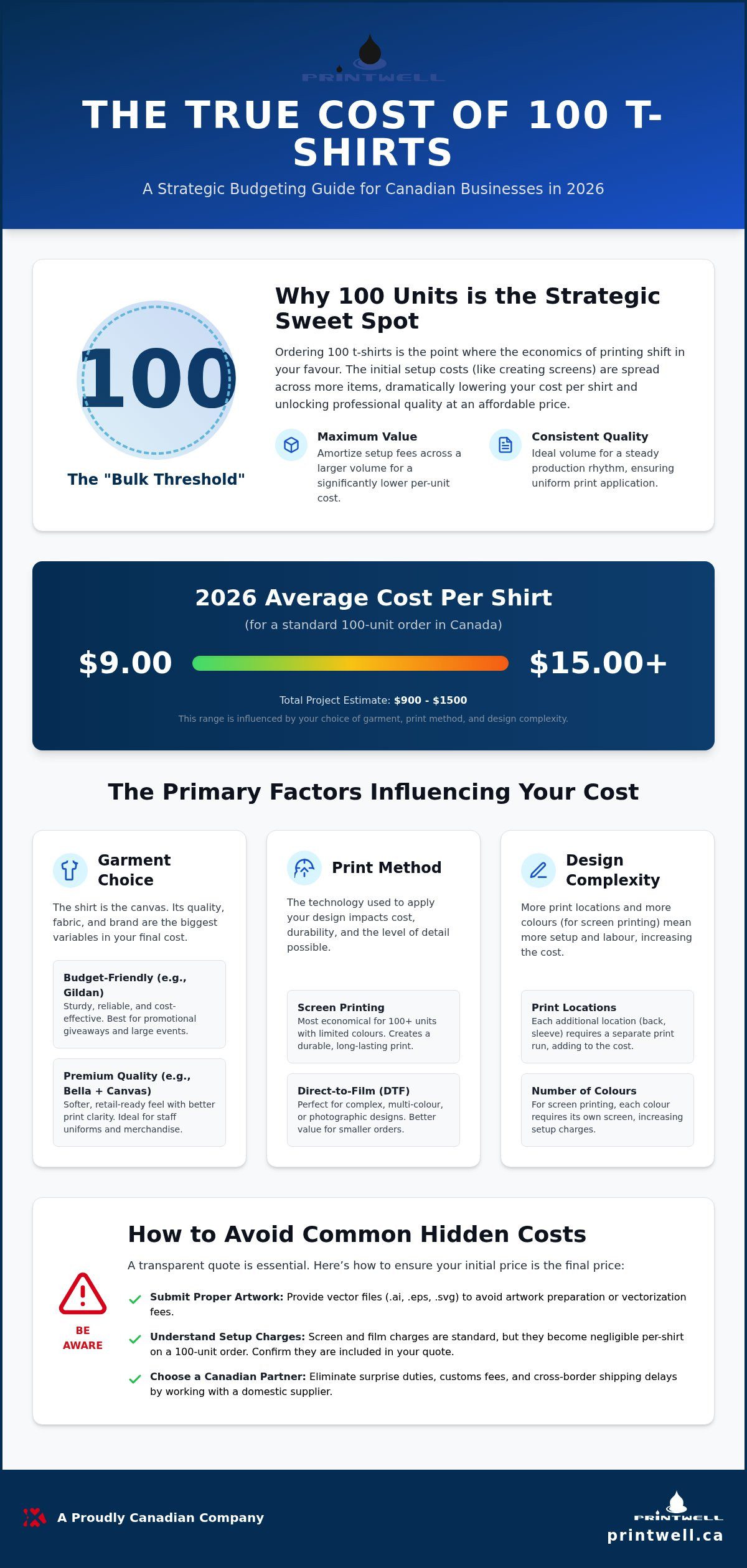
Reaching the 100-unit mark represents a significant milestone in custom apparel. In the printing industry, this is known as the “bulk threshold.” It’s the point where individual labour and setup time become secondary to the speed of the machines. When you increase your volume, the price per unit drops because the fixed costs of preparing your design are spread across a larger number of garments. This efficiency allows you to secure a professional look without a premium price tag. It transforms a simple order into a strategic investment for your brand.
Your total investment relies on three fundamental pillars: your garment choice, your chosen printing method, and the complexity of your design. Understanding the total cost to print 100 t-shirts involves looking at the bigger picture of your branding goals. Across the Canadian market in 2026, a standard 100-unit order generally averages between $9.00 and $15.00 per shirt, though specialized fabrics or multi-location prints can shift this range. This transparent breakdown helps you plan with confidence, allocate your resources wisely, and avoid unexpected budget creep at the checkout.
Why 100 Units is the Strategic Sweet Spot
At this volume, the math begins to work in your favour. Every order requires a certain amount of preparation; screens must be burnt, inks must be mixed, and machines must be calibrated. When you order only a few shirts, these setup costs make the per-shirt price feel inflated. At 100 units, those costs are effectively amortized, making the screen printing process far more economical than digital alternatives. This volume allows for a steady production rhythm, ensures consistent ink application, and results in a more durable finish. It is the ideal balance between quantity and cost to print 100 t-shirts for businesses looking to scale their visibility. You receive the best of both worlds: high-volume pricing and artisanal quality control.
Setting Realistic Expectations for Quality vs. Price
Your budget should always reflect your project’s final goal. A lightweight “budget” tee is excellent for a single-day event, a massive giveaway, or a short-term promotional campaign where quantity is the priority. However, if you’re creating staff uniforms or retail merchandise, investing in a premium, ring-spun cotton garment ensures a better fit, a softer feel, and a longer lifespan. Choosing a Canadian provider further protects your budget from the volatility of 2026 logistics. You avoid the surprise of customs fees, eliminate cross-border duties, and sidestep the delays often found with international shipping. This local approach provides certainty, supports the domestic economy, and guarantees that your shirts arrive exactly when you need them. It’s a reliable way to ensure your brand is represented with pride and professionalism.
The Primary Factors Influencing Your Per-Unit Printing Cost
Determining the final invoice for a custom order involves more than just selecting a quantity. While the volume provides the baseline, several specific variables dictate the final per-unit price. Understanding these factors allows you to make strategic choices that align with your branding goals and your budget. When calculating the total cost to print 100 t-shirts, garment quality is often the largest variable, followed closely by the complexity of your artwork and the speed of delivery. By looking at the broader Apparel Manufacturing statistics, it’s clear that material costs and labour efficiency are the primary drivers of price fluctuations in the 2026 market.
Choosing the Right Garment for Your Brand
The shirt you choose acts as the canvas for your design. A heavy cotton Gildan tee offers a sturdy, reliable, and cost-effective option for large-scale events or promotional giveaways. In contrast, premium brands like Bella + Canvas utilize ring-spun cotton, which provides a tighter weave and a much softer hand-feel. This higher-quality fabric results in better print clarity, increased durability, and a retail-ready appearance that employees or customers will actually want to wear. If you’re unsure which fabric suits your project, you can explore the different custom t-shirts available to find the perfect balance between comfort and value. Balancing these options ensures you don’t overspend on a temporary promotion or underspend on a long-term uniform.
Understanding Print Locations and Dimensions
Every time a shirt is moved or a new screen is prepared, the labour cost increases. A standard “left chest” logo is the most economical choice because it requires less ink and a smaller setup area. Expanding to a “full front” or “full back” design increases the visual impact, but it also uses more resources. Adding secondary locations like sleeve prints or nape-of-the-neck branding can elevate a simple tee into a high-end piece of merchandise. However, for those looking to minimize the cost to print 100 t-shirts, sticking to a single print location is the most efficient path. It streamlines the production process, reduces the number of setups, and keeps your per-unit price at its lowest possible point.
Beyond the physical shirt and the print location, two final factors can shift your budget: colour count and turnaround time. For traditional screen printing, each additional colour requires a separate screen and a dedicated setup. If your logo has five or six colours, you might find that Direct-to-Film (DTF) printing offers better value. Finally, always plan ahead. Standard production schedules allow us to maintain our high standards of craftsmanship without extra fees. Rush orders require us to reorganize our entire production floor, which inevitably inflates the standard price. Giving yourself a lead time of two to three weeks is the simplest way to keep your project on budget and stress-free.
Screen Printing vs. DTF: Which Method Offers Better Value for 100 Units?
Choosing the right printing technology is the most critical decision you’ll make once you’ve settled on your order size. At 100 units, you’ve reached a unique intersection where both traditional screen printing and modern Direct-to-Film (DTF) are highly effective. However, the best value for your project depends entirely on the nature of your artwork. While screen printing relies on physical stencils and ink layers, DTF uses a digital transfer process that excels in different areas. Balancing the cost to print 100 t-shirts requires a clear understanding of how these setups influence your final price.
When Screen Printing Wins on Price
Screen printing remains the industry standard for high-volume orders with limited colours. This method involves pushing ink through a mesh screen directly onto the fabric, creating a bond that is exceptionally durable, vibrant, and long-lasting. If your design features only one or two solid colours, screen printing is almost always the most economical choice. The setup fees associated with burning physical screens are amortized quickly at this volume. Generally, the break-even point where screen setup fees become more cost-effective than digital methods occurs between 50 and 75 units. For a 100-shirt run, you’ll benefit from:
- Unmatched Durability: Inks like plastisol or water-based options withstand hundreds of wash cycles without fading.
- Soft Hand-Feel: On lighter garments, the ink integrates with the fibres for a breathable, comfortable finish.
- Production Speed: Once the screens are set, the actual printing process is exceptionally fast.
When DTF Printing is the Smarter Investment
Direct-to-Film (DTF) has revolutionized the Canadian apparel market by removing the barriers of colour counts and setup fees. Instead of physical screens, your design is printed onto a specialized film and heat-applied to the garment. This is the superior choice if your logo includes complex gradients, photographic elements, or a wide spectrum of colours. Because there are no screens to burn, the cost to print 100 t-shirts with DTF doesn’t increase based on the number of colours in your design. It allows for incredible precision, capturing tiny details that might be lost in a traditional screen. To understand how to organize your designs for maximum efficiency, you can consult our DTF Gang Sheet Printing Guide. This method provides a sharp, slightly raised texture that feels premium and resists cracking, ensuring your brand looks professional, vibrant, and sharp from the first wear to the fiftieth.
Avoiding Hidden Fees: Shipping, Artwork, and Setup Costs
Surprise fees at the final checkout screen can turn an exciting branding project into a stressful logistical hurdle. When you’re calculating the cost to print 100 t-shirts, the base price per garment is only part of the equation. To keep your budget on track, you must account for artwork preparation, setup charges, and national shipping logistics. By understanding these variables early, you can avoid the “sticker shock” that often accompanies bulk orders. Choosing a Canadian provider ensures you pay in CAD, avoid volatile exchange rates, and sidestep the hidden duties associated with cross-border shipping.
The Importance of Print-Ready Artwork
High-quality prints begin with high-quality files. To avoid design re-creation fees, always provide your artwork in a vector format like AI, EPS, or PDF. Unlike standard JPEGs or PNGs, vector files can be scaled to any size without losing clarity, ensuring your logo remains sharp, professional, and crisp. Sending a low-resolution image often requires a manual redraw by a technician; this adds an unnecessary expense to your project and can delay your production timeline. If you want to simplify your design and stay within a specific budget, focus on clean lines, limited colours, and high-contrast elements. This thoughtful approach reduces prep time, minimizes errors, and guarantees a superior finished product.
Navigating Canadian Shipping and Turnaround
Shipping 100 t-shirts involves moving a significant amount of weight. A single box of 100 garments can weigh between 40 and 60 pounds, depending on the fabric weight and sizes selected. Reliable national shipping requires a balance between speed and cost; therefore, planning your timeline is the most effective way to save. Standard ground shipping across Canada is affordable and dependable, but last-minute “Rush” surcharges can quickly inflate your total cost to print 100 t-shirts. We recommend finalizing your order at least three weeks before your event to ensure a smooth production cycle.
Setup charges are another area where transparency matters. In screen printing, these are typically one-time fees per screen used in your design. If you plan on reordering the exact same design in the future, ask if your screens are kept on file to reduce subsequent costs. By paying in Canadian dollars, you also protect yourself from the fluctuating US exchange rates that often catch buyers off guard when ordering from international platforms. This local commitment provides price stability, supports Canadian labour, and ensures your project remains a predictable investment. For a deeper look at industry standards, consult our Professional Printing Guide. Ready to get started without the hidden surprises? You can request a transparent quote today to see exactly how we can support your vision.
Maximizing Your ROI with Printwell Canada’s Bulk Solutions
Investing in 100 custom garments is a significant step for any Canadian business, non-profit, or event organizer. It’s an opportunity to turn a simple piece of apparel into a durable, high-visibility asset that carries your message across the country. At Printwell Canada, we treat every project with the precision of a master artisan and the helpfulness of a friendly guide. We realize that the cost to print 100 t-shirts isn’t just a line item in your budget; it’s a strategic move to build community, reward employees, or launch a retail line. Our approach focuses on long-term value, ensuring that every print remains vibrant, every seam stays strong, and every logo represents your standards with total clarity.
Our commitment to your growth extends beyond apparel. We offer a fully integrated suite of professional solutions designed to give your brand a cohesive, polished look. If you need business cards to hand out at your next trade show, signs and banners to mark your location, or custom mugs for your office, we provide a single, reliable point of contact. This integrated service saves you time, reduces logistical friction, and ensures that your brand colours remain consistent across every medium. You don’t have to manage multiple vendors; you simply partner with a team that takes personal responsibility for your success.
A Solution-Oriented Approach to Your Project
Choosing the right path for your 100-unit order shouldn’t feel like a guessing game. We provide expert consultations to help you decide if the classic durability of screen printing or the intricate detail of DTF is right for your specific artwork. Our physical showroom allows you to touch the fabrics, see the print quality in person, and feel the weight of different garment brands before you commit. This level of transparency builds trust and eliminates the fear of receiving “cheap” feeling shirts. We focus on durability, visual appeal, and professional standards to ensure your investment delivers a high return through increased visibility and brand pride.
Ready to Start Your 100-Shirt Order?
Getting a clear, straightforward answer on the cost to print 100 t-shirts is the first step toward a successful project. Our process is designed to be methodical, organized, and entirely free of hidden fees. We take care of the heavy lifting, from artwork checks to national shipping, so you can focus on running your business or planning your event. With our reliable delivery across Canada and our unwavering commitment to craftsmanship, you can rest easy knowing your project is in expert hands. Get a custom quote for your 100-shirt order today and let’s work together to bring your vision to life with professional confidence and local warmth.
Launch Your Next Project with Professional Confidence
Ordering 100 units is a strategic decision that balances high-volume efficiency with artisanal quality. You’ve learned that the cost to print 100 t-shirts depends on your choice of garment, the complexity of your design, and the printing method you select. Whether you opt for the classic durability of screen printing or the vibrant detail of DTF, the key to success lies in preparation. By using vector artwork and planning for standard turnaround times, you ensure a smooth production cycle without unnecessary surcharges or logistical delays.
At Printwell Canada, we take pride in being your reliable partner for business and events. Our expert DTF and screen printing services are designed to deliver professional results that won’t crack or fade. We offer fast national shipping across Canada to ensure your order arrives exactly when you need it. Our team is ready to help you realize your vision through thoughtful craftsmanship and straightforward pricing. Order your custom t-shirts from Printwell Canada today and let’s create something your team will be proud to wear. Your brand deserves a professional finish that reflects your hard work and dedication.
Frequently Asked Questions
What is the average cost to print 100 t-shirts in Canada?
The average cost to print 100 t-shirts in Canada typically ranges from $9.00 to $15.00 per unit, depending on the garment brand and design complexity. This price point represents a significant drop from smaller orders because fixed setup costs are spread across a larger volume. You’ll find that budget-friendly options like Gildan are more economical, while premium ring-spun cotton slightly increases the per-unit investment. Always request a transparent quote to see how your specific design impacts the final total.
Is it cheaper to screen print or use DTF for 100 shirts?
Screen printing is generally more cost-effective for 100 shirts if your design uses only one or two colours. This traditional method relies on physical screens that become highly efficient at higher volumes. However, if your artwork includes many colours or intricate gradients, Direct-to-Film (DTF) offers better value because it doesn’t charge per colour. We help you evaluate your artwork to determine which technology provides the best balance of quality, durability, and professional standards for your project.
Do 100-unit orders qualify for free shipping?
Most orders of this size qualify for free or discounted shipping because they naturally exceed the standard industry spending thresholds, which usually sit between $250 and $500. Bulk orders of 100 shirts are heavy, often weighing up to 60 pounds, so securing free shipping provides a substantial saving. We offer reliable national shipping across Canada to ensure your project arrives safely, whether you are located in a major urban centre or a smaller community with specific delivery needs.
How long does it take to print and deliver 100 custom t-shirts?
You should typically allow two to three weeks for the professional printing and delivery of a 100-unit order. This timeline ensures our master artisans have enough time for meticulous quality checks, precise ink mixing, and careful garment preparation. While faster turnaround is sometimes possible, planning ahead helps you avoid rush surcharges and keeps your cost to print 100 t-shirts within your original budget. We prioritize reliability and clear communication to keep your branding project on schedule.
Can I mix different shirt sizes and colours within a 100-unit order?
You can certainly mix different garment sizes and colours within a single order to meet the needs of your team or event. Most providers don’t charge extra for varying sizes, but changing the ink colour during a screen printing run may incur a small “washup” fee. This flexibility allows you to offer a diverse range of apparel while still benefiting from bulk pricing. It’s a practical way to ensure everyone receives a shirt they’ll actually enjoy wearing and using.
What kind of artwork file do I need for a bulk t-shirt order?
Vector files are the gold standard for bulk printing, specifically AI, EPS, or high-resolution PDF formats. These files allow us to scale your logo to any size without losing clarity, ensuring a sharp and professional finish on every shirt. If you only have low-resolution JPEGs or PNGs, our team may need to redraw the artwork, which can lead to additional design fees. Providing print-ready files is the simplest way to maintain a straightforward budget and avoid delays.
Are there extra fees for printing on the back or sleeves of the shirts?
Yes, adding print locations to the back or sleeves will increase the per-unit price of your order. Each additional location requires a separate setup, extra ink, and a second pass through the production line. While a simple chest logo is the most economical choice, secondary locations add significant branding value and visibility. We recommend weighing the impact of these extra placements against your budget to find the most effective solution for your specific marketing or event goals.
Why should I choose a Canadian printing company over a US-based one?
Choosing a Canadian company protects you from the volatility of international exchange rates and the hidden costs of cross-border duties. You’ll pay in Canadian dollars, receive faster national shipping, and support our domestic economy. Beyond the financial benefits, working with a local provider ensures you have access to a team that understands your market and takes personal responsibility for your success. It’s about building a relationship based on trust, reliability, and shared community pride in every project.