 A Proud Canadian Company
What if “Canadian-made custom apparel” describes where the design is added, not where the garment itself was made? It’s an easy distinction to miss when comparing origin claims, and it matters if you’re choosing apparel for a brand, event, or team. At Printwell Canada, custom apparel is decorated in Ottawa, while the base garments may be manufactured elsewhere.
You’re right to look beyond a maple leaf or a “made here” message. Garment manufacture and Canadian customization are separate parts of the production story, and understanding the difference helps you make a more informed choice without losing sight of fit, finish, or intended use.
This 2026 buyer’s guide explains how to distinguish Canadian-made garments from garments customized in Canada, what origin claims and labels can tell you, and how to choose apparel and decoration for your project. You’ll also learn what to prepare, from garment preferences to artwork and order details, so you can plan with confidence and help avoid preventable delays.
Key Takeaways
- Assess Canadian made custom apparel by separating garment origin from where its decoration takes place.
- Follow each production stage, from garment manufacture and selection to artwork, decoration and fulfilment, to understand which origin claims apply.
- Compare Canadian-made, Canada-decorated and dual-claim apparel based on origin evidence, customization needs and project fit.
- Plan your order around how the apparel will be worn, who it’s for, the quantity needed and artwork readiness.
- Printwell produces DTF, embroidery and printing in-store in Ottawa, with custom apparel shipped across Canada.
What Does Canadian-Made Custom Apparel Actually Mean?
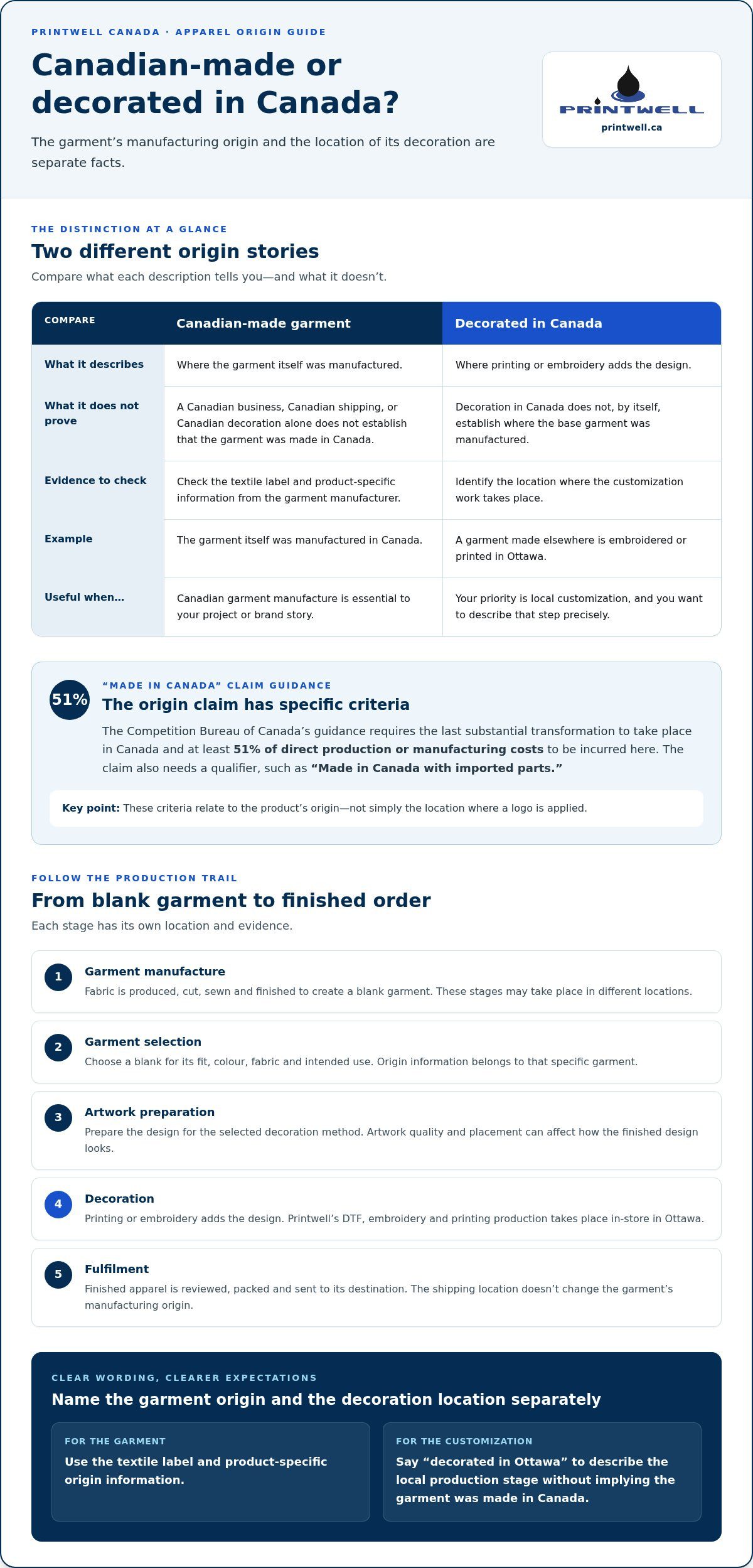
Garment manufacturing origin and customization location are separate facts. A T-shirt can be sewn in another country, then printed or embroidered in Canada. The decoration is Canadian, but that alone doesn’t make the garment Canadian-made. Keeping those stages distinct helps businesses, event organizers and teams choose apparel that matches their sourcing priorities and describe it accurately.
Canadian-made apparel is apparel whose garment itself was manufactured in Canada. For a “Made in Canada” claim, the Competition Bureau of Canada’s guidance requires the last substantial transformation to take place in Canada and at least 51% of the direct production or manufacturing costs to be incurred here. The claim also needs a qualifier, such as “Made in Canada with imported parts.” These criteria relate to the product’s origin, not simply the location where a logo is applied.
That distinction matters for Canadian made custom apparel, especially when origin is part of your brand story. “Printed in Canada” or “embroidered in Canada” describes a customization step. Neither phrase, on its own, says where the garment was made. Likewise, shipping an order from a Canadian business doesn’t establish where its apparel was manufactured.
Canadian-Made vs. Customized in Canada
Think of garment construction and decoration as different stages. A sweatshirt could be cut and sewn abroad, selected for a team order, then embroidered in Ottawa. In that example, the embroidery takes place in Canada; the garment’s manufacturing origin remains elsewhere. For apparel sold in Canada, the country of origin must appear on the textile label, even when decoration happens here.
Printwell’s DTF, embroidery and printing production takes place in-store in Ottawa. That identifies where these customization processes happen, not where the base garment was manufactured. Clear wording such as “decorated in Ottawa” communicates the local production stage without implying a Canadian-made garment.
Why the Distinction Matters to Buyers
Origin may shape purchasing decisions, brand messaging and what customers expect when they receive an item. If Canadian garment manufacture is essential to your project, look for evidence about the garment itself and whether the “Made in Canada” claim meets the Competition Bureau’s criteria. If your priority is local customization, state that specifically instead.
Choose precise wording for product pages, event materials and promotional copy. Broad phrases such as “Canadian-made custom apparel” can blur manufacturing and decoration, leaving buyers unsure what was made here. Separating the claims makes your message clearer: identify the garment’s manufacturing origin, then describe where and how it was customized. It’s a practical starting point for comparing options and planning apparel that fits your organization’s goals.
How Custom Apparel Moves from Garment Production to Canadian Decoration
A custom garment passes through several stages before it reaches its wearer. Fabric may be made in one place, turned into a finished garment elsewhere, then selected, decorated and shipped from Canada. Each stage has its own location and evidence. Following the sequence helps you understand what an origin claim describes, instead of treating the full process as if it happened in one country.
Apparel manufacturing makes the garment; customization adds the design. That plain distinction is useful when comparing Canadian made custom apparel with clothing decorated in Canada.
- Garment manufacture: Fabric is produced, cut, sewn and finished to create a blank garment. These stages may take place in different locations.
- Garment selection: The blank is chosen for its fit, colour, fabric and intended use. Its origin information belongs to that specific garment.
- Artwork preparation: The design is prepared for the selected decoration method. Artwork quality and placement can affect how the finished design looks.
- Decoration: Printing or embroidery adds the design to the garment. This work may happen in Canada even if the garment was made elsewhere.
- Fulfilment: Finished apparel is reviewed, packed and sent to its destination. The shipping location doesn’t change the garment’s manufacturing origin.
The Garment Manufacturing Stages Behind an Origin Claim
Fabric production, cutting, sewing and garment finishing are distinct parts of manufacturing. A Canadian-made claim should be supported by information about the specific product, not inferred from one isolated stage or from where its decoration happens.
The Competition Bureau Canada’s “Made in Canada” guidelines explain the criteria for origin claims, including substantial transformation in Canada and the share of direct production or manufacturing costs incurred here. If Canadian manufacture matters to your purchase, use the garment’s label and product-specific information from its manufacturer as evidence. A general statement about a brand’s Canadian operations may not establish the origin of every garment it sells.
What Happens During Canadian Apparel Customization
For a custom order, the work moves from selecting a suitable garment to preparing artwork, applying the design, reviewing the finished result and arranging fulfilment. The decoration method should suit the design and the garment’s intended use. Printwell Canada’s DTF, embroidery and printing production takes place in-store in Ottawa; this describes the customization location, not where the base garments were manufactured.
Embroidery is one option for adding a stitched design, while DTF and other printing methods create different finishes. The custom embroidery guide offers more detail on that method. For custom apparel decorated in Ottawa, explore Printwell Canada’s custom printing, with shipping available across Canada.
Canadian-Made vs. Canada-Decorated Apparel: How to Compare Your Options
The right choice depends on what matters most to your project: where the garment was made, where the design is applied, or both. Compare those claims separately, then consider garment suitability and how the finished order will reach its destination. A Canadian address, local decoration or Canadian shipping can each be useful, but none proves the garment itself was manufactured in Canada.
| Option | Origin evidence | Customization needs | Project fit and shipping |
|---|---|---|---|
| Garment made in Canada | Look for product-specific origin information, such as the garment label or manufacturer documentation. | Decoration may happen in Canada or elsewhere; identify it separately. | Fits briefs that prioritize domestic garment manufacture. Confirm where customization and fulfilment happen for your delivery plans. |
| Garment decorated in Canada | Evidence should identify the Canadian printing or embroidery location. This doesn’t establish garment-manufacturing origin. | Compare the available decoration method with your artwork and garment choice. | Fits projects focused on locally customized branded apparel. Shipping from Canada describes fulfilment, not garment origin. |
| Both claims supported | Look for evidence for both the garment’s Canadian manufacture and its Canadian decoration. | Plan the artwork and decoration for the selected garment. | Fits a brief that specifically calls for both. Consider the separate manufacturing and fulfilment locations when planning delivery. |
Use the table as a decision aid, not as a shortcut around product-specific details. A Canadian-made label alone doesn’t establish that a garment is more durable, more ethical or better for the environment. Those are separate qualities that require their own supporting information. Likewise, a local decoration process tells you where customization took place, not how the blank garment was produced.
What to Look for in Canadian Manufacturing Claims
Start with a clear statement about the garment’s origin, supported by information tied to that product. Note which stages a business names, such as cutting or sewing, and which it doesn’t specify. A Canadian brand, business address or shipping location isn’t proof that the garment itself was made here. If domestic manufacture is central to your brief, compare product labels and manufacturer origin details rather than relying on broad promotional wording.
Choosing an Option That Fits Your Purpose
For a procurement brief centred on Canadian garment manufacture, make origin evidence your first filter. For a team order, event or branded uniform, you may instead focus on garment comfort, artwork, decoration and fulfilment. Printwell Canada’s DTF, embroidery and printing production takes place in-store in Ottawa, supporting local customization without implying Canadian garment manufacture. If DTF is under consideration, the DTF gang sheet printing guide explains the method in more detail.
Separate claims make Canadian made custom apparel easier to assess and describe accurately. Printwell Canada’s Ottawa-based customization and Canada-wide shipping can support projects seeking local decoration and Canadian fulfilment; choose wording that reflects those specific stages.
Plan a Custom Apparel Order: Garments, Artwork, and Production
A little planning helps your custom apparel order move from idea to finished garments with fewer avoidable surprises. Start with how the apparel will be worn, then settle the garment, sizes, colours, quantity and design. This sequence works for team gear, event shirts and branded clothing, whether Canadian manufacture or Canadian decoration is part of your sourcing brief.
- Define the purpose and audience. Consider who will wear the apparel, where they’ll wear it and what comfort means for that setting. A team working outdoors may have different needs from guests receiving shirts at an indoor event.
- Choose the garment. Decide on a suitable type, then gather preferred sizes and colours. Think about the intended wear and how the garment’s shape and surface will work with the design.
- Organize quantities and artwork. Prepare the order quantities and a clear design file. Artwork at 300 dpi is recommended for printing. Raster artwork below 300 dpi must be changed to meet printing guidelines. DST files incur an $85 conversion fee.
- Review the proof. Check design placement, scale, spelling and colour appearance before production proceeds.
Prepare Apparel Choices and Artwork
Make a simple order sheet with garment type, sizes, colours and quantities. It helps keep group orders organized and gives you a practical way to spot missing size details before production. Share the design in its intended form and identify any placement preferences. Designs containing copyrighted or trademarked images aren’t printed, so use artwork you have the rights to reproduce.
You’ll receive a proof or mockup to review before printing. Use that review to catch text errors, confirm the design’s position and ensure the layout matches your intent. Approval is a useful checkpoint: resolve any adjustments before the artwork moves into production.
Know What to Do Before Submitting Customer-Supplied Garments
Bringing your own apparel? Email [email protected] before ordering. This step is required for customer-supplied garments. Keep your chosen items and order details clear, and allow the proof review to confirm the design placement before printing. Customer-uploaded images aren’t used in marketing or on the website without explicit written permission.
For Canadian made custom apparel, keep garment origin and decoration details distinct in your order notes and any promotional wording. That way, your project requirements stay clear, from the apparel itself to the finished design.
Ready to organize your garment and artwork details? Start planning your custom apparel order with Printwell Canada.
Get Custom Apparel Printed in Ottawa and Shipped Across Canada
Printwell Custom Printing is an Ottawa-based custom printing company that has been operating since 2002. Its in-store DTF, embroidery and printing production takes place in Ottawa, and custom apparel can be shipped across Canada. That gives organizations a local customization option with a practical route for distributing finished orders beyond the city.
There’s one useful distinction to keep in your project notes: Ottawa production describes where the design is added, not where the blank garment was manufactured. If Canadian garment origin is a requirement for your Canadian made custom apparel, assess that separately using information specific to the garment. Clear expectations make it easier to choose apparel and describe the finished order accurately.
What Printwell’s Canadian Production Means
Canadian production at Printwell refers to the customization work done in-store in Ottawa. DTF, embroidery and printing add a design to a garment; they don’t establish where that garment was made. Printwell’s production details should therefore be understood as local decoration, without assuming the base apparel is Canadian-manufactured.
Printwell states a 100% guarantee on custom printed products. For your own project, keep the design, garment choice and intended use in view as you plan the order. A business logo on custom T-shirts, for example, may call for different artwork placement than an embroidered design on a hoodie or hat.
Start an Apparel Project with Printwell
Choose a starting point that suits the way you prefer to plan. You can explore custom T-shirts, embroidered hoodies and custom hats online, use the online design tools, or visit the showroom at St. Laurent Shopping Centre in Ottawa. Each route can help you shape the project around its audience, purpose and preferred decoration.
Before placing an order, gather a few details to make the next steps more straightforward:
- The apparel type and how it will be worn.
- Required sizes, colours and quantities.
- Your artwork file and any placement preferences.
- The delivery destination for Canada-wide shipping.
Having those details ready helps keep garment selection, artwork preparation and fulfilment aligned. If you’re comparing options, keep garment origin and Ottawa-based customization as separate considerations, then choose the combination that fits your project. Printwell has been producing custom printing in Ottawa since 2002, with DTF, embroidery and printing completed in-store.
Explore the online tools or showroom to begin shaping apparel for your business, event or team. Explore custom apparel printing with Printwell.
Turn Your Apparel Plans into a Clear Sourcing Brief
Before placing an order, write down what your project needs to accomplish and which details are non-negotiable. Is Canadian garment manufacture essential, or is local customization the priority? Add your preferred apparel, intended wear, artwork status and delivery destination. A concise brief gives your team a shared reference point and helps keep product descriptions precise, especially if you plan to promote the apparel as Canadian made custom apparel.
Then focus on the next decision, not every possibility at once. Choose the garment and decoration approach that suit your audience, gather the artwork and order details, and review the proof carefully before production. Thoughtful preparation can help your finished apparel feel cohesive, useful and true to the message you want it to carry.
For custom apparel decorated in Ottawa and shipped across Canada, take the next step with Explore custom apparel printing with Printwell. Bring your idea into focus, and create apparel your group will be proud to wear.
Frequently Asked Questions
Does Canadian-made custom apparel mean the garment was made in Canada?
Yes, a “Made in Canada” claim refers to the garment’s manufacture, not simply where its design was added. For Canadian made custom apparel, the garment must meet the Competition Bureau’s criteria for that claim, including substantial transformation in Canada and the required share of Canadian direct production costs. Printing a logo on an imported blank doesn’t change its manufacturing origin. Keep the garment’s origin and its decoration location as separate details.
Can apparel be printed in Canada if the garment was made elsewhere?
Yes. A garment manufactured outside Canada can be printed here later. For example, a T-shirt made abroad could have a business logo printed in Ottawa. That would make the printing Canadian, not the garment’s manufacture. If you describe the item in a product listing or event order, use wording that identifies the decoration location without suggesting the blank was made in Canada.
How can I tell where a custom garment was manufactured?
Start with the garment’s textile label, then compare its country-of-origin information with product-specific details from the manufacturer. A retailer’s Canadian address, brand identity or shipping origin doesn’t establish where a particular item was made. For a multi-item order, check each garment style or product separately, since different blanks in the same order may have different origins. Keep relevant product information with your purchasing records.
Is custom apparel printed in Ottawa shipped across Canada?
Yes. Printwell ships custom apparel across Canada, with printing and decoration produced in Ottawa. For an event, team or business order going to another province, include the destination and your required in-hand date in your planning notes. You can place an order online or visit the showroom at St. Laurent Shopping Centre in Ottawa. Remember that the shipping route doesn’t indicate where the base garment was manufactured.
Can I bring my own apparel to Printwell for customization?
Yes, customers bringing their own apparel must email [email protected] before ordering. In your message, identify the items you plan to supply and include useful order details, such as garment type and quantity. A proof or mockup is provided for review before printing. Customer-uploaded images aren’t used in marketing or website material without explicit written permission.
What artwork resolution should I use for custom apparel printing?
Aim for artwork at 300 dpi at the intended print size. Resolution affects how clearly a raster image reproduces, so a small image enlarged for a large design may not retain enough detail. If your raster artwork is below 300 dpi, it must be changed to meet printing guidelines. Review the design at its planned size and check small text, fine lines and image edges before submitting it.