 A Proud Canadian Company
Why settle for a custom shirt that looks like a DIY project gone wrong after just one laundry cycle? You have likely dealt with the frustration of dull colours, peeling edges, or file requirements that feel far too complicated. It is a common hurdle for creators across Canada who want their hard work to shine. We believe that every print should be a source of pride, reflecting the care you put into your brand. Choosing a high-quality dtf transfer is the most effective way to ensure your designs remain vibrant, flexible, and impressively durable.
This guide will show you exactly how to identify premium materials, prepare your files with confidence, and apply professional-grade prints that stand out. You will learn how to achieve full-colour results on any fabric while maintaining a cost-effective workflow for small batches. We are going to explore the essential standards for the 2026 Canadian market, ensuring you get fast shipping and reliable results every time. By the end of this guide, you will have the knowledge to produce custom apparel that looks professional, feels great, and stands the test of time.
Key Takeaways
- Identify premium dtf transfer quality by focusing on the essential trio of colour vibrancy, wash durability, and fabric versatility.
- Prepare flawless print files by maintaining high-resolution standards and transparent backgrounds to ensure crisp, professional edges on every garment.
- Compare DTF with traditional screen printing and embroidery to determine the most cost-effective and visually striking method for your specific project.
- Master the application process using the professional “Golden Rule” for heat and timing to guarantee a lasting, high-quality bond.
- Source your materials from a dedicated Canadian provider to benefit from local craftsmanship, rigorous quality control, and reliable national shipping.
Understanding High-Quality DTF Transfers for Canadian Businesses
Direct-to-film technology has revolutionized the way we think about custom apparel production in the Great White North. A dtf transfer is a heat-press-ready solution for full-colour designs on any fabric. It effectively bridges the gap between the speed of digital printing and the longevity of traditional methods. By utilizing the Direct-to-film (DTF) printing process, creators can produce intricate designs that were once considered too complex for standard heat transfers. This modern printing method uses specialized aqueous inks printed onto a PET film, which is then cured with a TPU adhesive powder to create a professional-grade bond.
This method relies on high-quality materials to deliver a tripartite benefit: vibrant colour, incredible durability, and total versatility across all fabric types. It is this combination that has made the dtf transfer the preferred choice for Canadian apparel brands in 2026. As local businesses prioritize both quality and efficiency, the ability to print on demand without compromising on the “hand-feel” of the garment has become essential. It’s a reliable way to ensure your brand stands out in a competitive market while maintaining a manageable workflow.
The Evolution of Direct-to-Film Technology
The technology has come a long way from its early, somewhat rigid iterations. Modern transfers now feature high-stretch capabilities and a soft-feel finish that rivals high-end retail prints. In the Canadian market, there is a noticeable shift toward eco-friendly, water-based inks that satisfy both environmental standards and consumer expectations. This evolution allows for fine detail and sharp edges that screen printing often misses, especially when dealing with small text or thin lines. You get a result that is flexible, breathable, and remarkably resistant to cracking over time.
Why DTF is Outperforming Traditional Vinyl
One of the most practical advantages is the “no weeding” factor. Traditional heat transfer vinyl requires tedious manual labour to remove excess material; this can waste hours of production time on complex logos. DTF eliminates this step entirely. Because the ink integrates with the fabric rather than sitting on top like a thick layer of plastic, the finished product is far more comfortable to wear. It easily handles complex gradients and photographic details, providing a level of visual depth that traditional vinyl simply cannot match. This results in a professional garment that looks intentional, feels premium, and survives the rigours of the Canadian laundry cycle.
Key Technical Requirements for Professional DTF Prints
Achieving a professional-grade finish starts long before the heat press touches the fabric. To ensure your dtf transfer looks sharp and remains durable through dozens of washes, your digital files must meet specific technical standards. According to an industry analysis of printing technologies, the precision of the initial digital file is the single most important factor in determining the final print quality. If the foundation is weak, the resulting garment will never reach its full potential.
Most production delays occur because of simple file errors that could have been caught during the design phase. By following a structured preparation process, you can avoid pixelation, muddy colours, and awkward white borders. If you aren’t sure whether your artwork is ready for production, you can always consult the team at Printwell Canada to ensure your project starts on the right foot.
Resolution and File Formats
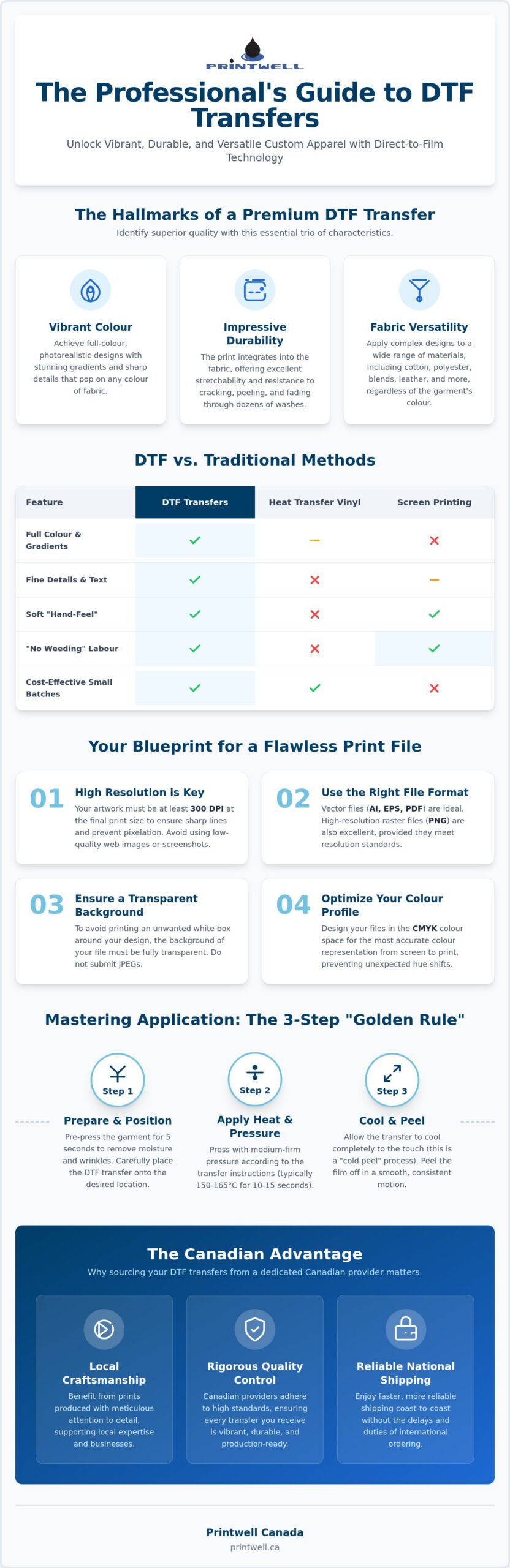
Resolution is the backbone of any high-quality print. 300 DPI is the industry standard for ensuring crisp edges and vibrant colours. When you work at a lower resolution, you risk the “staircase” effect where lines look jagged and blurry. Vector files like AI or EPS are the gold standard because they can be scaled infinitely without losing quality. High-resolution PNGs are also acceptable, provided they have a completely transparent background. You should never use low-resolution web images or screenshots for professional transfers; these files lack the data necessary for a clean print and will always result in a sub-par product.
Optimizing Colours for Fabric
You can realize the best colour accuracy by designing in a CMYK colour profile from the very beginning. While your computer screen displays colours in RGB (light-based), printers use CMYK (ink-based). Converting your files early prevents unexpected shifts in hue when the design hits the film. A critical component of the dtf transfer is the white ink underbase. This layer acts as a primer, allowing the CMYK colours to pop against dark fabrics like navy or black. When managing gradients, ensure they don’t fade into 0% opacity too abruptly, as this can create a “haloing” effect where the white adhesive becomes visible at the edges of your design.
- Resolution: Minimum of 300 DPI at the final print size.
- Background: 100% transparent with no stray pixels or hidden layers.
- Format: Saved as a high-quality PNG, PDF, or vector file.
- Colour Profile: Set to CMYK to ensure what you see is what you get.
- Line Weight: Ensure all fine details are at least 1pt thick for proper adhesive bonding.
Comparing DTF Transfers to Screen Printing and Embroidery
Deciding how to brand your apparel often comes down to a choice between tradition and innovation. While screen printing has been a staple for decades, it often requires high minimums and expensive setup fees for every colour used. A dtf transfer bypasses these hurdles by allowing for unlimited colours and photographic detail without the need for individual screens. For projects ranging from 1 to 50 units, this technology is significantly more cost-effective. It provides a level of graphic impact that screen printing struggles to achieve on smaller scales. You get a professional result without the heavy upfront investment.
Embroidery remains a classic choice for corporate uniforms because of its tactile, professional finish. However, it is limited by the physical nature of thread. If your design features complex gradients or ultra-fine text, embroidery can quickly become bulky or illegible. High-quality transfers offer a lightweight alternative that integrates directly into the fabric. You get the visual punch of a full-colour digital print while maintaining a soft, flexible feel. It is a solution that feels like part of the shirt rather than an attachment. This thin profile is particularly beneficial for lightweight summer tees or performance wear where breathability is a priority.
Durability and Longevity: The 50-Wash Standard
Canadian households put their clothes through a lot; your prints must be able to keep up. High-quality transfers are engineered to withstand a 50-wash standard without significant fading, peeling, or cracking. This impressive durability is largely due to the stretchability of the ink and the quality of the adhesive powder used during the curing stage. Unlike traditional heat-transfer vinyl, which can often feel like a stiff sticker, modern films are designed to be thin and resilient. This makes them an excellent choice for ribbed fabrics or athletic gear that requires constant movement and flexibility.
Cost Analysis for Small Brands
For emerging Canadian labels, managing overhead is vital. One of the biggest advantages of this technology is the complete lack of setup fees. There are no screens to burn and no digitizing fees to pay before the first shirt is printed. This lowers the entry barrier for new collections and limited edition drops. You can realize immediate per-unit savings, especially on multi-colour logos that would be cost-prohibitive elsewhere. For those ready to scale up their operations, bulk t-shirt printing remains a powerful complementary service for larger orders. It allows you to grow your brand at your own pace while maintaining a consistent standard of quality.
Step-by-Step Guide to Applying Your DTF Transfers
Applying a dtf transfer correctly is the final step in the journey from digital design to professional apparel. It is a process that demands precision and the right tools. You won’t achieve retail-quality results with a standard home iron; you need the consistent heat and heavy pressure of a dedicated heat press. A sturdy, flat surface is equally important to ensure that the adhesive cures evenly across the entire graphic. When these elements align, you create a bond that is built to last through the rigours of daily wear.
Every fabric blend reacts differently, but the “Golden Rule” for most Canadian apparel creators is to set your press to 300°F (150°C) for 12 to 15 seconds. Use firm, even pressure to force the melted adhesive powder into the weave of the garment. If your pressure is too light, the print will eventually peel. If it’s too hot, you risk scorching the fabric or causing the ink to bleed. Finding this balance is the hallmark of a master artisan. Once the initial press is done, a “second press” or finishing press for 5 seconds is essential to lock the design into the fibres and provide a professional, soft-feel finish.
The Pressing Process
Success lies in the preparation. Start by pre-pressing your garment for 5 seconds to remove any hidden moisture or wrinkles. This creates a clean, dry canvas for the film to bond with. Next, position your transfer carefully and execute the main press according to the Golden Rule. The most critical decision happens next: the peel. Hot-peel films allow you to remove the carrier sheet immediately while it’s still warm, which speeds up your production. Cold-peel films require the garment to be completely cool to the touch before you pull back the plastic. If you’re ready to put these steps into practice, you can order your custom DTF transfers from our Canadian facility and experience the difference in quality.
Troubleshooting Common Application Issues
Even with the best equipment, challenges can arise. If your design isn’t sticking, the culprit is almost always insufficient pressure or an inaccurate temperature reading on your press. Use a digital thermometer to verify your heat platen’s output. For 100% polyester fabrics, you might encounter “dye migration,” where the fabric colour bleeds into the white ink of the dtf transfer. Lowering your temperature to 280°F and extending the time can often mitigate this issue. When pressing over seams, zippers, or pockets, use a pressing pillow to elevate the print area. This ensures the heat platen makes full contact with the design rather than being held up by the thick edges of the garment.
- Pre-press: 5 seconds to remove moisture.
- Main Press: 300°F (150°C) for 12-15 seconds.
- Pressure: Firm and even across the entire platen.
- Peel: Follow the specific film instructions (Hot or Cold).
- Finishing Press: 5 seconds with a protective sheet to lock the design.
Choosing Printwell Canada for Your DTF Printing Needs
In a market often dominated by impersonal international aggregators, Printwell Canada stands as a reliable, local alternative. We are a premier national provider of artisan-grade dtf transfer solutions, rooted in a commitment to Canadian craftsmanship. Our team takes personal responsibility for every project that passes through our facility. We combine modern technology with a human touch, ensuring that your custom apparel reflects the high standards of your brand. By choosing a domestic partner, you benefit from clear communication, national shipping, and a shared understanding of the local market.
Our dedicated showroom serves as a centre of excellence where we help clients realize their most ambitious branding goals. It is a space dedicated to quality, visibility, and professional standards. We don’t just print; we consult. Every batch undergoes rigorous testing to confirm it meets our strict internal benchmarks for colour accuracy and adhesive strength. This meticulous approach allows us to deliver a dtf transfer that you can apply with total confidence, knowing it won’t fail when your customers need it most.
The Printwell Quality Guarantee
We believe that a great print starts with a great file. Our “Master Artisan” approach involves a manual inspection of every design before it hits the printer. We look for resolution issues, stray pixels, and transparency errors that automated systems often miss. This extra layer of care ensures vibrant colour, superior wash-fastness, and exceptional durability on every garment. If we spot a potential problem, our helpful customer support team will guide you through the fix. We are here to act as your friendly guide, making the technical side of printing feel straightforward and accessible.
Ordering Your Custom DTF Transfers Today
Maximizing your value starts with how you organize your designs. We encourage our clients to use gang sheets to minimize waste and lower their per-unit costs. This allows you to fit multiple logos, neck labels, or sleeve prints onto a single film. It is a practical way to manage your inventory while keeping your production costs predictable. For those seeking a full end-to-end solution, we invite you to explore our custom apparel printing services. We handle everything from the initial transfer to the final pressed garment, providing a seamless path to high-quality merchandise. Order your high-quality DTF transfers from Printwell Canada now! and see how professional craftsmanship can elevate your brand.
Elevate Your Custom Apparel with Professional Precision
Success in the custom apparel industry relies on the perfect harmony of technology and technique. You now have the roadmap to navigate the technical requirements of file preparation and the practical steps of heat application. By focusing on high-resolution designs and precise pressing standards, you ensure that every project meets the expectations of your customers. A professional dtf transfer is more than just ink on film; it is a durable, vibrant, and flexible branding solution that represents your commitment to quality.
Partnering with a local expert provides the reliability your business needs to grow. At Printwell Canada, we back every order with artisan-grade quality control, 50+ wash-tested durability, and fast nationwide Canadian shipping. We take pride in helping you turn creative visions into tangible results that last. Your brand deserves a finish that stands out, feels great, and stays put.
Order Your Professional DTF Transfers from Printwell Canada
We look forward to seeing your designs come to life. Let’s build something impressive together.
Frequently Asked Questions
What is the difference between DTF and DTG printing?
DTG involves printing ink directly onto the garment fibres, whereas a dtf transfer is first printed onto a specialized film and then heat-pressed onto the fabric. DTF offers superior versatility because it works on almost any material, including polyester and nylon, while DTG is primarily suited for high-cotton blends. This makes DTF a more flexible choice for diverse apparel lines that require consistent results across various fabric types.
Can I apply DTF transfers with a regular household iron?
You cannot achieve professional results with a regular household iron because it lacks the consistent heat and heavy pressure required for a permanent bond. A dedicated heat press ensures the adhesive powder melts evenly into the fabric fibres, creating a durable finish. Using an iron often leads to uneven application, which causes the design to peel or crack after only a few laundry cycles.
Do DTF transfers work on dark-coloured polyester shirts?
DTF transfers work exceptionally well on dark-coloured polyester shirts thanks to the opaque white ink underbase used in the process. This layer prevents the garment’s dark dye from bleeding through the design, ensuring your colours remain vibrant and true. It is a reliable solution for athletic wear and team jerseys where colour accuracy on synthetic fabrics is a top priority for a professional look.
How should I wash garments with DTF transfers to make them last?
Turn the garment inside out and wash in cold water to maximize the life of your print. Avoid using harsh bleaches or fabric softeners that can break down the adhesive bond over time. For the best results, hang the clothing to dry or use a low-heat tumble setting to keep the design flexible and prevent the ink from becoming brittle or cracking.
What is a DTF gang sheet and how do I build one?
A gang sheet is a single roll or sheet of film that contains multiple designs arranged to maximize space and reduce costs. You build one by placing your various logos or graphics close together in a single digital file while maintaining a small gap for cutting. This method allows you to produce several different designs in one print run, significantly lowering your total production expenses.
How long does shipping take for DTF transfers within Canada?
Shipping times vary based on your location, but most orders reach major Canadian cities within two to five business days. Many local providers offer 24 to 48-hour production turnarounds before the package enters the courier network. This ensures you receive your materials quickly, helping you maintain a steady and reliable workflow for your custom apparel business without long international delays.
Are DTF transfers eco-friendly and safe for children’s clothing?
High-quality transfers utilize water-based inks that are generally considered safer and more eco-friendly than traditional plastisol printing methods. These materials are free from heavy metals and harsh chemicals, making them suitable for children’s clothing and baby garments. It is a thoughtful choice for Canadian brands that prioritize both safety and environmental responsibility in their manufacturing and branding process.
What temperature and pressure should I use for DTF application?
The standard setting for most applications is 300°F (150°C) for 12 to 15 seconds with firm, even pressure. It is vital to execute a second press for five seconds with a protective sheet to fully cure the design into the fabric. Always verify your specific film’s requirements, as some specialty materials or delicate fabric blends may require slight adjustments to these baseline settings.