 A Proud Canadian Company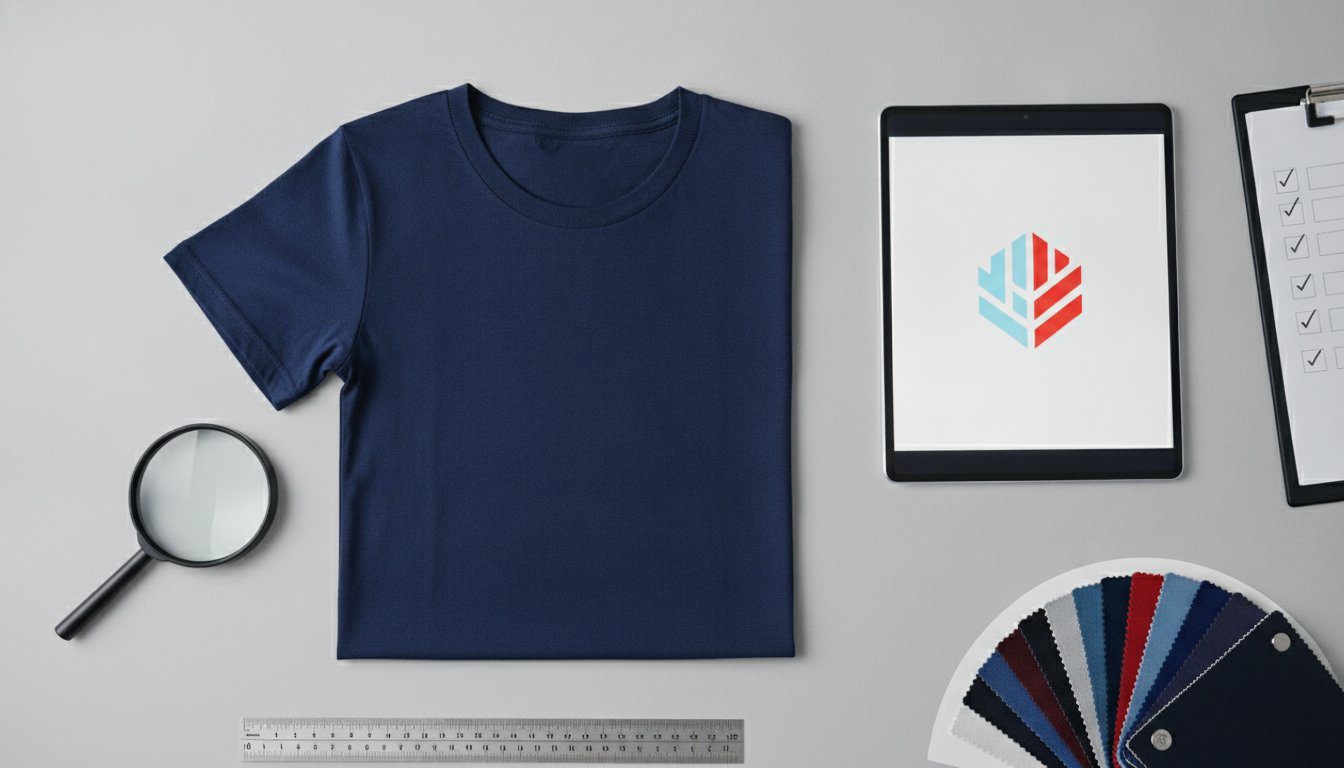
Have you ever opened a package of custom t-shirts only to find the graphics are pixelated, the colours are dull, or the fit is completely off? It’s a frustrating experience that many Canadians face when they’re trying to represent their brand, team, or local event. You deserve a product that reflects your pride and attention to detail. We understand that the process can feel overwhelming, especially when you’re caught between choosing DTF or screen printing while worrying about shipping times across the provinces.
Quality results are the product of intentional preparation, not just luck. This expert-approved checklist ensures your next custom t shirt arrives with vibrant colours, a perfect fit, and professional durability that lasts through every wash. We’ve simplified the technical jargon to give you a clear path from design to delivery. You will learn how to prepare high-resolution files, select the right printing method for your volume, and navigate Canadian sizing standards with total confidence.
Key Takeaways
- Define your garment’s purpose and audience early to ensure the final product delivers the right balance of comfort, fit, and professional durability.
- Select the ideal fabric by assessing material composition and GSM, allowing you to choose a weight that suits your specific environment and usage.
- Guarantee a high-definition result for your custom t shirt by providing 300 DPI artwork and converting fonts to outlines to ensure vibrant, crisp colours.
- Organize your logistics by confirming exact size breakdowns and local shipping timelines to ensure your order arrives across Canada exactly when you need it.
- Leverage the expertise of a Canadian-owned master artisan to access modern DTF technology and professional oversight for every project.
The Pre-Order Checklist: Defining Your Custom T-Shirt Goals
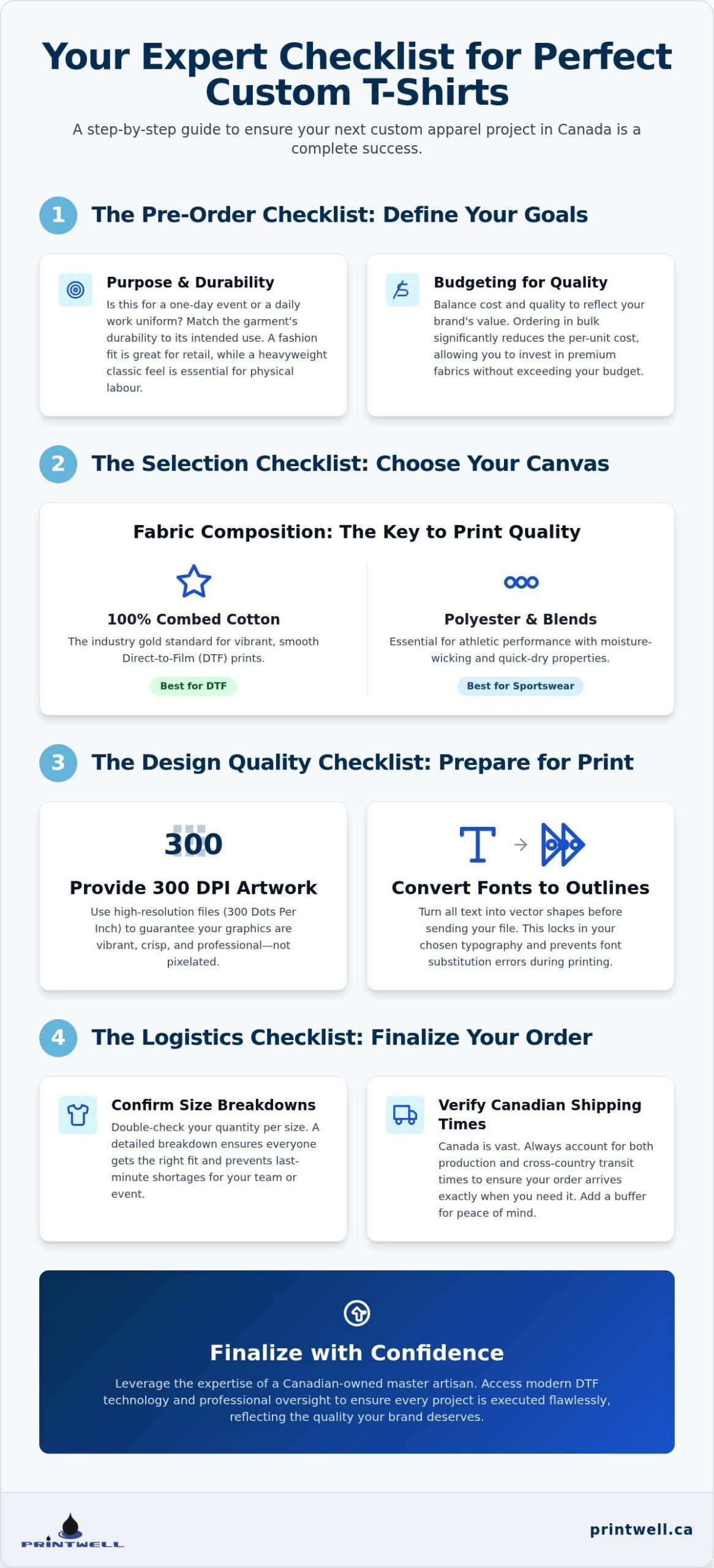
Success begins with a clear objective. Before you touch a design tool or select a colour palette, you must understand exactly why these shirts exist. A successful custom t shirt project starts with a clear goal. A shirt meant for a weekend charity run has different requirements than a garment intended for daily warehouse labour. Defining your purpose, identifying your wearers, and setting a realistic timeline ensures your project stays on track and meets your high standards. When you start with a strategy, you avoid the common pitfalls of rushed ordering.
Purpose and Durability Requirements
Consider the lifespan of your garment. If you are ordering for a corporate retreat or a retail brand, a “fashion fit” is often the best choice. These shirts are softer, thinner, and offer a soft-touch feel that people love to wear. However, if you are outfitting a construction crew or a landscaping team, you need a heavyweight classic feel. These sturdier options withstand industrial washing and the rigours of physical work without losing their shape. You should also consider common T-shirt decoration methods and how they interact with your fabric. For instance, vibrant Direct-to-Film (DTF) prints pop beautifully on dark cotton, while certain polyester blends might require specific treatments to maintain their brilliance over time.
Budgeting for Quality
Balancing cost and quality is a strategic decision that impacts how your brand is perceived. While it is tempting to choose the lowest price point, the value of your brand is often tied to the feel of the fabric. High-quality materials suggest a high-quality service. Fortunately, ordering in larger volumes is a highly effective way to manage your investment. Bulk orders significantly reduce the per-unit cost, allowing you to upgrade to premium fabrics without exceeding your total budget. For a deeper look at how to scale your project effectively, check out our bulk custom t-shirt printing guide. This resource provides the specific pricing strategies needed for Canadian businesses to make informed, professional decisions.
Finally, verify your timeline with intentionality. Canada is a vast country. Shipping from a production centre to the Maritimes or the northern territories takes time. A perfect custom t shirt doesn’t just need to be well-made; it needs to arrive before your event starts. Always account for both production days and transit times to avoid last-minute stress. Planning for a few extra days of buffer time is a hallmark of a well-organized project. It ensures you have the shirts in hand, organized, and ready for distribution without the anxiety of a late delivery.
Selection Checklist: Choosing the Right Fabric and Garment Style
Selecting the right blank garment is the most critical decision after defining your goals. A high-quality custom t shirt relies on a canvas that supports the ink or thread perfectly. You must look beyond the brand name and examine the technical specifications. The choice between a structured cotton shirt and a flexible tri-blend affects how the design sits, how it breathes, and how long it remains a favourite in the wearer’s wardrobe. Every fabric choice sends a message about your brand’s commitment to quality and longevity.
Cotton vs. Synthetics: Which Prints Better?
Your choice of fabric dictates the final print quality. For the smoothest Direct-to-Film (DTF) results, 100% combed cotton is the industry gold standard. Its tight weave provides a flat, consistent surface that allows the film to bond securely. If your team needs athletic performance, polyester blends offer essential moisture-wicking properties. These blends are lighter and faster-drying, though they require a more nuanced approach to temperature during the bonding process. For those seeking a premium, textured look, high-stitch density fabrics are essential for custom embroidery. A dense fabric prevents the stitches from pulling or puckering, ensuring your logo remains sharp and professional. When reviewing these options, always check the tags for compliance with Canadian textile labelling regulations to verify exact fiber content.
Understanding Fabric Weight (GSM)
Fabric thickness is measured in grams per square metre (GSM). This number tells you exactly how the shirt will feel on the body. Choosing the right weight ensures the garment is fit for its intended environment.
- Lightweight (130-150 GSM): These are breathable and airy. They work best for summer festivals, promotional giveaways, or as base layers in warmer climates.
- Midweight (160-180 GSM): This is the versatile standard for most custom t shirt projects. It offers the perfect balance of durability and comfort for retail and corporate wear.
- Heavyweight (190+ GSM): These garments feel substantial and rugged. They are the preferred choice for streetwear brands and workwear that needs to survive tough conditions.
Don’t overlook the importance of colour contrast and sizing consistency. A dark navy design on a black shirt will disappear, regardless of the print quality. Always aim for high contrast to ensure your message is visible from a distance. Never assume that a “Large” from one manufacturer matches another. Sizing varies significantly between brands, cuts, and regions. Reviewing specific size charts for every order is the only way to guarantee a perfect fit for your team. If you’re ready to see how these high-quality fabrics feel in person, you can browse our curated garment selection to find the perfect match for your next project.
Design Quality Checklist: Preparing Your Artwork for High-Definition Printing
A beautiful garment starts with impeccable artwork. If your digital file is flawed, even the most advanced machinery cannot save the final product. High-definition printing requires high-definition preparation. To ensure your custom t shirt looks as professional as your brand, you must follow a technical protocol that bridges the gap between your screen and the fabric. This process involves more than just adding a photo to a template. It requires an intentional focus on resolution, colour spaces, and file architecture.
Vector vs. Raster: The Golden Rule
Vector files are the master artisan’s preferred medium. Files ending in .AI, .EPS, or .PDF are composed of mathematical paths rather than pixels. This means you can scale a logo from a business card to a billboard without losing a single sharp edge. Raster files like .PNG or .TIFF are acceptable for complex photographic designs, but they must be saved at a minimum of 300 DPI at the actual print size. Lower resolutions result in the blurry or pixelated look that every buyer fears. When preparing these files, ensure you remove background colours entirely. A stray white box around a logo is a common error that interrupts the visual flow of the garment. Mastery of the fundamentals of great t-shirt design helps you anticipate how these technical choices impact the wearer’s experience.
Before exporting your final design, convert all text to outlines. This simple step prevents font substitution errors, ensuring your chosen typography remains exactly as intended. You should also set your digital workspace to CMYK colour mode. Screens use RGB light, but printers use CMYK ink. Converting early allows you to catch any neon colours that might look duller when translated to fabric. Check your transparency for stray pixels. These often hide at the edges of a design and can appear as tiny, unwanted dots in the final print. Precision at this stage guarantees a clean, professional finish. If you are creating artwork specifically for staff uniforms or branded workwear, our guide on custom company shirts in Canada covers professional layout standards and decoration methods that keep your brand looking sharp across every garment.
Placement and Sizing Standards
Visualizing the design on a flat screen can be deceptive. A design that looks large on your monitor might look tiny on a 2XL hoodie. To get it right, you should measure a physical shirt to visualize the design size. Following industry standards ensures your custom t shirt feels balanced and intentional.
- Standard Full Front: Aim for 10″ to 12″ wide. This creates a bold, centred presence on the chest that is easy to read.
- Left Chest Logo: Keep this between 3.5″ and 4″ wide. This is the classic standard for corporate branding and professional uniforms.
- Nape of Neck: Use a subtle 2″ to 3″ area. This is ideal for secondary branding or tagless labels that add a premium, boutique touch.
Take a physical shirt, lay a ruler across it, and confirm your measurements before submitting your order. This tactile step bridges the gap between digital theory and physical reality. It allows you to see how the design will interact with seams, collars, and different garment sizes. By following this artwork checklist, you ensure your order arrives exactly as you envisioned, with every detail rendered in crisp, vibrant clarity.
Order Logistics Checklist: Managing Quantities, Timelines, and Shipping
Once your artwork is polished, the focus shifts to the physical delivery. Precision in your order details is just as important as the pixels in your design. A custom t shirt order involves multiple moving parts that must work in harmony. You need to manage quantities, verify timelines, and account for the vast distances of our national landscape. Failing to finalize these details early can lead to unnecessary delays or sizing errors that are difficult to correct after production begins. Professional results require a methodical approach to the paperwork as much as the printing.
The “Canadian Geography” Buffer
Canada is big. Really big. Shipping from a central production hub to Vancouver Island or the rugged coast of Newfoundland takes time. While modern production is fast, national logistics require realistic expectations. We recommend adding a 3-5 day buffer to your timeline if you are shipping to Western Canada or the Maritimes. This ensures that even if a winter storm or a logistical hiccup occurs, your shirts arrive before your event. The durability of your t shirt printing also matters here. High-quality DTF prints are flexible and tough; they won’t crack or peel during the extreme temperature fluctuations found in long-distance shipping containers during a Canadian winter.
Final Proofing Protocol
Before the machines start, you have one last chance to catch errors. Always request a digital proof to verify spelling and design placement. This is your opportunity to look for “trapped” white spaces that should be transparent. These tiny gaps in a design can ruin the look of a shirt if they aren’t caught early. Once you approve the proof, verify that the invoice matches your size breakdown exactly. Collect specific counts for S, M, L, XL, and plus-sizes from your team. Guessing at sizes is the fastest way to end up with a box of shirts that nobody can wear. Precision at this stage protects your investment and ensures everyone gets a shirt that fits.
Understand the terms for custom-printed goods before you pay. Because these items are made specifically for you, they generally cannot be returned for a simple change of heart. However, a reputable shop will always stand by their craftsmanship if there is a manufacturing defect. If you are ordering branded apparel for your entire workforce, reviewing a dedicated resource on ordering custom company shirts in Canada will help you navigate sizing consistency, fabric selection, and compliance requirements for staff uniforms. Double-check your shipping addresses one more time. A single digit error in a postal code can send your package on a week-long detour across the country. By staying organized and checking the details twice, you ensure a smooth delivery process. Ready to start? Get your custom quote today to begin your project with a team that understands Canadian logistics.
The Printwell Advantage: Finalising Your Custom Order with Confidence
Choosing a partner for your apparel project is as important as the design itself. At Printwell Canada, we combine professional confidence with local warmth to ensure your vision becomes a reality. Every custom t shirt we produce benefits from our “Master Artisan” oversight. This means a seasoned expert reviews your project at every stage, ensuring your graphics are crisp, your colours are vibrant, and your garments are flawless. We are a Canadian-owned business dedicated to quality, reliability, and the success of our community. We take personal responsibility for the outcome of your project because we realize your brand matters as much to us as it does to you.
Our approach is industrious, modern, and highly organized. We utilize the latest printing technology to deliver efficient results without losing the human touch. You can expect straightforward communication that guides you through the technical details without alienating jargon. We provide the utility you need, the visibility you want, and the professional standards you deserve. By choosing Printwell Canada, you gain the peace of mind that comes from knowing exactly who is handling your order. It’s a partnership built on trust and a shared pride in craftsmanship.
Why DTF Printing is the Modern Standard
Ready to Start Your Project?
Following this checklist is the surest path to a stress-free custom apparel experience. When you define your goals, select the right fabric, and prepare high-resolution artwork, you set the stage for a successful delivery. The team at Printwell Canada is ready, capable, and eager to assist you with the technical nuances of your project. If you have questions about complex designs or specific garment fits, our experts are here to provide the advice you need to proceed with total confidence. We believe that quality custom t shirt production is a form of meaningful communication. We are proud to help you tell your story.
Your journey from a digital concept to a physical garment should be smooth and rewarding. We have organized our process to ensure you are never overwhelmed by information. Each step leads logically to the next, resulting in a product that you will be proud to wear and share. Let us bring our craftsmanship and modern technology to your next project. Get your custom t-shirt quote today!
Elevate Your Brand with Professional Apparel
Your vision deserves to be realized with precision and care. By following this checklist, you’ve gained the technical knowledge to navigate DPI requirements, fabric GSM, and the essential shipping buffers required for our national landscape. These intentional choices turn a simple garment into a powerful tool for your brand, team, or event. Success in apparel is always the result of thoughtful preparation and a commitment to quality standards.
We are ready to bring our master artisan expertise to your next project. As a Canadian-owned and operated business specializing in high-definition DTF printing, we combine modern technology with a personal commitment to your success. We provide reliable turnaround times and nationwide shipping to ensure every custom t shirt arrives ready to make an impact. You don’t have to navigate the technical details alone when you have a local partner dedicated to your goals.
Start your custom t-shirt order with Printwell Canada today!
We look forward to helping you create professional apparel that you will be proud to wear for years to come.
Frequently Asked Questions
What is the best file format for custom t-shirt printing?
Vector files are the gold standard for achieving sharpness, scalability, and professional clarity. We recommend submitting your artwork in .AI, .EPS, or .PDF formats to ensure your design remains crisp at any size. If you are using a photographic design, a high-resolution .PNG file with a transparent background and a minimum of 300 DPI is required to maintain the integrity of the image.
How long does it typically take to receive a custom t-shirt order in Canada?
Your delivery timeline depends on the combination of production time and the transit distance across our vast provinces. While our in-house production is streamlined for a fast turnaround, shipping to Western Canada or the Maritimes usually adds three to five business days to the process. We always suggest checking current shipping standards to ensure your order arrives well before your scheduled event or launch date.
What is the difference between DTF printing and screen printing?
Direct-to-Film (DTF) is a modern technology that allows for unlimited colours, intricate gradients, and exceptional stretch without the heavy setup fees of traditional methods. Screen printing is a classic technique best suited for very large runs of simple designs with limited colours. DTF has become the preferred choice for a custom t shirt because it delivers retail-quality durability and vibrant detail even on smaller batch orders.
Is there a minimum order quantity for custom t-shirts?
Our modern DTF printing process allows for incredible flexibility, meaning you aren’t forced into ordering hundreds of shirts just to get a professional result. We can accommodate small-batch requests for niche projects, local teams, or specialized branding. This approach helps you manage your inventory effectively while still accessing the same high-quality craftsmanship we provide for our larger corporate clients.
Can I print on both the front and back of the shirt?
Yes, you can utilize multiple print locations to maximize your brand’s visibility and impact. Most of our garments support printing on the full front, the back, and even the sleeves for a truly customized look. We recommend keeping your primary message centred on the chest while using the back or nape of the neck for secondary branding or social media handles.
How should I wash my custom-printed t-shirt to make it last?
To preserve the vibrancy and bond of your print, turn the garment inside out before washing in cold water. Use a mild detergent and avoid bleach or harsh fabric softeners that can break down the adhesive over time. Tumble dry on a low-heat setting or hang the shirt to dry to ensure the fabric and design maintain their original shape and professional appearance for years.
Can I order a mix of different shirt colours with the same design?
You can certainly mix garment colours within a single order as long as your design maintains a high level of contrast against every background. A white logo will pop beautifully on navy and forest green, but it will disappear on a light grey or cream shirt. We can help you review your colour palette to ensure your custom t shirt remains legible and striking across every fabric choice you select.
What happens if my artwork resolution is too low?
Low-resolution artwork results in a finished product that looks blurry, pixelated, or unprofessional. If our team identifies a file that doesn’t meet our 300 DPI standard, we will reach out to guide you through the correction process before we begin production. Our “Master Artisan” oversight is designed to catch these technical hurdles early, protecting your investment and ensuring the final print meets our rigorous quality standards.