 A Proud Canadian Company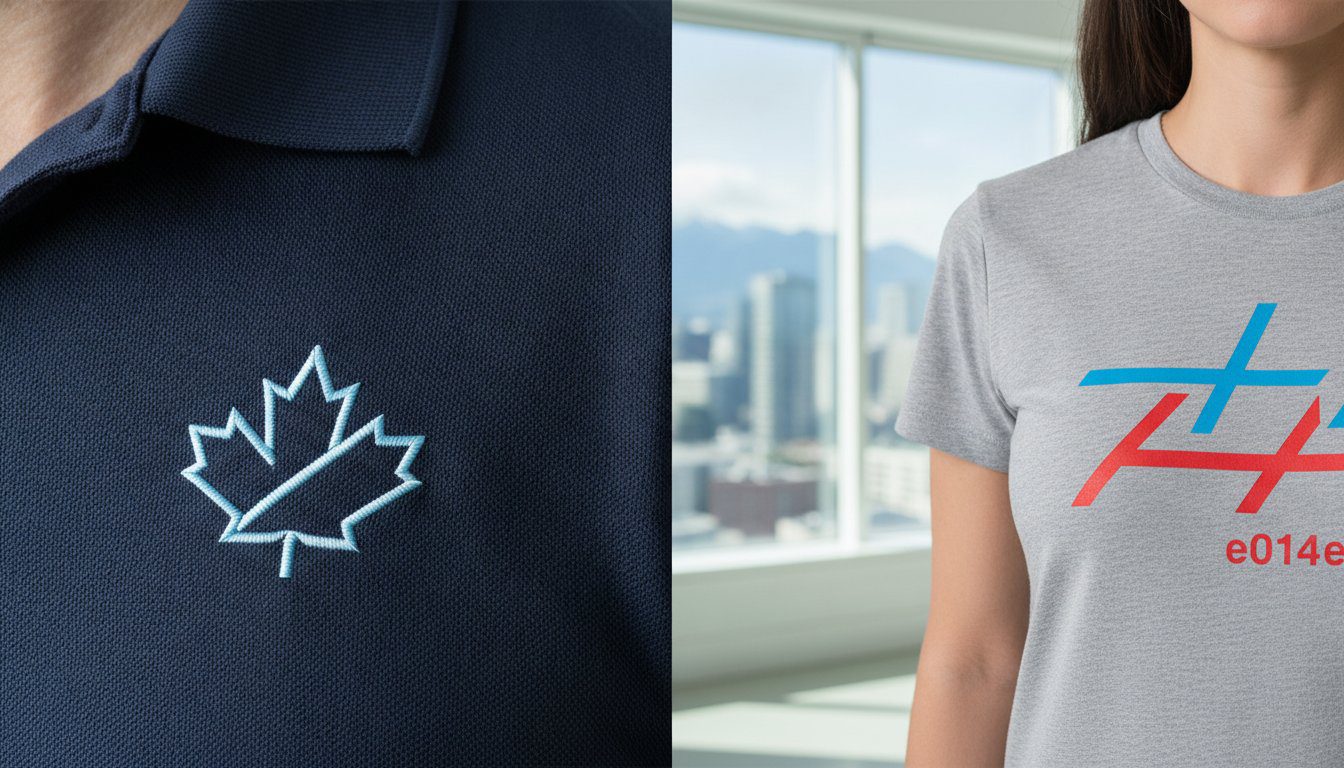
A uniform that peels or fades after just a few washes isn’t just a budget drain; it is a quiet confession that your brand might not value the finer details. You want your team to look sharp, feel proud, and stay comfortable from the first hour of the shift to the last. Deciding between embroidery vs printing for uniforms is the most critical step in this process, as the wrong choice can lead to puckered fabric on light shirts or “cheap” looking logos in a corporate boardroom.
We believe that every Canadian business deserves gear that is durable, professional, and purposeful. Whether you are outfitting a tech startup in Toronto or a landscaping crew in Vancouver, you need a solution that survives frequent laundering and our unpredictable climate. This guide provides the clarity you need to choose with confidence. We will compare the tactile elegance of traditional stitching against the vibrant colour of modern films, helping you realize a better return on your apparel investment while ensuring your brand identity remains crisp and clear.
Key Takeaways
- Understand the “cost-per-wear” metric to see how investing in quality, durability, and style saves your business money over time.
- Match your specific garment choice to the right technique, ensuring embroidery stays crisp on heavy polos while prints remain vibrant on lightweight t-shirts.
- Evaluate the durability of embroidery vs printing for uniforms to guarantee your brand looks professional even after dozens of industrial wash cycles.
- Learn how to manage design complexity, from intricate multi-colour logos to simple, bold text, to achieve the most polished and legible finish.
- Leverage local Canadian craftsmanship and efficient nationwide shipping to provide your entire team with high-quality, reliable apparel.
The Uniform Dilemma: Why Your Decoration Choice Defines Your Brand
Your team’s uniform is a visual handshake. It is often the very first interaction a customer has with your business, serving as a silent salesperson that communicates your values before a single word is spoken. A crisp, well-decorated shirt signals reliability, attention to detail, and pride in craftsmanship. Conversely, a logo that is cracked, peeling, or fraying suggests a lack of care that customers might assume extends to your services. Choosing between embroidery vs printing for uniforms is not just a logistical decision; it is a branding strategy that determines how the world perceives your professionalism.
When evaluating your options, many business owners focus solely on the upfront invoice. However, the true value lies in the “cost-per-wear” metric. A cheaper decoration method might save a few dollars today, but if the garment needs replacing in three months because the logo has faded, the initial savings vanish. High-quality decoration ensures your apparel survives the Canadian workweek. It withstands the heat, the cold, and the constant friction of daily tasks. This durability protects your investment and ensures your team looks as sharp on day 100 as they did on day one.
There is also a significant impact on employee morale. Employees who wear high-quality, comfortable branded gear feel like valued members of a professional organization. They are brand ambassadors. They represent your company with more confidence when their uniform feels like a professional asset rather than a disposable chore. By aligning your decoration method with industry standards, you provide your staff with the right tools to do their jobs well.
The Role of Uniforms in Brand Consistency
Consistency builds trust. Whether your team is based in a single shop or spread across the country, their appearance must remain unified. Using modern printing techniques or precision embroidery ensures your brand colours look identical on every fabric type. A stitched logo on a heavy jacket provides a premium, textured feel that complements an authoritative brand voice. Meanwhile, a vibrant print on a custom t-shirt offers a modern, accessible energy that resonates with retail customers. Maintaining this visual harmony across different materials helps customers recognize and realize the strength of your brand instantly.
Understanding the Lifecycle of a Work Uniform
Every industry has its own rhythm of wear and tear. Retail environments might favour light fabrics and frequent light washing, but industrial settings demand garments that can handle dozens of high-temperature wash cycles. Wash-fastness is non-negotiable for daily-wear apparel. Choosing “cheap” options often leads to frequent re-orders, which can double your apparel costs over a single year. By matching the decoration to the garment’s expected lifecycle, you ensure your team stays sharp while your budget stays protected. Thoughtful planning today prevents the frustration of a fading brand tomorrow.
Decoding the Craft: How Embroidery and Modern Printing Techniques Work
While we established that quality defines your brand, the technical path to achieving that look depends on the physical chemistry of the application. The comparison of embroidery vs printing for uniforms is essentially a choice between mechanical stitching and thermal bonding. Each method transforms raw fabric into a professional tool, but they do so using very different equipment and skill sets. One relies on the tension of needles and thread, while the other utilizes digital precision and heat-activated adhesives to create a seamless finish.
The “hand-feel” of a garment is a subtle but powerful communicator of quality. Embroidery provides a substantial, raised texture that you can feel with your fingertips; it suggests a sense of permanence and tradition. Modern digital printing, however, aims for a “soft-hand” finish where the design feels like a natural part of the fabric rather than a thick layer sitting on top. Choosing between these textures depends on whether you want your logo to stand out with three-dimensional depth or blend in with sleek, modern vibrancy.
The Art of Custom Embroidery
Embroidery is the process of stitching thread directly into the fabric to create a permanent design. It begins with digitizing, a technical step where a master artisan converts your digital logo into a specialized map of stitches. This map tells the machine exactly where to place each needle drop, ensuring clarity, density, and precision. While the history of embroidery spans thousands of years, today’s industrial machines use polyester threads engineered for extreme resilience. These threads resist fading, handle industrial bleaching, and maintain their lustre through hundreds of laundry cycles. The result is a premium finish that adds authority to any uniform.
The Science of Direct-to-Film (DTF) Printing
Traditional screen printing often struggles with small orders due to high setup costs, but modern Direct-to-Film (DTF) printing has revolutionized the industry. DTF involves printing your design onto a specialized film and then heat-bonding it to the garment. This method creates a durable, flexible bond that moves with the wearer without cracking or peeling. It allows for intricate details, full-colour gradients, and sharp lines that embroidery simply cannot reproduce. For businesses that need complex logos on lightweight fabrics, DTF provides a professional finish that is often superior to traditional vinyl. If you are ready to see how these methods look on your gear, you can explore our custom hoodies and hats to find the perfect match for your brand.
Embroidery vs. Printing: Comparing Durability, Cost, and Detail
When you weigh the benefits of embroidery vs printing for uniforms, you are essentially balancing three critical pillars: longevity, visual complexity, and budget. Every business owner wants their team to look professional, but the “best” choice is the one that aligns with your specific work environment and brand aesthetic. While one method might excel in a boardroom, another is better suited for a construction site or a high-traffic retail floor. Understanding these trade-offs ensures you invest in apparel that remains a credit to your company for months to come.
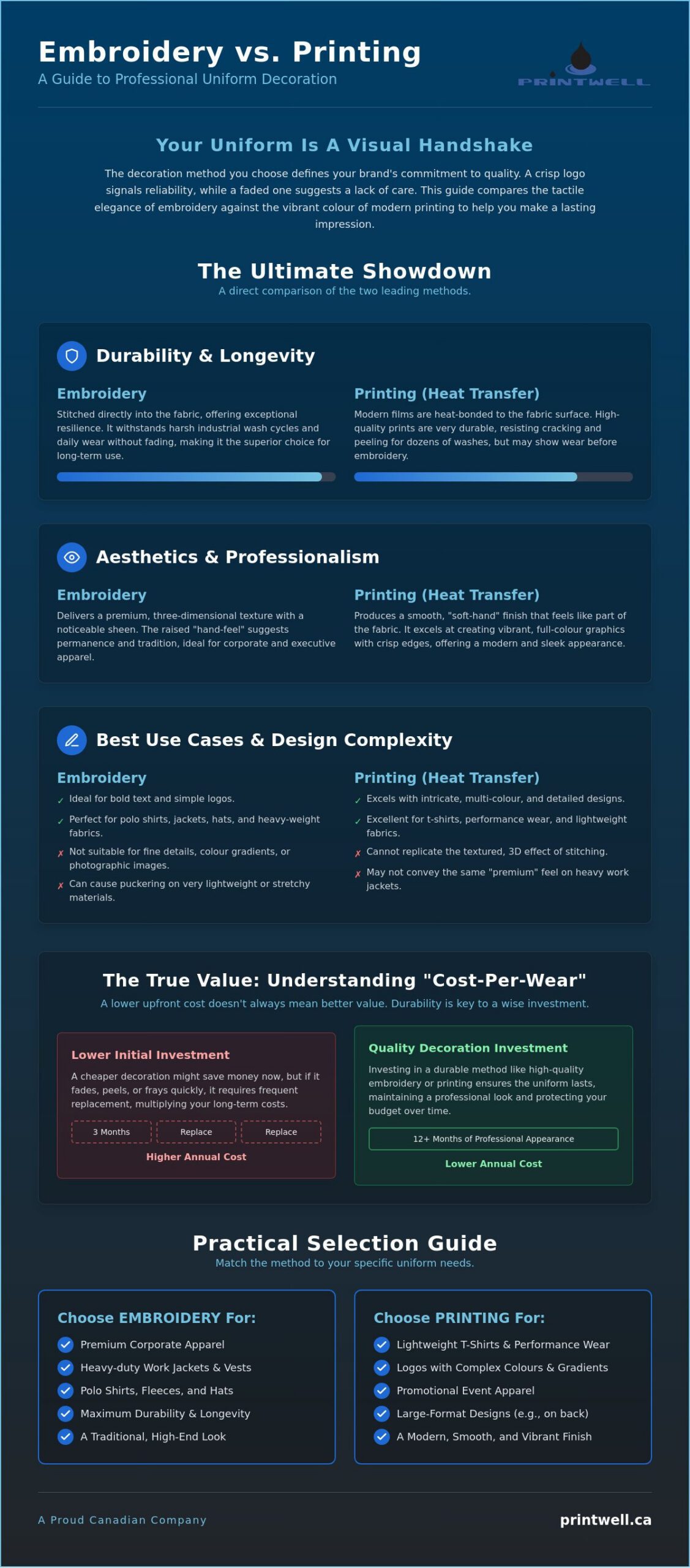
Durability is often the deciding factor for Canadian businesses that require high-performance gear. Embroidery is the undisputed heavyweight champion of longevity. It is engineered to survive 50+ industrial wash cycles without losing its shape, colour, or integrity. In many cases, the high-quality polyester thread will actually outlast the fabric of the garment itself. Printing, particularly modern digital transfers, has made incredible strides in wash-fastness, but it still faces eventual wear from high-temperature drying and friction. If your uniforms are subjected to daily heavy-duty labour, stitching provides a permanent solution that resists the rigours of the job.
Cost and scalability also play a major role in your decision. Embroidery typically involves a one-time digitizing fee to convert your artwork into a stitch file, making it a thoughtful investment for repeat orders. Printing often becomes the more economical choice for large-scale bulk orders, especially when using modern printing techniques to reproduce vibrant designs. By evaluating your team size and re-order frequency, you can realize a clear ROI on your apparel investment.
Durability in the Canadian Climate
Our climate demands versatile apparel that can handle extreme shifts in temperature. For heavy winter outerwear, parkas, and toques, embroidery is the superior choice because thread does not crack or peel when exposed to sub-zero temperatures. Conversely, modern digital prints offer exceptional flexibility on lightweight, moisture-wicking summer gear. These prints stretch and breathe with the fabric, ensuring your team stays comfortable during a humid Ontario summer or a rainy BC spring without the decoration feeling stiff or heavy.
Detail and Colour Accuracy
Design complexity often dictates your technical path. Printing is the gold standard for complex, multi-coloured photographic logos or designs with fine gradients that thread simply cannot replicate. However, embroidery remains the hallmark of professional style for simple, bold wordmarks and chest logos. It is important to avoid heavy embroidery on very thin fabrics, as the weight of the stitches can cause “puckering,” which distorts the garment. Matching the density of your logo to the weight of your fabric ensures a crisp, flat finish that looks intentional and polished.
Practical Selection Guide: Matching Methods to Specific Uniform Pieces
Selecting the right garment is only half the battle. To ensure your investment pays off, you must match the decoration technique to the physical properties of the fabric. The debate of embroidery vs printing for uniforms often finds its resolution in the weight of the material and the intended use of the piece. A heavy-duty canvas jacket requires a different approach than a moisture-wicking golf shirt. By choosing the right method for each item, you create a uniform program that is functional, comfortable, and visually consistent.
For corporate settings, polos and button-down shirts are the natural home for embroidery. The structured collars and mid-weight fabrics support the density of stitches without sagging. Conversely, custom t-shirts and hoodies often benefit from the flexibility of modern printing. Large graphics on the back of a hoodie can feel heavy and abrasive if embroidered; a high-quality print remains soft and moves naturally with the wearer. For teams looking to source personalized hoodies in Canada that balance decoration quality with fabric performance, matching the right technique to your specific poly-cotton blend is essential for a lasting result. When it comes to headwear, embroidery is the undisputed standard. Custom hats and toques have curved surfaces and stiff backings that make them ideal for the structural integrity of thread. If you are looking for the perfect headwear to round out your kit, you can order custom hats that feature our precision stitching.
Special consideration is needed for technical outerwear and softshells. While embroidery looks premium, the needle punctures can compromise the water-resistant membranes of high-end rain gear. In these cases, a durable digital transfer provides a vibrant logo while keeping your team dry. Matching the method to the garment’s function ensures your team stays protected from the elements while looking their best.
The Best Method for Every Fabric Weight
Fabric weight is a primary technical constraint. Heavyweight fabrics like thick hoodies and work jackets feel at home with embroidery because the material is sturdy enough to hold thousands of stitches. For a deeper look at how thread count, garment weight, and logo placement work together, our guide to premium custom embroidered hoodies walks through professional examples and selection criteria that apply equally to jackets and other heavyweight pieces. Lightweight fabrics, such as performance tees, require printing to prevent fabric sagging or “heavy” spots that pull at the neckline. Mid-weight fabrics like standard polos are the “toss-up” zone. Both methods work well here, allowing you to choose based on your preferred aesthetic and budget goals.
The Hybrid Strategy: Mixing Both for Maximum Impact
Elevating Your Brand with Printwell Canada’s Custom Uniform Services
The Printwell advantage lies in our mastery of both premium embroidery and modern Direct-to-Film (DTF) printing. Because we handle these processes in-house, we maintain strict quality control over every garment that leaves our facility. We don’t just fulfill orders; we provide solutions that enhance your professional standard. Whether you need a small batch of custom hats for a local team or a nationwide rollout of industrial workwear, we have the capacity and the care to deliver exceptional results.
We are deeply rooted in our regional identity and take pride in serving businesses across the country. Our nationwide shipping ensures that whether you are based in a busy city centre or a remote industrial site, your uniforms arrive on time and ready for work. We realize that your deadlines are critical for company launches or seasonal events, and we are committed to meeting those timelines with reliability and transparency.
Expert Guidance for Your Uniform Program
Every logo is unique, which is why our team reviews every design to recommend the most effective decoration method. We look at the complexity of your artwork, the weight of your chosen fabric, and the specific demands of your industry. Our focus is on providing durable materials that withstand the Canadian workday, from humid summers to freezing winters. We help you realize your brand vision by ensuring your apparel is practical, visible, and professional. You can learn more about the power of custom embroidery and how it can elevate your corporate identity.
Seamless Ordering and Fast Turnaround
Starting your order is a straightforward and helpful process. You simply upload your design, choose your garments, and let our artisans handle the technical details. Our online ordering system is designed for the busy Canadian business owner who values efficiency and clarity. We are ready, capable, and eager to assist you in creating a uniform program that offers a clear ROI. From the initial design upload to the final delivery at your door, we ensure a seamless experience that lets you focus on what you do best: running your business.
Build a Lasting Impression with Quality Branded Apparel
The decision between embroidery vs printing for uniforms ultimately comes down to your team’s daily reality and your long-term brand goals. If you need structural durability for heavy jackets or a premium, textured look for corporate polos, embroidery is your best ally. For vibrant, flexible graphics on lightweight hoodies and t-shirts, modern DTF printing provides the comfort and detail your brand needs to stand out. By matching the right technique to the specific fabric weight, you ensure your uniforms remain sharp and professional through every Canadian season.
At Printwell Canada, we take the guesswork out of your apparel investment with our expert in-house production and helpful guidance. We offer a high-quality selection of garments, including hats, hoodies, and polos, all backed by fast nationwide shipping across Canada. Our team is ready to help you realize your vision with craftsmanship that lasts and service that feels local. Get a custom quote for your company uniforms today. We look forward to helping your team look their best and represent your business with pride.
Frequently Asked Questions
Is embroidery more durable than printing for work uniforms?
Yes, embroidery is the most durable decoration method available for professional work apparel. It uses high-quality polyester thread that is engineered to resist fading and abrasion, often outlasting the fabric of the garment itself. This makes it the ideal choice for uniforms that undergo industrial laundering or heavy daily wear in demanding environments.
Can I have both embroidery and printing on the same piece of clothing?
You can absolutely combine both techniques on a single garment to create a versatile, hybrid look. Many Canadian businesses choose an embroidered logo on the chest for a premium first impression while utilizing a large digital print on the back for maximum brand visibility. This strategic approach allows you to balance professional style with functional, high-impact branding.
Which method is more cost-effective for a small team of ten people?
Both embroidery and Direct-to-Film (DTF) printing are excellent, cost-effective options for a small team of ten. Unlike traditional screen printing, which often requires significant setup for each colour, these modern methods handle small quantities with high efficiency. Your final choice should depend more on your specific garment weight and the desired texture of your logo.
Will printing on my uniforms peel off after a few washes?
High-quality modern prints, such as our DTF transfers, are designed to resist peeling and cracking through dozens of rigorous wash cycles. While older vinyl methods were often prone to failure, modern adhesives create a flexible bond that moves naturally with the fabric. Proper care, like washing garments inside out and avoiding high-heat drying, will further extend the life of your prints.
What is the best decoration method for moisture-wicking performance shirts?
Printing is the superior choice for lightweight, moisture-wicking performance fabrics because it maintains the shirt’s technical properties. Embroidery can be too heavy for these thin materials, which often causes the fabric to sag or pucker around the design. A thin, breathable print ensures the garment remains comfortable and functional during active workdays or outdoor tasks.
Does embroidery work on all types of fabric?
Embroidery works best on mid-to-heavyweight fabrics like structured polos, hoodies, and jackets. It is not recommended for very thin or highly elastic materials, as the dense stitching can distort the garment’s shape. Deciding on embroidery vs printing for uniforms requires matching the stitch density to the structural integrity of your specific fabric selection to ensure a flat, crisp finish.
How do I decide between screen printing and DTF printing for my company hoodies?
The decision typically comes down to your total order volume and the number of colours in your design. Screen printing is usually more economical for bulk orders of 50 units or more with simple, solid-colour logos. For smaller runs or designs featuring complex gradients and many colours, DTF printing provides a sharper, more vibrant finish without the traditional setup costs. If you are weighing whether to use embroidered hoodies instead, our professional examples and buying guide can help you compare the two approaches side by side before committing to an order.
Can you embroider very small text or complex gradients?
Embroidery has physical limitations when it involves very fine details or photographic colour transitions. Text smaller than 5mm can become difficult to read, and smooth gradients are hard to replicate with solid thread colours. If your logo features intricate lines or shaded elements, modern printing techniques are the best way to ensure every detail remains legible and accurate.