 A Proud Canadian Company
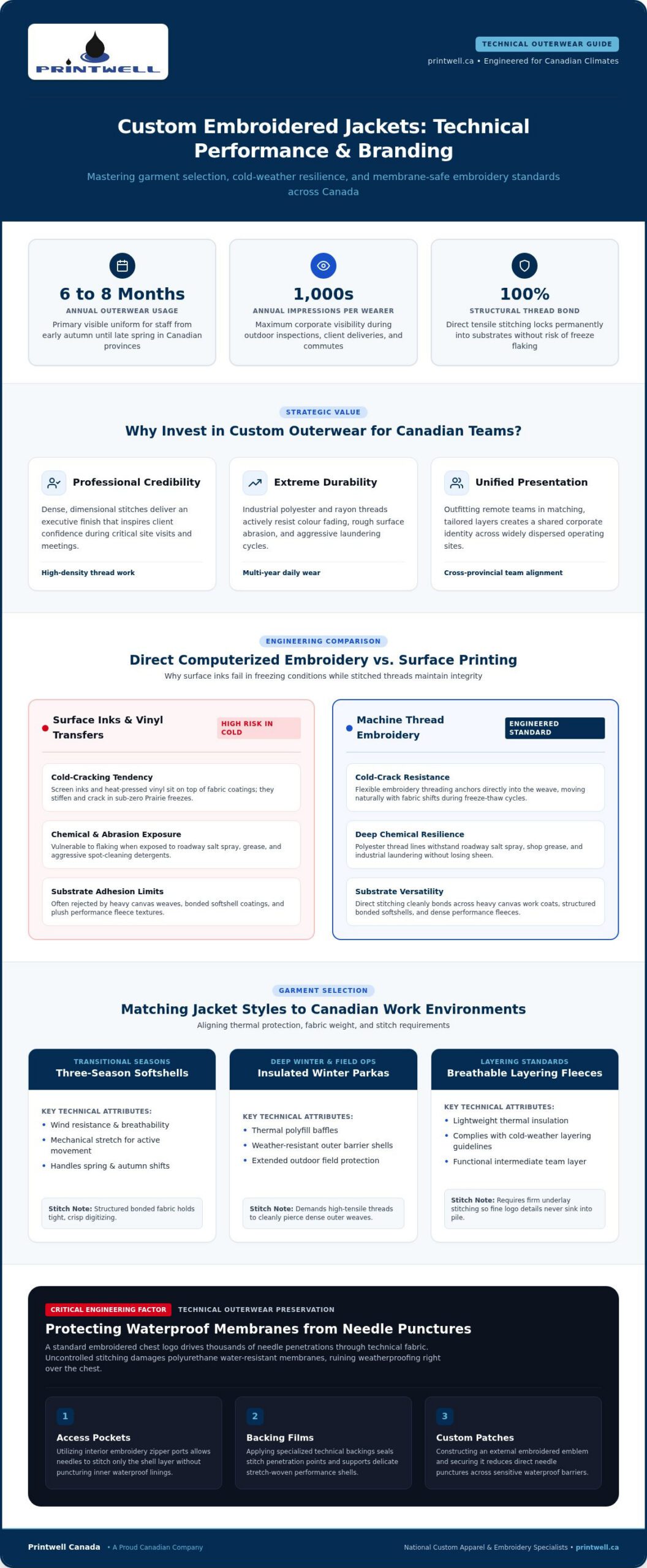
A standard embroidered chest logo punches thousands of tiny needle holes through technical fabric, meaning the wrong decoration method can quietly ruin the very waterproof shell you bought to protect your team. You shouldn’t have to compromise weatherproofing just to display a crisp, polished logo. When ordering custom embroidered jackets Canada businesses and athletic teams need outerwear engineered to endure freezing sleet, damp coastal rain, and biting Prairie winds without puckering or leaking.
You already know that quality outerwear builds morale, commands authority, and keeps your crew comfortable in demanding conditions. In this comprehensive guide, you’ll discover how to choose, design, and order durable custom embroidered jackets tailored for Canadian climates, ensuring vibrant thread longevity and reliable warmth. We’ll explore membrane-safe decoration methods, clear digitizing benchmarks, and straightforward ordering steps that outfit your organization with durable apparel your people will wear with pride.
Key Takeaways
- Learn how to protect technical waterproof membranes from damaging needle punctures using access pockets, backing films, and custom patches.
- Discover the best garment weights and shell compositions to withstand harsh Canadian winter commuting and demanding field conditions.
- Master logo sizing, placement standards, and digitizing essentials to guarantee clean lettering without puckering delicate fabrics.
- Streamline your ordering process for custom embroidered jackets Canada wide with fast digital proofs and dependable national delivery.
- Explore how pairing embroidered outerwear with matching custom hats and hoodies creates a cohesive, professional team uniform.
Why Invest in Custom Embroidered Jackets Across Canada?
Outerwear is rarely just seasonal gear in our northern climate. For most organizations, it represents the primary uniform visible to the public from early autumn until late spring. Equipping your crew with premium outerwear builds team morale, projects executive polish, and protects staff against biting elements. When selecting custom embroidery over flat printing, you invest in dimensional texture that holds up across years of daily use.
High-density thread work transforms everyday utility shells into walking brand assets. The right outerwear delivers tangible returns across three distinct areas:
- Professional Credibility: Dense, dimensional stitches provide an executive finish that inspires client confidence during site visits and corporate meetings.
- Extreme Durability: Industrial polyester and rayon threads resist colour fading, rough surface abrasion, and aggressive laundering cycles.
- Unified Presentation: Outfitting remote teams in matching, tailored layers creates a shared identity across widely dispersed operating sites.
Maximizing Corporate Visibility in Colder Climates
Canadian winters are undeniably long. Across most provinces, staff wear outer layers for six to eight months every year, hiding standard corporate tees and polo shirts beneath heavy fleece or insulated shells. Because jackets serve as the outermost layer throughout daily commutes, outdoor inspections, and client deliveries, high-visibility branding pays massive dividends. Outfitting your workforce with custom embroidered jackets Canada wide ensures thousands of annual impressions per wearer, turning field technicians and sales leaders into recognizable ambassadors wherever duty takes them.
Embroidery vs. Surface Printing on Heavy Outerwear
Screen printing and vinyl transfers sit directly on top of fabric coatings, making them vulnerable to flaking when exposed to freezing Canadian temperatures. Modern computerized machine embroidery operates differently. Needles anchor strong, tensile threads straight into the garment’s weave, locking your emblem permanently into the substrate.
This structural bond offers clear technical advantages over print alternatives:
- Cold-Crack Resistance: Inks stiffen and crack in sub-zero Prairie freezes, whereas flexible embroidery threading moves naturally with fabric shifts.
- Deep Chemical Resilience: Embroidered thread lines withstand contact with roadway salt spray, grease, and industrial spot-cleaning detergents without losing their sheen.
- Substrate Versatility: Direct stitching bonds cleanly across heavy canvas, structured bonded softshells, and dense performance fleeces that often reject ink adhesion.
By blending traditional artisan thread handling with computer-controlled precision, embroidered outerwear preserves your organization’s reputation while withstanding our toughest seasonal work environments.
Selecting the Right Jacket Styles and Technical Fabrics
Every region presents distinct operational demands, from wet coastal sleet to dry sub-zero Prairie winds. Selecting the right fabric requires balancing thermal protection with embroidery suitability. Heavy canvas work coats demand high-tensile threads to cleanly pierce dense outer weaves, while bonded microfleece requires firm underlay stitching so fine logo details never sink into the plush pile.
Matching Jacket Weights to Seasonal Canadian Demands
Aligning garment construction with workplace conditions ensures staff comfort and active mobility. Sourcing appropriate outerwear generally involves three primary categories:
- Three-Season Softshells: Combining wind resistance, breathability, and mechanical stretch, softshells handle transitional spring and autumn shifts without restricting movement.
- Insulated Winter Parkas: Engineered with thermal polyfill baffles and weather-resistant outer shells, heavy parkas provide vital protection during extended outdoor field duties.
- Breathable Layering Fleeces: Lightweight and warm, technical fleece serves as a functional intermediate layer adhering to national protective cold-weather layering guidelines for cold-climate workplaces.
Preserving Technical Waterproofing During Decoration
A standard chest logo drives thousands of needle penetrations through a garment. On performance shells featuring water-resistant polyurethane membranes, uncontrolled needle punctures compromise waterproof performance right over the chest. Decorating technical outerwear requires careful engineering to keep the elements out.
Professional decorators preserve outerwear performance through three proven methods:
- Concealed Embroidery Access Zippers: High-grade corporate jackets incorporate hidden interior lining zippers. These ports allow the hooping frame to clamp the outer shell fabric alone, keeping interior insulation and waterproof seam seals completely untouched.
- Thermo-Activated Backing Seals: When stitching through unlined weather-resistant shells, applying a waterproof thermoplastic adhesive film over the back of the finished embroidery seals needle perforations against driving rain.
- Specialized Backing Stabilizers: Performance softshells stretch under tension. Using high-stability cutaway backings prevents fabric puckering while keeping the garment comfortable and flexible against the body.
If you’re unsure which shell construction suits your staff, the experienced team at Printwell Canada can guide you toward garments designed with dedicated embroidery access. Investing in properly engineered custom embroidered jackets Canada wide ensures your team stays warm, dry, and distinctly recognizable throughout the working year.
Direct Embroidery vs. Custom Patches: Which Suits Your Jackets?
Choosing between direct thread embroidery and applied patches comes down to artwork complexity, jacket fabric composition, and overall styling goals. Direct embroidery stitches your logo straight into the jacket body, creating a unified and classic executive aesthetic. Custom patches, whether embroidered, woven, or laser-etched, offer crisp edge definition, dimensional elevation, and versatile placement across complex outerwear construction.
Both methods satisfy mandatory consumer and garment standards under Canada’s Textile Labelling Act, which governs fibre identity and care disclosures. Understanding how each approach interacts with outerwear will help you choose the right path for your fleet.
Direct Embroidery: The Classic Executive Standard
Direct needle stitching remains the hallmark of corporate outerwear. Thread patterns integrate seamlessly into the outer fabric, creating a fluid, professional presentation that moves with the garment. Because the stitching sits flush against the shell, it eliminates bulky edges that might catch on harness straps or seatbelts during active work.
- Natural Flexibility: Direct needlework keeps the left chest supple, preventing stiff, cardboard-like front panels on lighter transition jackets.
- Executive Integration: Tonal or full-colour threads sink cleanly into bonded softshell weaves and mid-weight fleece layers for an understated corporate aesthetic.
- Permanent Bonding: High-tensile threads weave directly around garment fibres, ensuring your logo never lifts, peels, or shifts through years of hard wear.
Custom Embroidered and Technical Patches
Direct embroidery can struggle on thick winter canvases or intricate vector designs with tiny lettering. In these scenarios, independent patches excel. When ordering custom embroidered jackets Canada organizations often select custom patches to solve structural decoration challenges.
Patches provide several distinct advantages for heavy outerwear and complex team branding:
- Micro-Text Legibility: Dense twill backings and fine merrowed borders allow small text and fine linework to stitch cleanly without sinking into rough fabrics.
- Versatile Placement: Heat-applied or perimeter-stitched patches mount smoothly over utility pockets, storm flaps, and bicep panels where embroidery machine hoops cannot easily reach.
- Tactile Brand Dimension: Thick twill, rubberized PVC, and textured faux leather offer substantial relief, giving field coats an industrial, rugged character.
If you’re outfitting an entire organization, you can easily replicate this cohesive patch or thread design across matching gear, such as headwear, hoodies, or other custom promotional products Canada programs rely on to maintain visual continuity.
Logo Placement, Sizing, and Artwork Digitizing Essentials
Flawless jacket decoration relies on two pillars: balanced visual sizing and technical file conversion. Even the most striking emblem looks underwhelming if the proportions clash with the garment’s cut or if the embroidery file lacks proper underlying stitch architecture. Knowing where to position your graphics and understanding the technical digitizing process ensures your investment looks deliberate and polished.
Strategic Placement Options for Outerwear
Jacket construction introduces unique design considerations, including storm flaps, diagonal chest pockets, and pronounced raglan shoulder seams. Selecting the right placement balances visibility with everyday functionality:
- Left-Chest Classic: The corporate standard. Logos positioned on the left chest generally measure 3.5 to 4.0 inches wide, sitting roughly 7 to 9 inches down from the shoulder seam for balanced alignment.
- Right Sleeve and Bicep: Sized between 2.0 and 3.0 inches wide, sleeve embroidery adds modern secondary branding visible when staff wear safety vests or seated gear over their outer layer.
- Nape and Back Yoke: Centred 1 to 2 inches below the collar seam, a compact 2.5- to 3.5-inch emblem offers subtle visibility from behind without fighting collar folds.
- Full-Back Statement: Spanning 10 to 12 inches wide across the shoulder blades, large crests provide maximum recognition for security personnel, field contractors, and athletic clubs.
The Critical Role of Professional Digitizing
Embroidery machinery cannot read standard vector files like AI, PDF, or EPS directly. It requires a dedicated stitch file, such as a DST or EMB file, containing explicit pathing coordinates for every single needle drop. Digitizing is an engineering discipline, not a simple graphic file export.
Skilled digitizers make precise technical adjustments based on the jacket’s fabric:
- Stitch Angles and Underlay: A foundational lattice of underlay stitches must be laid down first to stabilize stretchy technical softshells and prevent the fabric from puckering under surface satin stitches.
- Push-Pull Compensation: Outerwear fabrics contract along the stitch direction and expand outward across needle lines. Digitizers manually offset these tensions to keep circles perfectly round and squares square.
- Minimum Lettering Thresholds: For sharp legibility, text must maintain a minimum height of 0.20 to 0.25 inches (5 to 6 mm) with column line stroke widths of at least 1 mm to prevent thread bird-nesting.
Before launching a production run of custom embroidered jackets Canada businesses should always review a physical sample or dedicated digital stitch simulation. To turn your vectors into crisp, long-lasting outerwear, send your artwork to Printwell Canada for professional digitizing and pre-production proofing.
How to Order Custom Embroidered Outerwear with Printwell Canada
Ordering corporate apparel across our vast country shouldn’t feel like a guessing game. Printwell Canada merges artisan embroidery techniques with modern commercial technology, providing organizations from coast to coast with dependable results. Our collaborative approach ensures every jacket leaving production meets strict performance standards for daily wear, executive presentation, and severe weather resistance.
Simple Artwork Submission and Proof Approval
The process begins by submitting your vector artwork, ideally as an AI, EPS, or vector PDF file. Vector graphics retain clean mathematical lines, giving our specialists the exact geometry required to build a reliable stitch file. If your branding initiative includes diverse garments like company tees or promotional goods, you can also coordinate outerwear runs alongside DTF gang sheet printing Canada teams use for multi-item apparel packages.
Once your design arrives, our production team reviews stitch densities, push-pull tolerances, and Pantone thread matching. You’ll receive a detailed digital proof displaying thread shades, exact dimensions, and jacket placement. We don’t advance any order to physical production until you review and approve the digital mockup, ensuring your emblem looks exactly as envisioned.
Nationwide Fulfillment Built for Canadian Organizations
Coordinating gear for multi-branch operations requires dependable logistics. Whether outfitting a regional utility crew or a coast-to-coast executive team, shipments travel through reliable national freight carriers with real-time parcel tracking directly to your facility or office.
When procuring custom embroidered jackets Canada businesses value three core commitments:
- Artisan Thread Craft: Specialized high-tensile embroidery threading built to endure heavy commercial laundering, friction, and sub-zero temperatures.
- Pre-Production Certainty: Rigorous digital mockups and stitch evaluations that eliminate guesswork before needles touch fabric.
- Dependable Delivery: Seamless nationwide fulfillment across every Canadian province and territory, keeping seasonal apparel rollouts strictly on schedule.
Equipping your workforce with custom embroidered jackets Canada wide establishes an authoritative, unified presence on any job site. Preparing your artwork and selecting the right shell weights sets your team up for years of comfortable, professional wear.
Equip Your Organization with Outerwear Built to Endure
Investing in professional outerwear does more than shield your crew from freezing elements; it turns every job site, client meeting, and daily commute into an unmistakable statement of quality. Balancing appropriate shell fabrics with specialized digitizing protects technical waterproof membranes and prevents puckering. When sourcing custom embroidered jackets Canada organizations achieve superior results by harmonizing garment performance with master embroidery craftsmanship.
At Printwell Canada, our commercial multi-head embroidery machines deliver meticulous stitch precision, backed by expert Canadian artwork digitizing and comprehensive digital proofing. Paired with dependable nationwide delivery across every Canadian province and territory, outfitting your workforce remains seamless from first proof to final unboxing. Design your custom embroidered jackets with Printwell Canada today and give your team dependable outerwear built to handle anything our seasons deliver.
Frequently Asked Questions
What is the typical turnaround time for custom embroidered jackets in Canada?
Production timelines for custom embroidered jackets Canada wide generally range between seven to fifteen business days following digital proof approval. This window allows our technicians to digitize artwork, run physical stitch simulations, embroider garments on multi-head commercial machinery, and complete final quality trimming. Cross-country shipping timelines depend on your regional facility location, with reliable tracked delivery provided across every Canadian province and territory.
Will direct embroidery compromise the waterproof membrane of a technical jacket?
Direct embroidery will compromise a technical waterproof membrane if needles pierce both the shell and inner laminate indiscriminately. Decorators prevent moisture penetration by utilizing hidden embroidery access zippers built into technical outerwear linings. Clamping only the exterior shell leaves the protective waterproof backing intact. For unlined shells lacking access pockets, applying an interior thermo-activated waterproof sealing tape over the backing ensures needle punctures remain watertight.
What file format do I need to supply for embroidery digitizing?
You should supply vector artwork saved in AI, EPS, SVG, or print-ready vector PDF formats. Vector files preserve mathematically scalable vector paths and sharp outline coordinates, which digitizers require to generate accurate embroidery files like DST or EMB. If only raster files exist, submit a crisp image file at a minimum resolution of 300 DPI so stitch paths can be redrawn cleanly.
How do I choose between an embroidered patch and direct-to-garment embroidery?
Choose direct embroidery for traditional corporate softshells and layering vests where you want the logo to flex naturally with the fabric. Opt for custom embroidered patches when your artwork contains tiny lettering, dense borders, or multi-colour details that would otherwise pucker lightweight technical fabrics. Patches also work exceptionally well on rugged canvas field coats and heavy thermal layers where direct hooping is physically restricted.
What are the most popular placement locations for corporate jacket embroidery?
The left-chest placement remains the most popular location for corporate uniforms, measuring between 3.5 and 4.0 inches wide for a balanced appearance. The right bicep and sleeve panels are increasingly popular for trade certifications and secondary logos. For field staff and technical crews requiring clear identification from behind, the upper back yoke or full-back shoulder blade area provides high-visibility branding.
Can you embroider over jacket pockets and heavy thermal fleece linings?
Embroidering directly through functional exterior pockets or heavy thermal linings can sew pockets shut and compress insulating polyfill baffles. Professional decorators avoid this by using interior embroidery access ports, hooping only the outer shell, or stitching custom patches that are heat-pressed and edge-secured. This keeps storage pockets fully operational while preserving the garment’s thermal performance across demanding winter environments.
How should custom embroidered jackets be laundered to protect the stitching?
When caring for custom embroidered jackets Canada businesses should wash garments inside out in cold water on a gentle cycle. Fasten all zippers and velcro flaps beforehand to prevent hardware from snagging fine embroidery threads. Always hang or lay jackets flat to air dry, because intense dryer heat can shrink technical fabrics and warp thread tensions. Avoid chlorine bleach and fabric softeners.