
 A Proud Canadian Company
Why does a design that looks sharp on your screen often turn into a cracked, shrunken disappointment after the first laundry day? It’s a common frustration for business owners and event organizers who want their brand to stand for quality. You deserve a garment that feels substantial, looks professional, and maintains its integrity through months of heavy use. Selecting the best material for printed t-shirts is the first step in ensuring your custom apparel reflects the pride you take in your work.
We understand that the right fabric choice leads to better ink adhesion, higher customer satisfaction, and a more professional final product. This guide explores the technical differences between ringspun cotton, synthetic polyesters, and versatile tri-blends. We will compare how different materials react to heat, how they manage moisture, and how they stand up to the rigours of the Canadian climate. By the end of this article, you’ll have the clarity needed to match your specific printing method with a material that delivers comfort, durability, and longevity.
Key Takeaways
- Identify the best material for printed t-shirts by balancing fabric chemistry, weave precision, and decoration compatibility to achieve a professional, durable, and comfortable result.
- Discover why the ringspun process creates a superior surface for custom designs, leading to better ink adhesion and a more polished appearance for your brand.
- Explore the benefits of CVC and polyester blends for active environments, ensuring your team remains comfortable with moisture-wicking performance while maintaining high visibility.
- Learn how to match specific decoration techniques to fabric weights, ensuring your heavy-duty apparel provides the stable foundation required for professional embroidery.
- Master the use of GSM and fabric thickness measurements to select garments that are perfectly suited for the unique demands of the Canadian climate throughout the year.
Understanding the Best Material for Printed T-Shirts in 2026
The foundation of any successful branding project lies in the thread count and fiber quality of the garment. When you choose the best material for printed t-shirts, you aren’t just buying clothing; you’re investing in a durable medium for your message. This selection process relies on a specific trifecta: comfort for the wearer, durability for the print, and cost-effectiveness for your budget. These three pillars support the weight of your brand’s reputation. High-quality materials like those used in custom promotional products Canada ensure that your logo looks as sharp in six months as it does on day one. Thoughtful material choice acts as a form of meaningful communication, signaling to your audience that you value quality and professional standards.
Why Material Choice Dictates Design Longevity
Fiber structure is the primary factor in how well a design holds up over time. Natural fibers like cotton have a porous surface that drinks in water-based inks, creating a soft, breathable bond. Synthetic polyesters offer a smoother, tighter weave that keeps ink sitting on the surface. This is excellent for vibrant colours, but it can feel less breathable in humid weather. A shirt that lacks breathability often ends up at the back of the closet, which represents a lost opportunity for your brand. Choosing a “cheap” material might save a few dollars today; however, it often leads to pilling, fading, and a loss of trust from your employees or customers. Quality fabric provides a stable surface, ensures ink adhesion, and maintains the garment’s shape after dozens of washes.
Defining Your Primary Goal: Retail vs. Event vs. Uniform
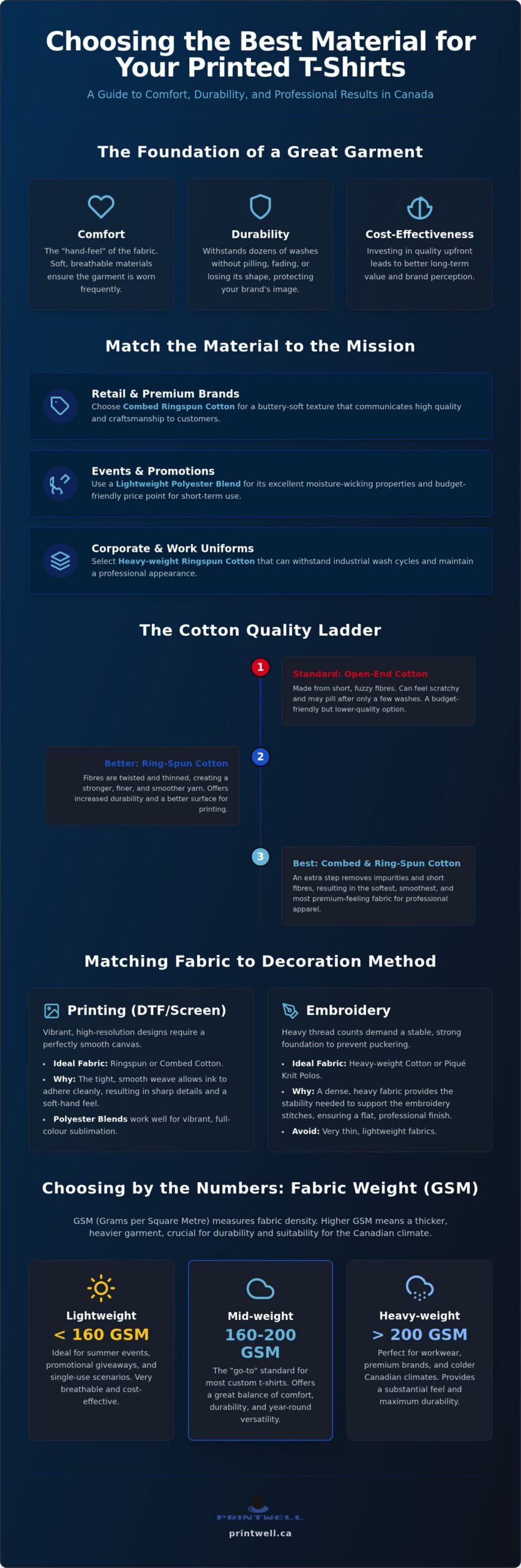
Your intended use should dictate your final choice. For a one-day charity run, a lightweight poly-blend provides the moisture-wicking properties and price point you need. A corporate uniform requires a heavy-weight, ringspun cotton that can withstand fifty industrial wash cycles without losing its professional appearance. The “hand-feel” of the fabric is another critical consideration. A retail customer expects a soft, buttery texture that suggests premium craftsmanship. An industrial worker needs a rugged, durable weave that resists tears and abrasions. By matching the material to the mission, you ensure high satisfaction, professional results, and better long-term value for your investment. Selecting the correct weight ensures the garment stays in rotation, which maximizes your brand’s visibility across Canada.
The Cotton Standard: Combed, Ring-Spun, and Organic Options
Cotton has earned its reputation as the gold standard for custom apparel across Canada. Its natural fibers are highly absorbent, which allows modern inks to sink deep into the fabric rather than just sitting on top. This creates a soft-hand feel that customers and employees truly appreciate. When you search for the best material for printed t-shirts, you’ll find that 100% cotton remains the most reliable choice for achieving high-contrast designs and long-lasting comfort.
Ring-Spun vs. Combed Cotton: The Professional Difference
The difference between a budget shirt and a premium one often comes down to the mechanical processing of the fibers. Standard “open-end” cotton is made from short, fuzzy fibers that are twisted together. It can feel scratchy and may pill quickly after a few washes. In contrast, ring-spun cotton involves thinned and twisted strands that result in a much stronger, finer rope of fiber. This process increases durability and creates a smoother surface for decoration.
- Ring-Spun: Continuous twisting and thinning of the cotton strands for added strength and reduced bulk.
- Combed: An extra step where fine brushes remove impurities and short fibers to ensure a soft texture.
- Smoothness: A tighter weave that provides a superior canvas for high-resolution DTF transfers.
Premium combed cotton provides a buttery-soft texture that feels expensive to the touch. These high-density fabrics maintain their shape through repeated laundry cycles and harsh weather. If you’re looking for a more textured, professional look, these high-density cottons are also excellent for custom embroidery because the tight weave supports heavy thread counts without puckering.
Organic Cotton and Sustainability in Canada
In 2026, sustainability is a core requirement for many Canadian organizations. Organic cotton is grown without synthetic pesticides or fertilizers. This makes it a kinder choice for the environment and for people with sensitive skin. Many businesses now prioritize GOTS-certified garments to align with their corporate social responsibility goals. Finding the best material for printed t-shirts often involves weighing this environmental impact against your specific project needs.
Organic fibers react beautifully to modern, water-based printing inks. Because the fibers haven’t been weakened by harsh chemical treatments, they retain a natural resilience. This resilience translates to better colour retention and a garment that feels substantial and durable. Choosing organic options allows you to offer a premium product that tells a story of intentionality. If you’re ready to see how these fabrics feel in person, you can browse our selection of premium Canadian apparel to find the perfect fit for your next project.
Performance Fabrics: Polyester and Synthetic Blends for Active Use
While natural fibers offer classic comfort, synthetic materials provide technical advantages that cotton simply cannot match. If your project involves athletic teams, outdoor festivals, or physically demanding work environments, the best material for printed t-shirts is often a high-performance polyester or a balanced blend. These fabrics are engineered for resilience, ensuring that your branding remains visible and vibrant even after intense physical activity and repeated laundering.
Synthetic fibers excel at colour-fastness. Unlike natural fibers that may fade over time, polyester locks in pigment with remarkable efficiency. This makes it a preferred choice for designs featuring bold, high-contrast palettes. Beyond 100% polyester, many Canadian businesses opt for Chief Value Cotton (CVC) or poly-cotton blends. These materials offer a versatile middle ground. They combine the soft, breathable feel of cotton with the wrinkle-resistant, shrink-proof properties of polyester. It’s a practical solution for uniforms that need to look sharp from the start of the shift to the end.
Moisture Management and Athletic Branding
The primary benefit of polyester is its ability to manage moisture through a process known as wicking. In the variable Canadian climate, keeping your team dry is essential for both comfort and health. Polyester fibers are naturally hydrophobic, meaning they repel water rather than absorbing it. This pushes perspiration to the outer surface of the garment where it can evaporate quickly. This functionality makes polyester the gold standard for:
- Athletic Performance: Keeps athletes cool during high-intensity training and competition.
- Outdoor Events: Provides comfort during humid summer festivals or damp autumn markets.
- Visual Impact: Serves as a perfect canvas for vibrant, all-over colour designs that won’t crack or peel.
The Rise of Tri-Blends for Lifestyle Apparel
The Interaction of Ink and Thread: Matching Fabrics to Decoration
Selecting the best material for printed t-shirts requires an understanding of how fabric interacts with ink and thread. While 100% cotton is generally forgiving, synthetic blends introduce technical challenges like dye migration. This occurs when the polyester dye “bleeds” into the printed design during the heat-curing process, which can turn a crisp white logo into a dull pink or grey. Professional results depend on using the right barrier or transfer technology to ensure your colours remain true to your brand’s identity. By matching the decoration method to the fibre chemistry, you avoid common pitfalls and produce a garment that looks premium for its entire lifespan.
Why DTF is the Universal Solution for Modern Blends
Many industry sources suggest sublimation is the only way to decorate polyester, but this method is limited to light-coloured fabrics. DTF gang sheet printing Canada has changed the landscape by providing a mechanical bond that works on almost any fibre combination. Whether you are printing on a dark tri-blend or a stretchy athletic shirt, DTF maintains its vibrancy and flexibility. The ink sits on a specialized film before being transferred, creating a durable layer that stretches with the fabric without cracking. It is often the best material for printed t-shirts when your project involves complex, multi-fibre garments that traditional screen printing might struggle to handle.
Embroidery Considerations: Stability and Fabric Weight
For a tactile and authoritative look, custom embroidery is the preferred choice for premium corporate apparel. High-stitch-count logos put significant tension on the fabric, which can lead to “puckering” if the material is too thin. This creates an unprofessional, wrinkled appearance around the design. To achieve a clean and flat result, you should pair embroidery with heavyweight cotton, pique knits, or thick fleece. These stable foundations support the weight of the thread and maintain their shape over time. This combination provides a polished finish for polo shirts and hoodies that need to withstand the rigours of daily wear in a professional environment.
If you are unsure which decoration method suits your chosen fabric, you can get a professional assessment of your custom apparel project to ensure a flawless and durable result.
Choosing by the Numbers: Fabric Weight, GSM, and Intended Use
Density determines durability. While the fibre type provides the texture, the weight of the fabric dictates how the garment hangs, breathes, and survives the laundry. In the industry, we measure this using GSM (Grams per Square Metre) or ounces. Understanding these numbers is the final step in selecting the best material for printed t-shirts. A shirt that feels too thin can appear “see-through” or cheap, which reflects poorly on your professional standards. Conversely, a shirt that is too heavy might feel restrictive during a humid Canadian summer. By matching the weight to the intended environment, you ensure your team or customers feel comfortable and valued.
The GSM Scale: From Summer Tees to Winter Layers
The Canadian climate requires a strategic approach to fabric weight. You need garments that work as standalone pieces in July and as reliable base layers in January. Selecting the right density ensures your brand remains visible throughout the year. Here is how the numbers translate to real-world utility:
- 130-150 GSM: These are lightweight and highly breathable. They are the ideal choice for large-scale promotional giveaways or active outdoor events where movement is the priority.
- 160-180 GSM: This is the “standard” or “mid-weight” range. It offers a perfect balance of softness and structure. Most retail-quality shirts and professional uniforms fall into this category because they feel substantial without being bulky.
- 200+ GSM: Heavyweight fabrics provide a premium “streetwear” aesthetic. They are exceptionally durable, resist wrinkling, and offer the most stable surface for high-density decoration.
Realizing Your Vision: A Final Selection Framework
Choosing the best material for printed t-shirts becomes simple when you follow a methodical framework. This organized approach ensures you don’t overlook the practical needs of the end-user. Before you finalize your bulk order, walk through these three essential steps:
Step 1: Define the environment. Consider where the shirt will be worn most often. An indoor office setting allows for softer, mid-weight blends. An outdoor construction site or a damp warehouse requires the resilience of a heavyweight, 100% cotton weave that can handle abrasion.
Step 2: Match the design to the method. If your design features intricate fine lines, a smooth, high-GSM combed cotton is necessary. For bold, vibrant graphics on dark fabrics, ensure your material is compatible with DTF transfers to prevent cracking or fading over time.
Step 3: Select the GSM for brand perception. The weight of the fabric is a tactile message. A heavier shirt feels more “premium” and expensive. If you want your merchandise to be perceived as a high-end retail product, aim for the 180-200 GSM range. This ensures the garment maintains its shape and professional appearance, wash after wash.
Elevate Your Brand with the Right Fabric Foundation
Choosing the best material for printed t-shirts is about more than just a soft feel; it’s a strategic decision that affects durability, brand perception, and wearer satisfaction. You now understand how ringspun cotton provides a smooth canvas for intricate designs, while synthetic blends offer the moisture-wicking performance needed for active environments. By balancing GSM weights with the right decoration method, you ensure your custom apparel stands up to the rigours of daily wear and the diverse Canadian climate.
At Printwell Canada, we pride ourselves on being your master artisan and friendly guide. We offer expert DTF and embroidery services, a premium material selection for every budget, and reliable nationwide Canadian shipping. Whether you are building a corporate uniform or launching a retail line, we are ready to help you make a lasting impression. Start your custom t-shirt project with Printwell Canada today and see the difference that quality craftsmanship makes. Your vision deserves a professional finish that lasts. Let’s build something remarkable together.
Frequently Asked Questions
What is the most durable material for a printed t-shirt?
Heavyweight 100% cotton and premium poly-cotton blends like CVC are the most durable options for custom apparel. These fabrics maintain their shape through repeated laundry cycles and resist pilling better than standard materials. A higher GSM ensures the garment remains a staple in your wardrobe for years. This durability provides long-term value for your brand, making it the best material for printed t-shirts intended for daily work uniforms or rugged outdoor use.
Is 100% cotton or a cotton-poly blend better for printing?
The choice depends on your specific priorities for the final product. 100% cotton offers superior ink absorption and natural breathability, which is ideal for high-resolution retail designs. Cotton-poly blends provide better wrinkle resistance and less shrinkage, making them a practical choice for busy teams. Both materials produce excellent results when paired with the correct decoration method. We recommend assessing whether you value a soft natural feel or easy-care performance more for your project.
What does ‘ring-spun cotton’ actually mean for shirt quality?
Ring-spun cotton refers to a mechanical process that continuously twists and thins the cotton strands into a fine, strong rope of fibre. This technique removes the impurities and short fibres found in standard “open-end” cotton. The result is a significantly smoother surface that feels softer against the skin and provides a more stable canvas for printing. This refined texture leads to better design clarity and a garment that feels noticeably more premium to the touch.
Which t-shirt material is best for preventing shrinkage?
Synthetic blends and pre-shrunk ringspun cotton are the most effective materials for preventing unwanted shrinkage. Polyester fibres don’t react to heat and water the same way natural fibres do, which helps the garment retain its original dimensions. If you prefer the feel of 100% cotton, always look for “pre-shrunk” specifications in the product details. This manufacturing step ensures your custom designs don’t warp or become unwearable after the first trip through a Canadian dryer.
What is the best fabric for DTF (Direct-to-Film) printing?
Cotton-poly blends and tri-blends are often considered the best material for printed t-shirts using DTF technology. DTF transfers create a mechanical bond with the fabric, which allows them to adhere beautifully to both natural and synthetic fibres. This versatility ensures vibrant colours and a flexible finish on everything from hoodies to lightweight tees. The process is particularly effective on dark-coloured polyester, where it maintains high opacity without the risk of dye migration or fading over time.
How does fabric weight (GSM) affect the look of a custom shirt?
Fabric weight dictates the “drape” and perceived value of your custom apparel. A lower GSM (130-150) results in a lightweight, airy garment that is perfect for summer events but may appear slightly translucent. A mid-range GSM (160-180) provides the standard retail look that most customers expect. Heavyweight fabrics (200+) offer a structured, boxy fit that feels substantial and premium. Choosing the right weight ensures your design is supported by a fabric that reflects your brand’s standards.
Can you embroider on lightweight t-shirt materials?
You can embroider on lightweight materials, but it requires careful stabilization to prevent the fabric from puckering. High-stitch-count logos put a lot of tension on thin fibres, which can cause the design to look wrinkled or distorted. For the most professional results, we recommend choosing a mid-weight or heavyweight fabric for embroidery projects. This provides a stable foundation that supports the thread count and ensures your logo remains flat and crisp throughout the life of the garment.
Which material is best for high-performance athletic shirts?
100% polyester is the superior choice for high-performance athletic wear due to its moisture-wicking properties. These synthetic fibres are hydrophobic, meaning they push sweat to the surface where it can evaporate quickly. This keeps athletes dry and comfortable during intense physical activity in humid or damp conditions. Additionally, polyester is highly resistant to shrinking and fading, ensuring that team uniforms maintain their professional appearance and vibrant colours through a full season of heavy use and industrial laundering.